Overview
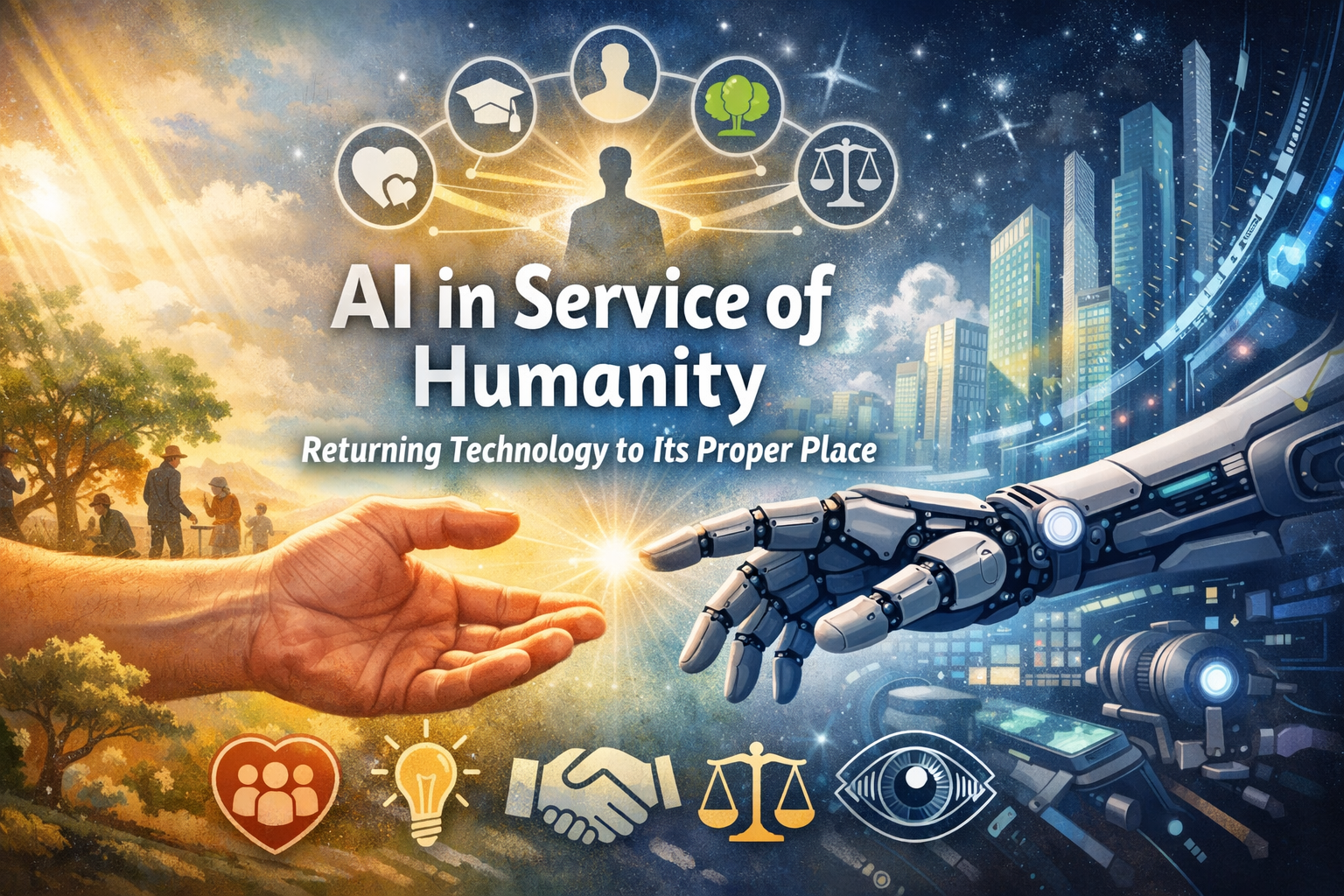
This Foundation article establishes the positioning for the entire Human-AI Collaboration theme (March 2026). It introduces the Service Principle — technology exists to extend human capacity, not to replace human purpose — and provides five observable markers for assessing whether an organization’s AI deployment serves humanity or has inverted the relationship. Building on the philosophical foundation (Foundation #1, Week 1) and the values declaration (Foundation #2, Week 5), this article takes a practical position on where technology belongs relative to human purpose, judgment, and dignity.
Best for: CEOs, COOs, and leadership teams making strategic decisions about AI deployment philosophy and human-AI collaboration design When to use: Before AI deployment decisions, during organizational AI strategy design, when evaluating whether existing AI systems serve or displace human purpose Expected outcome: Clear positioning framework for technology’s role in the organization, with five testable markers for ongoing assessment Prerequisites: Familiarity with Five Irreducible Human Capacities (Foundation #1, Week 1) and AI Alignment Manifesto (Foundation #2, Week 5)
The Problem
The relationship between technology and humanity has gradually inverted. Technology was built to serve human needs — the plow served the farmer, the printing press served the scholar, the telephone served the family. But modern AI systems increasingly create their own demands, optimize for their own metrics, and reorganize human workflows around technological capability rather than human purpose.
The inversion defined: Instead of technology serving human purposes, humans have begun serving technological capabilities. Organizations restructure teams around what algorithms recommend, redefine success based on what dashboards measure, and gradually shift from asking “What is technology for?” to “What can technology do?” — a fundamentally different question with fundamentally different consequences.
Why this matters for AI deployment: Without an explicit positioning decision about where technology belongs relative to human purpose, AI systems gradually displace human judgment — not because they were designed to, but because nobody designed them not to. The “human-in-the-loop” becomes the human rubber-stamping outputs they no longer understand.
Why This Matters
The technology-humanity inversion creates compounding organizational consequences:
| Consequence | What It Looks Like | Root Cause |
|---|---|---|
| Purpose displacement | AI optimization targets become the de facto definition of success | Technology setting its own objectives rather than serving human-defined ones |
| Judgment atrophy | Humans stop overriding AI recommendations; veto authority exists in theory but not in practice | Cultural and structural discouragement of human intervention |
| Relational hollowing | Fewer human touchpoints, less empathy-driven interaction, monitoring replaces mentoring | AI deployment reduces human contact instead of liberating capacity for it |
| Values drift | Organizational values embedded in AI at deployment gradually diverge from living organizational values | No ongoing governance connecting AI behavior to evolving human intent |
The core risk: Technology that isn’t explicitly positioned in service of humanity defaults to positioning humanity in service of itself. The inversion is the default — service is the intentional choice.
The Framework: The Service Principle and Five Markers
The Service Principle
Technology exists to extend human capacity, not to replace human purpose. This is the positioning statement for values-driven AI deployment. It is not anti-technology — it is pro-humanity. A well-designed AI agent that gives a small business owner back fifteen hours a week, reinvested in coaching, customer relationships, and strategic thinking, is technology in its proper place. An AI system that gradually displaces human judgment until the “human-in-the-loop” is a rubber stamp is humanity in service of technology.
The distinction is intent: Did you design the system with a clear answer to the question, “What is the human for?”
Marker 1: The Human Decides What Matters
Humans define objectives, values, and constraints. Technology optimizes within those boundaries — it does not set them. When the relationship inverts, AI optimization targets become the de facto definition of success and humans adjust their expectations to match system output.
The test: Ask your team who defined the goals the system is optimizing for. If the answer is “the system was trained on historical data,” the technology is defining its own purpose.
Marker 2: The Technology Amplifies, Not Replaces, Judgment
AI provides information, analysis, and recommendations. Humans apply the five irreducible capacities (moral judgment, meaning-making, relational trust, creative wisdom, moral courage — established in Foundation #1) to make final decisions. Technology in its proper place enhances these capacities rather than bypassing them.
The test: When was the last time a human overrode an AI recommendation? If the answer is “never,” either your AI is perfect or your humans have stopped exercising judgment. The second possibility is far more likely.
Marker 3: The System Explains Itself
People affected by AI decisions can understand, in meaningful terms, why those decisions were made. This extends beyond technical explainability to contextual, values-connected explanation that makes sense to the affected person in their language. Connects to Declaration 3 (Transparency Over Cleverness) from the AI Alignment Manifesto.
The test: Can a customer affected by an AI decision get an explanation that feels honest and complete? If translation by a data scientist is required, the system is speaking only to itself.
Marker 4: The Human Can Say No
Override authority exists, is accessible, and is exercised without penalty. Connects to Declaration 4 (The Human Veto Is Sacred) from the AI Alignment Manifesto and Question 4 from the Alignment Audit (Week 8). The veto must be culturally supported — if exercising it feels risky, the veto does not functionally exist.
The test: Has anyone on your team exercised a veto in the last quarter? If not, determine whether this reflects system accuracy or cultural discouragement of dissent.
Marker 5: The Technology Makes the Human More Human
After AI deployment, people have more time for work requiring empathy, creativity, moral reasoning, and relational depth — not less. This is the ultimate marker. Technology in its proper place liberates human capacity for distinctly human work. When the relationship inverts, AI deployment leads to fewer human touchpoints and a gradual hollowing of roles that require human presence.
The test: Since deploying AI, do your people spend more or less time on work requiring empathy and judgment? If less, the technology is consuming human capacity rather than serving it.
Key Takeaways
- The inversion is the default: Without intentional positioning, technology naturally displaces human purpose rather than serving it. Service requires a deliberate design choice.
- The Service Principle provides a positioning anchor: “Technology exists to extend human capacity, not to replace human purpose” gives organizations a testable standard for every AI deployment decision.
- Five markers make the principle observable: The Human Decides What Matters, Technology Amplifies Judgment, The System Explains Itself, The Human Can Say No, and Technology Makes the Human More Human — these are assessable conditions, not abstract ideals.
- Foundation #3 connects philosophy to positioning: Foundation #1 defined what is irreducibly human. Foundation #2 declared the values. Foundation #3 takes the position: technology belongs in service of humanity. Not beside it. Not above it. In service of it.
- The positioning choice has organizational consequences: Centering technology is faster and easier to measure; centering humanity is harder but builds something that lasts — organizations where people believe, customers trust, and values hold under stress.
Related Resources
Series Context
- Previous: Week 8 – “The Alignment Audit: 10 Questions Every CEO Should Ask”
- Next: Week 10 – “The Human-in-the-Loop Imperative: When to Pause the Algorithm”
- Foundation #1: Week 1 – “Before We Talk About AI, We Must Talk About What It Means to Be Human”
- Foundation #2: Week 5 – “AI Alignment Manifesto: A Declaration for Values-Driven Intelligence”
March Series (Human-AI Collaboration)
- Week 9: AI in Service of Humanity (Foundation #3) — This article
- Week 10: The Human-in-the-Loop Imperative (Extension — Operational decision-making)
- Week 11: Building Trust Between Teams and Their AI Tools (Extension — Organizational trust)
- Week 12: The Hierarchy of AI Assistance: From Tool to Partner (Practical — Framework)
Concepts Extended
- Five Irreducible Human Capacities (Foundation #1, Week 1) — referenced as the capacities technology should amplify
- Declaration 3: Transparency Over Cleverness (Foundation #2, Week 5) — connected to Marker 3
- Declaration 4: The Human Veto Is Sacred (Foundation #2, Week 5) — connected to Marker 4
- Alignment Audit Question 4: Override Authority (Week 8) — operationalized through Marker 4
- Two Operating Systems (Week 6) — the Service Principle governs the relationship between analog and digital systems
- Stated vs. Stress Values (Week 7) — the positioning choice determines which values survive pressure
New Concepts Introduced
- The Technology-Humanity Inversion
- The Service Principle (technology exists to extend human capacity, not to replace human purpose)
- Five Markers of Technology in Its Proper Place
- The Positioning Choice (center technology or center humanity)
- Judgment Atrophy (humans stop overriding AI due to cultural or structural factors)
- Relational Hollowing (AI deployment reducing human touchpoints instead of liberating capacity)
Version History
- v1.0.0 (2026-03-03): Initial publication – Foundation Article #3 (Positioning) establishing the Service Principle and five markers for Human-AI Collaboration month
