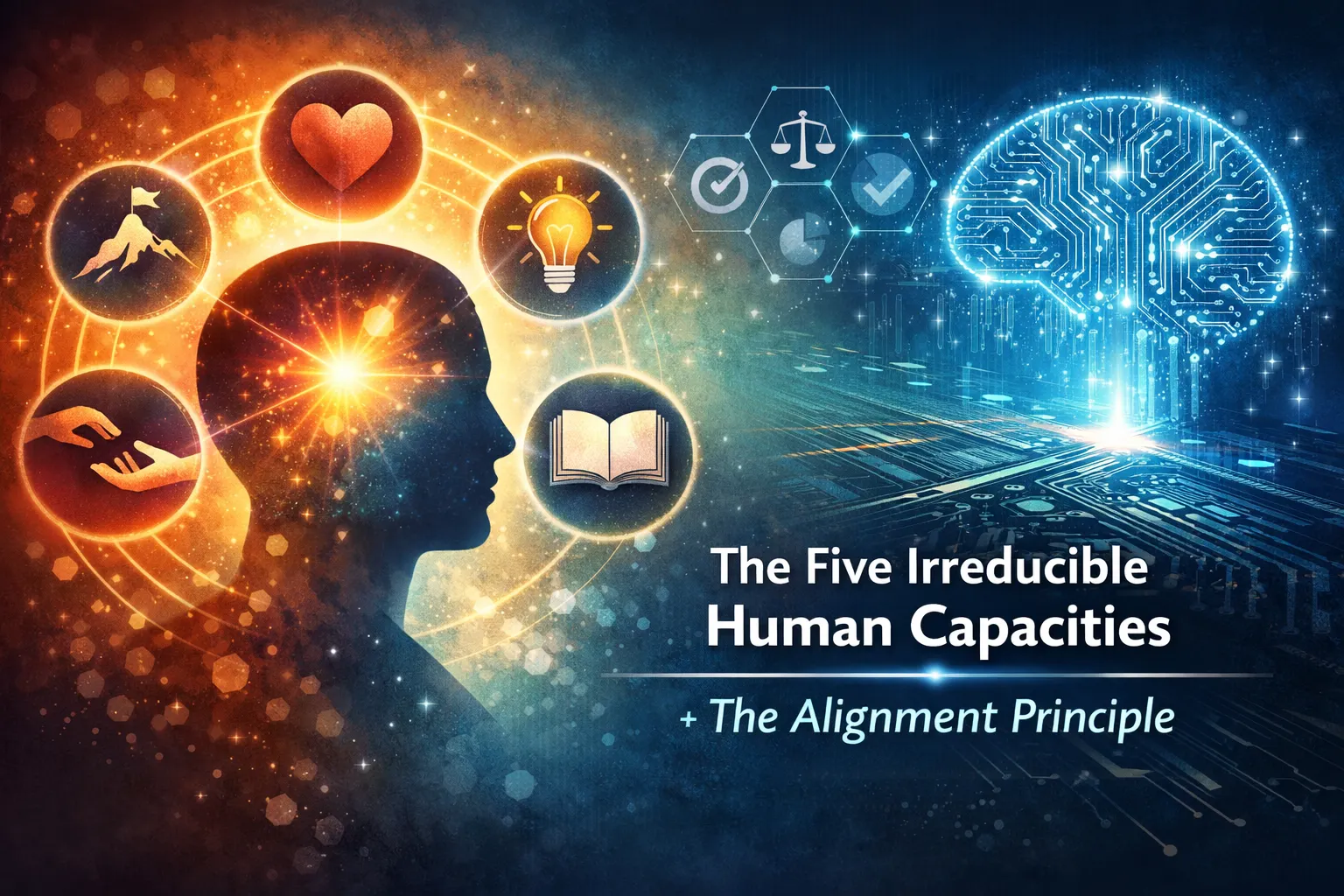
The capacities that AI can support but never replace.
Overview
This foundational article establishes the philosophical framework for the entire Values-Driven AI Ecosystem content series. It argues that before implementing AI, organizations must first understand what is distinctly and irreducibly human—the capacities that AI can support but never replace. The article introduces the Five Irreducible Human Capacities framework and the Alignment Principle that guides values-driven AI design.
Best for: CEOs, executive teams, and leaders planning AI strategy When to use: Before beginning AI implementation planning, during strategic reviews, when establishing AI governance frameworks Expected outcome: Clear understanding of human vs. AI roles, framework for identifying “human anchors” in processes Prerequisites: Completion of 2026 Alignment Audit recommended
The Problem
Organizations approach AI implementation by asking capability questions: What can AI automate? What can it optimize? What can it predict? These are second-order questions that assume the first-order question has been answered: What is distinctly, irreplaceably human?
Without answering this foundational question, organizations risk:
- Automating moral judgment without recognizing they’ve done so
- Replacing meaning-making with metrics
- Optimizing away the trust, wisdom, and courage that made the organization worth building
- Deploying systems without understanding what they’re supposed to serve
The consequence is AI systems that undermine the very human capacities they were meant to support.
Why This Matters
Every AI deployment is implicitly a statement about what humans are for. When you automate a process, you’re declaring humans aren’t needed there. When you delegate a decision to an algorithm, you’re saying human judgment isn’t required. When you replace a human interaction with a chatbot, you’re saying the relational dimension doesn’t matter.
Sometimes these statements are correct—transaction processing, scheduling, routing don’t require irreducible human capacities. But sometimes organizations automate moral judgment without realizing it, replace meaning-making with metrics, or optimize away trust and wisdom and courage.
The organizations that thrive in the AI era will be those with the clearest understanding of what technology is for—and what it must never replace.
The Framework: Five Irreducible Human Capacities
These five capacities define human contribution—capacities that AI can support but never replicate. They are the bedrock upon which meaningful work, ethical decisions, and organizational culture depend.
Capacity 1: Moral Judgment
Definition: Moral judgment is the capacity to weigh information against values, to discern right from wrong beyond mere efficiency calculations.
Why AI cannot replicate it: AI processes data and applies rules but cannot care about the difference between right and wrong. It has no stake in outcomes. It cannot weigh efficiency against justice, expediency against ethics.
Example: A lending algorithm denies a loan application by processing data and applying rules. But humans decided whether those rules were fair, considered whether rules disadvantaged already-disadvantaged populations, and weighed efficiency against justice.
Organizational application: Before any AI deployment, ask: “Where in this process does moral judgment need to happen?” Those are places where humans must remain not just in the loop, but in authority.
Capacity 2: Meaning-Making
Definition: Meaning-making is the capacity to connect information to significance, data to purpose, facts to meaning.
Why AI cannot replicate it: AI excels at pattern recognition across datasets but cannot explain why patterns matter. It cannot connect data to mission, information to purpose.
Example: AI can report that quarterly results went up or down. Humans ask: “What does this mean for our mission? How does this connect to what we’re trying to build? What story does this tell about who we’re becoming?”
Organizational application: Ensure AI outputs include context humans need for interpretation. Never let metrics replace the meaning-making conversation about what those metrics signify.
Capacity 3: Relational Trust
Definition: Relational trust is the bond formed between parties who each have something at stake, who choose to extend themselves toward each other despite uncertainty.
Why AI cannot replicate it: Trust requires vulnerability, the possibility of betrayal, and two parties who each have something at stake. AI cannot be vulnerable. It cannot be betrayed. It has nothing at stake.
Example: When customers trust a company, they trust that human beings made decisions with integrity, that real people will stand behind promises, that someone—a person, not a program—will make things right if something goes wrong.
Organizational application: Be careful where AI is deployed in customer relationships. The moment you optimize away human connection, you’ve optimized away the very thing that makes loyalty possible.
Capacity 4: Creative Wisdom
Definition: Creative wisdom combines creativity (the capacity to generate what didn’t exist before) with wisdom (the capacity to know which creations should exist).
Why AI cannot replicate it: AI can generate text, images, code, and music at scale. But generation without wisdom is production without discernment, output without judgment, possibility without responsibility.
Example: The most important creative decisions are never delegated to AI. Organizations may use AI to generate options or accelerate production, but the decision about what to create, why it matters, and whether it should exist remains human.
Organizational application: Use AI to expand possibility space, but reserve human judgment for determining which possibilities should become realities.
Capacity 5: Moral Courage
Definition: Moral courage is the willingness to do what’s right when it costs you something—speaking up when silence is safer, holding the line when pressure mounts, choosing integrity over advantage.
Why AI cannot replicate it: AI has no courage because AI has nothing to lose. It doesn’t fear consequences, risk reputation, or face temptation. Courage requires stakes, and stakes require something at risk.
Example: No algorithm, however sophisticated, will refuse to do something wrong. That refusal—saying no when crossing a line—is a human act that must remain human.
Organizational application: Cultivate moral courage at every level. Create cultures where people are expected and empowered to say no when something crosses ethical boundaries.
The Alignment Principle
AI should be aligned not just with human preferences, but with human flourishing.
Distinction between preferences and flourishing:
- Preferences are what we want in the moment
- Flourishing is what we need to become fully human
An AI system aligned with preferences gives you what you ask for. An AI system aligned with flourishing supports the development of moral judgment, meaning-making, relational trust, creative wisdom, and moral courage. It augments these capacities rather than replacing them.
Practical implication: Values-Driven AI actively designs systems that help humans become more—not less—human.
Implementation: Three Steps for Leaders
Step 1: Map the Human Contribution
For every process involving AI, identify where the five irreducible capacities are required:
QuestionCapacityWhere does ethical weighing need to happen?Moral JudgmentWhere is interpretation of significance required?Meaning-MakingWhere is the relationship itself the value?Relational TrustWhere must discernment guide creation?Creative WisdomWhere might someone need to say no?Moral Courage
These locations are human anchors—places where AI should support but never supplant human involvement.
Step 2: Design for Augmentation, Not Replacement
Once human anchors are identified, design AI systems to strengthen them:
CapacityDesign PrincipleMoral JudgmentBuild mandatory human review pointsMeaning-MakingInclude context for interpretation in AI outputsRelational TrustKeep humans visible and accessibleCreative WisdomProvide reflection time before accepting AI recommendationsMoral CourageCreate cultures that reward speaking up
Step 3: Audit for Drift
AI systems drift over time. Support becomes replacement. Augmentation becomes automation. Boundaries blur and humans recede.
Quarterly audit question: “Are our human anchors still anchored?”
Drift indicators:
- Human review points being skipped for efficiency
- Meaning-making conversations replaced by dashboard reviews
- Customer relationships becoming entirely automated
- AI recommendations accepted without reflection
- Concerns about AI behavior going unvoiced
When drift is detected, correct before it compounds.
Key Takeaways
- The foundational question: Before asking what AI can do, ask what is distinctly and irreplaceably human. Organizations that skip this question build on sand.
- Five irreducible capacities: Moral judgment, meaning-making, relational trust, creative wisdom, and moral courage cannot be replicated by AI because they require caring about outcomes, having something at stake, and being accountable for consequences.
- Every AI deployment is a statement: When you automate or delegate, you implicitly declare what humans are for. Make those declarations consciously.
- The Alignment Principle: AI should be aligned with human flourishing, not just preferences—supporting the development of human capacities rather than replacing them.
- Human anchors: Identify where irreducible capacities are required in each process. These are non-negotiable points of human authority.
- Drift is inevitable: Build audits into governance. The question isn’t whether systems will drift but whether you’ll catch it in time.
Related Resources
Series Context
- Previous: Week 52 (Dec 2025) – “Your 2026 Alignment Audit: 12 Questions to Ask Before the New Year”
- Next: Week 2 – “The Judgment Gap: What AI Cannot Replicate”
January Series (The Humanity Question)
- Week 2: The Judgment Gap: What AI Cannot Replicate (Extends this foundation)
- Week 3: Wisdom vs. Intelligence: Why SMEs Need Both (Extends this foundation)
- Week 4: The Five Human Capabilities AI Will Never Replace (Practical summary)
Foundation Articles
Frameworks Introduced
- Five Irreducible Human Capacities
- The Alignment Principle
- Human Anchors methodology
- Augmentation vs. Replacement design principle
