A few weeks ago I was on a call with the CEO of a family-owned manufacturer in the upper Midwest. Forty-five employees. Twenty-eight years in business. His father started it. He took it over the day he turned thirty-six.
He told me about a phone call he had been on the night before with one of his oldest customers — a relationship measured in decades, a contract that represented a meaningful percentage of the year.
The customer wanted one revision skipped. One step. Not a corner cut, exactly. A step that the customer believed was unnecessary, given how long the two companies had been working together. Just this one shipment. Just this one time. The pressure on the customer's end was real. The pressure on his end — to keep the relationship — was also real.
He almost said yes.
That is the part he wanted me to hear. Not that he said no. That he almost said yes. That for the first time in twenty-eight years, the line his father had drawn — the one the family said no exceptions about, the one that had cost them a few large customers over the years and held the trust of many small ones — had wobbled inside his head.
He had said no in the end. The relationship survived. The line held.
But it had come closer to bending than it ever had before.
And what he told me at the end of the call is the part I have not stopped thinking about.
"I think we've been getting away with not writing the rule down."
For five weeks we have been building instruments — the measurement infrastructure of a values-driven business. The Integrity Yield. Trust Velocity. The Close Call Log.
This week we move from instruments to architecture.
The close calls a small business logs every month follow patterns. Some patterns are random. Most are not. Most are the same pressure, applied to the same surface, in slightly different costumes — a customer who asks for the exception, a deadline that asks for the shortcut, an AI output that asks to skip the human read, a hire who asks the team to bend the standard for the sake of speed.
Inside each of those patterns lives a decision the company has already made, somewhere, sometime, in some founder's head, and never written down.
Those undocumented decisions are called judgment calls until they aren't. Until the pressure is real enough, or the person carrying the judgment is tired enough, or the relationship is old enough, or the dollars are big enough — and the line wobbles. Sometimes the line holds. Sometimes it doesn't.
The architecture that converts the undocumented judgment into a decision that cannot be relitigated under pressure is what I call a Bright Line.
This is the first of four articles on bright lines and guardrails — the structural layer of the Values-Driven AI Ecosystem.
What a Bright Line Actually Is
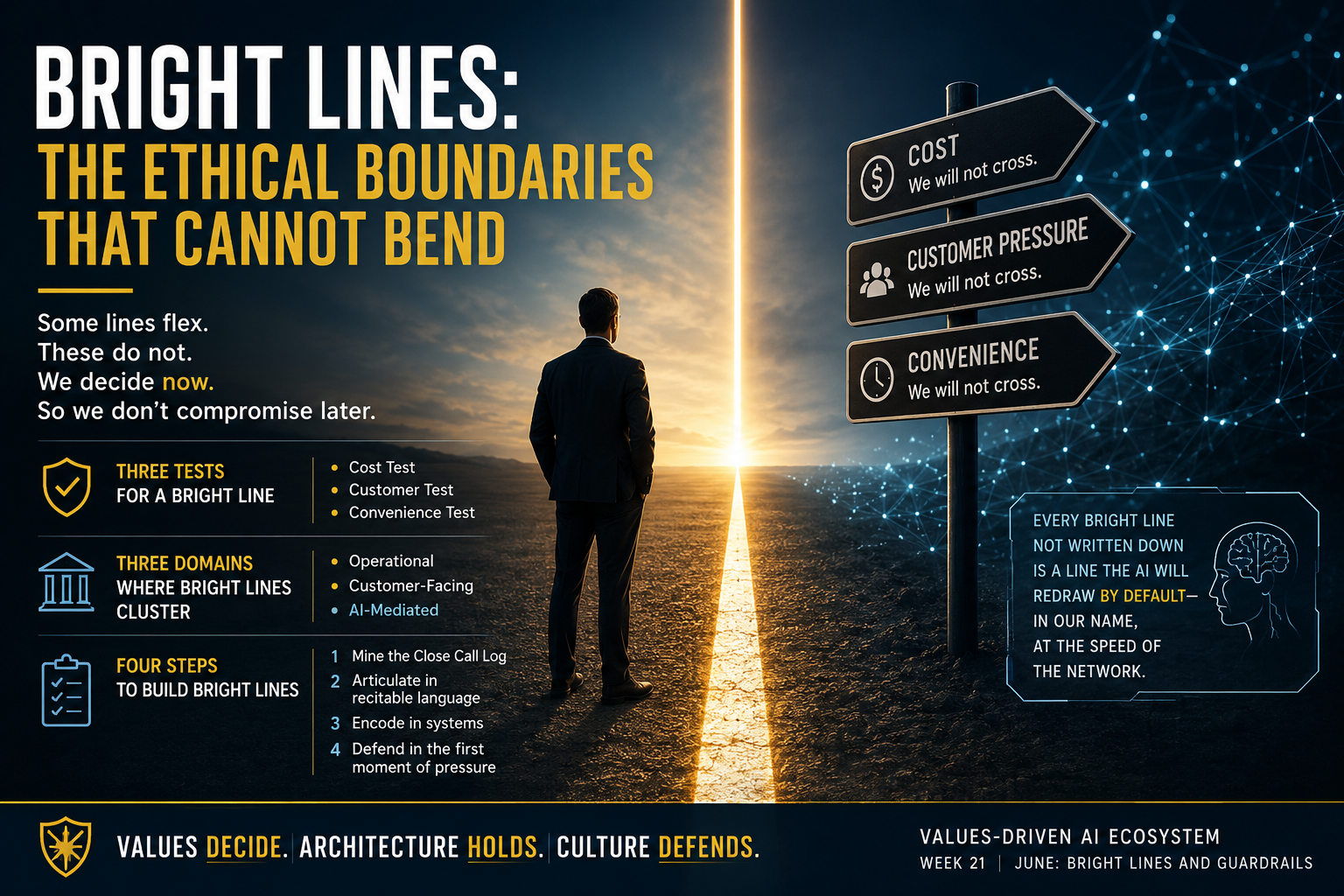
A Bright Line is an ethical boundary that the organization has decided, in advance, will not be moved by cost, by customer pressure, by convenience, or by any single quarter's results.
It is distinct from a guardrail. A guardrail flexes. A guardrail is calibrated to the risk of the moment — tightened when the stakes are high, loosened when the stakes are low. Guardrails are the day-to-day governance of an operating business, and they have their place.
A Bright Line does not flex. A Bright Line is the small set of decisions the organization has agreed will be made the same way every time, by every person, regardless of who is asking and how much it would cost to refuse them.
Most SMBs already have bright lines. Almost none of them have written them down.
The cost of leaving them unwritten is the wobble. Every time the bright line is tested, somebody alive in the company has to find it again — has to remember whether the founder said we don't do that about this exact thing, has to weigh the dollars, has to read the room. By the third or fourth time, the line has drifted. By the tenth, the line is wherever the most pressured person on the team is willing to draw it on any given Tuesday.
A bright line written down can be defended without a meeting.
A bright line carried only in the founder's head retires the day the founder retires.
The Three Tests of a Bright Line
Not every decision deserves to be a bright line. Most decisions are calibrations and should be governed by guardrails. A small set deserves the structural weight of a line that cannot bend.
A decision belongs on the bright-line list if it passes three tests.
The Cost Test. Would you hold this line even if it cost you a meaningful customer, a meaningful hire, or a meaningful quarter? If the answer is only if it doesn't cost too much, it is not a bright line. It is a preference.
The Customer Test. Would you hold this line even if your most important customer asked you, in writing, to make an exception? If the answer wavers, the line is not yet a line. It is a posture.
The Convenience Test. Would you hold this line at the end of a hard week, late in a quarter, when the team is tired and one exception would make the next ten days survivable? If the answer needs context, the line has not yet been chosen. It has only been considered.
The decisions that pass all three tests are the decisions worth the architectural weight of a bright line. Most SMBs have five to nine of them. Almost none have written them all down.
The Three Domains of Bright Lines
The pattern that worked in May for the Close Call Log holds here. Bright lines cluster in three domains. Naming the domain at the point of decision is what makes the line enforceable across the operation.
Operational Bright Lines
These are the lines that protect the work. The non-negotiable quality check. The standing rule that cannot be waived for a delivery window. The procedure that does not get skipped no matter who is asking. These lines tend to come from real failures in the company's history — a moment when the operation almost shipped something it would have spent two years apologizing for, and the founder decided never again, ever, under any conditions.
Customer-Facing Bright Lines
These are the lines that protect the relationship — sometimes by accepting the relationship and sometimes by declining it. The customers the company will not take. The promises the company will not make. The discounts that are not on the table. The conversations the company has openly with customers even when the news is hard.
These bright lines tend to be the ones that wobble most under pressure, because the cost of holding them is visible and immediate, and the cost of bending them shows up only later, often quietly, often as drift.
AI-Mediated Bright Lines
These are the lines that protect the integrity infrastructure as AI begins to scale the operation. The output the AI is never allowed to send without a human read. The decision the AI is never allowed to make autonomously. The data the AI is never allowed to surface. The customer the AI is never allowed to onboard without escalation.
AI-Mediated bright lines are the newest category and, for most SMBs, the most under-architected. Every line the company does not draw here is a line the AI will draw by default — and the default is usually whatever the training data found most common in the world, which is almost never what the company actually believes.
This third domain is the reason June matters as much as it does. The May arc gave you the instruments to see what your values quietly prevent. The June arc gives you the architecture to make sure they keep preventing it at the speed and scale that AI will operate.
How to Set Your Bright Lines
The four-step build that worked for the operational instruments of May works here too.
Step one. Mine the Close Call Log. The lines you need to draw are usually already showing up as patterns in your Log. If three close calls in a quarter are the same shape — the same kind of customer asking for the same kind of exception, the same kind of AI output requiring the same kind of human intervention, the same kind of hire asking the team to bend the same kind of standard — the operation is telling you where the bright line belongs. Write down the pattern.
Step two. Articulate the line in language anyone in the company can recite. If your bright line requires a paragraph to explain, it is not yet a bright line. It is still a position paper. A bright line sounds like a sentence the night shift could repeat back to you cold. We do not ship without a load case review. We do not onboard a customer who cannot articulate their values in their own language. We do not let the AI draft an apology without a human read. The compression is the point. A line that cannot be remembered cannot be defended.
Step three. Encode the line in the systems. A bright line that lives only in the team's memory will erode within two years. The line needs to live in the standing rule, the checklist, the AI prompt, the customer-acceptance form, the contract template — wherever the decision actually gets made. The systems are what carry the line when the people are tired.
Step four. Defend the line in the first moment of pressure. The first time a customer pushes hard against a new bright line is the moment the bright line is actually drawn. If it bends, every subsequent person in the organization knows the line is negotiable. If it holds — visibly, with the founder's voice attached to the holding — the line becomes architecture. The first defense is the line. Everything before is preparation.
What Happens When Bright Lines Are Drawn
The manufacturer I started with — the one who almost said yes to his oldest customer — spent the following week writing down the line his father had drawn twenty-eight years earlier.
It took him forty-five minutes. The line was already there. He had simply never written it down.
He read it to his leadership team at the next standing meeting. He read it to the floor at the next all-hands. He put it on the customer-acceptance form. He put it in the contract template. He put it in the prompt of the AI assistant the sales team had started using to draft proposals — the assistant would no longer suggest a path forward that violated the line, because the line was now in its instructions.
Three months later, the same customer called back with the same request.
His head of sales declined the request in the first sixty seconds of the call. The customer pushed. The head of sales said the line was in writing and pointed at the contract. The customer pushed harder. The head of sales said the line was in writing and held it.
The customer renewed for another year on the company's terms.
That is what happens when a bright line is written down. The decision is no longer made in the moment by whoever happened to pick up the phone. The decision was made in advance by the company. The phone call is just where the line gets defended.
Why This Matters Most Now
For most of the last twenty years, the SMBs that held their bright lines did so because the founder was in the building and could be invoked. Call the boss was a sentence that worked because the boss could be reached, and the boss carried the line in his head, and the boss was usually the person the customer or the team most wanted to satisfy.
The next ten years will not work like that.
AI will increasingly mediate the decisions that used to require a human conversation. The customer will interact with a chatbot before they interact with a salesperson. The proposal will be drafted by an assistant before a human reviews it. The first response to a hard moment will be machine-generated, at the speed of the network, in language the company did not personally compose.
Every bright line that exists only in the founder's head will be invisible to the AI. The AI will not invoke the founder. The AI will draw whatever line the training data most commonly drew — which is, on average, whatever was easiest, fastest, most likely to please the asker, and most consistent with the lowest-common-denominator behavior on the internet.
The bright lines you do not write down are the lines AI will redraw for you, in your name, at scale.
That is the architecture problem the June arc is built to solve.
What Comes Next
Bright Lines are the first layer of the June architecture. Next week we move to the second — Ethics as Code: Embedding Values in AI Architecture — the practice of taking the bright lines you have drawn and encoding them into the AI systems that will increasingly enforce them. The week after, we look at the third — The Veto Power: When Humans Must Override the Algorithm — the discipline of preserving human authority over the decisions that should never be made by software. The month closes with Building Your Integrity Dashboard: A Step-by-Step Guide — the practical instrument that holds the architecture together.
Together, the four pieces are the architectural layer that sits on top of the measurement infrastructure the May arc built.
The May arc taught you to see your integrity.
The June arc teaches you to defend it.
A bright line written down is a quiet promise the company has made to itself before anyone is in the room to ask it to break that promise.
It is also, increasingly, the only instruction the AI in your operation will reliably honor.
Write the lines down. Read them out loud. Encode them in the systems that will act in your name when you are not on the call.
Make today your masterpiece. And start drawing the lines that cannot bend.