Most first agents fail the same way. Not badly. Broadly.
Someone hands the new assistant the inbox, the calendar, the drafting, and the follow-up. Three weeks in, nobody can say exactly what it is responsible for. And nobody can say whether it did that well.
A first agent should be smaller than that.
Small enough to be true.
Three Artifacts, One Page
This arc has produced three things.
The Aligned Ecosystem gave you a Shared Constitution — what your company will not do, no matter which system is doing it. Context Is Everything gave you a Context Contract — what has to travel with a decision so the next system honors the promise behind it. The Governance Layer gave you a Governance Ledger — the person who owns a rule and reads what it produces.
All three were written for systems you already run.
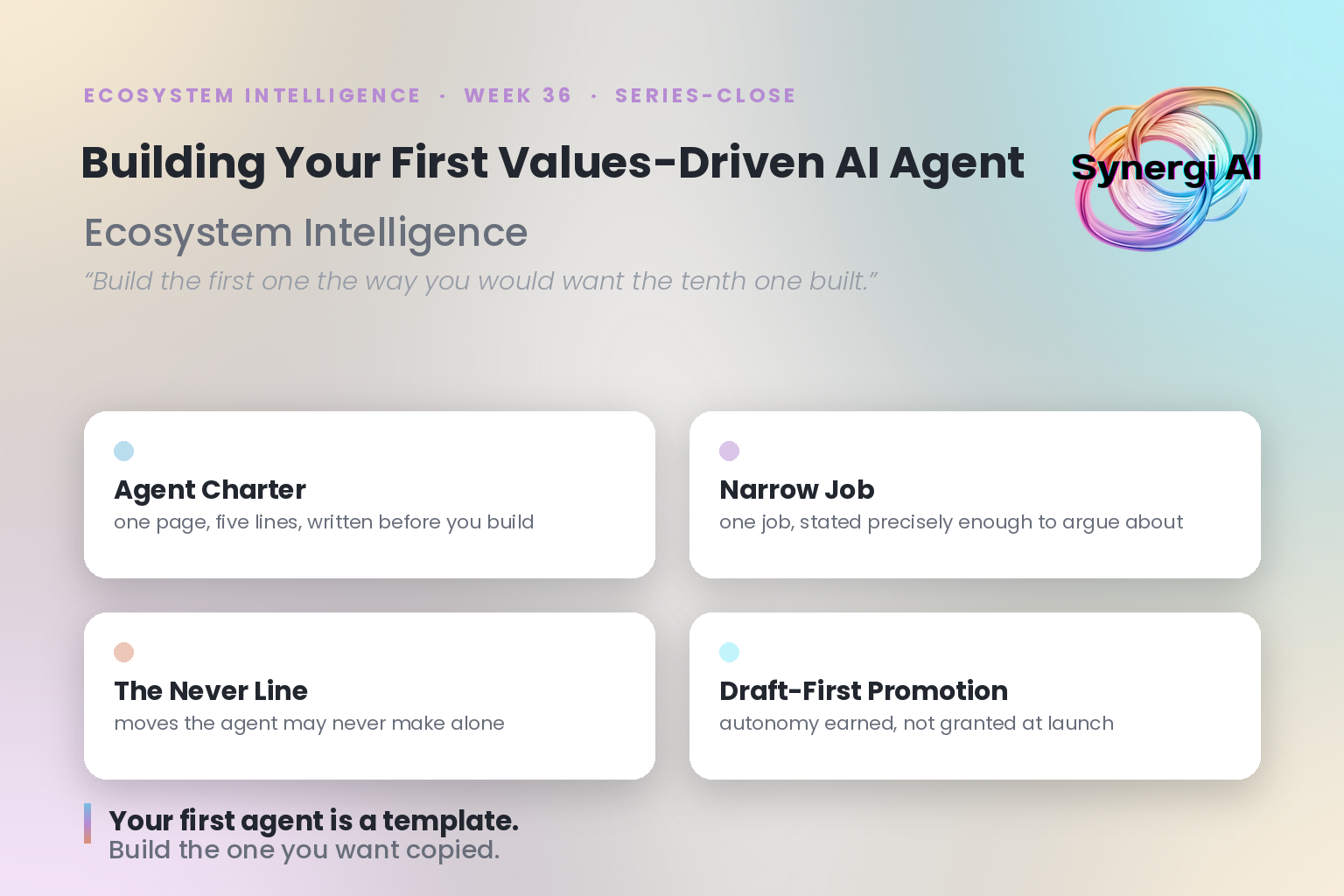
This week they collapse into one page for a system that does not exist yet. Call it the Agent Charter. Five lines, written before you open a single tool.
1. The Job. One job, stated narrowly enough to argue about. "Draft first-pass replies to inbound pricing questions" is a job. "Handle client email" is a wish. Narrow scope is not timidity. It is the only way you will ever know whether the thing worked.
2. The Line. What this agent may never do without a human. Not a list of everything it shouldn't do — the two or three moves that would cost you a relationship. Quote a price. Commit to a date. Answer a message carrying grief or a legal threat. This line comes straight out of your constitution, rewritten at agent scale.
3. The Handoff. What travels with its output. Where the answer came from, what it assumed, what it was unsure about, and which human touched it last. An agent that hands off a conclusion without its context is teaching the rest of your ecosystem to guess.
4. The Owner. One name. The person who would be uncomfortable if this agent embarrassed the company, and who has the authority to shut it off on a Tuesday without calling a meeting.
5. The Proof. What the agent produces that a person can read — and the day of the month that person reads it.
The charter is not documentation. It is the design.
Every line is a constraint, and the constraints are what make the agent yours instead of generic. A tool built to do anything reflects nobody. A tool built to do one job, inside one line, under one name, reflects a company that has decided who it is.
Build It This Week
Pick a job that repeats every week and that you would be comfortable showing a client.
Write the five lines before you build anything. Ten minutes, on paper. If you cannot fill line two or line four, you have found the real problem, and it was never a technical one.
Then run the agent in draft for two weeks. It proposes. The owner approves. Nothing leaves the building untouched.
Promote it to autonomous only when the owner can answer line five without looking anything up — how often it ran, what it got wrong, what it escalated. That is not excessive caution. That is the difference between deploying an agent and acquiring an unattended decision that happens faster.
Earlier in this Arc
- The Aligned Ecosystem: When All Your AI Agents Share Values named Handoff Drift and the Shared Constitution.
- Context Is Everything: How Values Flow Through Multi-Agent Systems defined the five-part Context Contract a handoff must carry.
- The Governance Layer: Who Watches the Watchers? named the owner, the readable proof, and the change rule that keep a guardrail alive.
The First One Is the Template
You are not really building one agent.
You are building the pattern every agent after it will copy — the scope you tolerate, the line you draw, the owner you name, the proof you ask for. Whatever you accept in the first one, you will accept in the tenth. And by the tenth, you will not be watching.
That is why the small version matters this much. This arc opened with a question about many agents sharing values. It closes with one agent, one page, one name — because an ecosystem is never designed all at once. It is the accumulated character of whatever you built first.
Next in the series, we turn to measurement: what to count when the things you care about are profit, people, and purpose together.
Build the first one the way you would want the tenth one built.
Make today your masterpiece. And let your first agent be small enough to be true.