The manufacturer I have been writing about for the last three weeks called me on a Friday afternoon.
"I have all the pieces," he said. "The Yield. The Velocity. The Close Call Log. The Bright Lines. The encoding. And the veto we ran last week."
A pause.
"Now where do I look at it?"
That is the question this article answers.
For six months the series has been building instruments. Each one does its specific work. Together they form an operating system. But a leader cannot read six instruments in six different documents on six different days and still see the company.
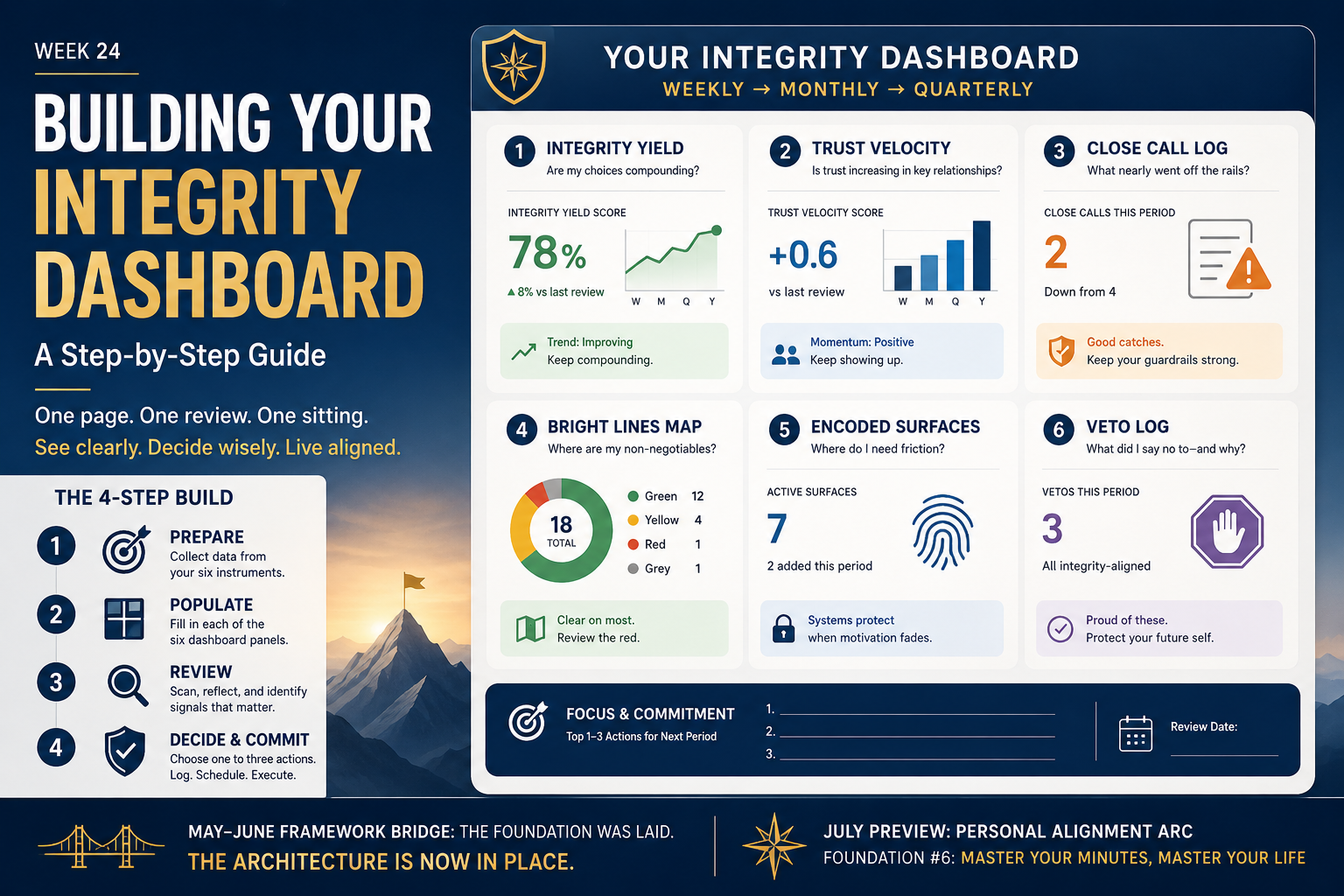
The Integrity Dashboard is the single page that holds the architecture together.
It is not software. It is one document. One review. One sitting.
The leader looks at it weekly for the first quarter the architecture is in place, monthly after that, and quarterly in steady state. The dashboard is where decisions get made about what to defend, what to revise, and what to retire.
The Six Panels
The dashboard has six panels because the year has produced six instruments. The order matters.
Panel 1 — Integrity Yield. The lagging measure. What the company's values returned this period in revenue retained, customers held, employees stayed.
Panel 2 — Trust Velocity. The leading measure. Whether the slope of stakeholder trust is compounding or eroding right now, before the Yield catches up.
Panel 3 — Close Call Log. The negative-space measure. The crises that did not happen because the lines held. Each entry is one row.
Panel 4 — Bright Lines Map. The decisions. The named ethical boundaries the company will not move on, sorted by domain — Operational, Customer-Facing, AI-Mediated.
Panel 5 — Encoded Surfaces. The implementation. For each AI-Mediated bright line, the four-surface check: System Prompt, Guardrail Policy, HITL Trigger, Data Access Layer. Green where the line is encoded. Red where it is not.
Panel 6 — Veto Log. The human authority. Every time a person had to override the system this period, with one sentence on why.
Six panels. One page. One sitting.
How to Build It This Week
The dashboard is a discipline before it is a document. Start simple.
Step one. Open one page. Write the six panel titles down the left side.
Step two. Under each panel, write one sentence describing what the company sees right now. Not what it should see. What it does see.
Step three. Mark the panels that are empty. Empty panels are the architecture's next assignment.
Step four. Schedule the review. Weekly for the first quarter. Then monthly. Then quarterly. Put it on the calendar with the same weight as the financial close.
That is the build. There is no software step. There is no consultant step. The instrument is the discipline of the review.
What the Dashboard Does
The dashboard is the surface where six months of work becomes one decision per quarter.
It is the document the board asks for. It is the page a new executive reads on day one. It is the page the CEO can show a regulator, a customer, or a successor and say, this is how this company defends what it stands for.
It is also the page that catches drift while drift is still cheap.
When the Trust Velocity slope flattens, the dashboard sees it. When the Close Call Log goes quiet, the dashboard sees it. When the encoded surfaces start showing red on the same bright line two quarters in a row, the dashboard sees it.
The instruments measure. The architecture defends. The dashboard looks.
What Comes Next
This closes the Bright Lines and Guardrails arc. The architectural defense layer is complete — the instruments, the lines, the encoding, the veto, and now the dashboard that holds them in one frame.
Next week the series turns inward. Master Your Minutes, Master Your Life opens the Personal Alignment arc — because no architecture survives a leader who has not aligned themselves first.
For this week:
Open one page. Write the six panels down the left side. Put one sentence under each. Mark the empty panels. Put the review on the calendar.
The May arc taught you to see your integrity. The June arc taught you to defend it.
Make today your masterpiece. And start watching the architecture hold.