The owner of a forty-person freight brokerage spread three documents across her conference table. A quarterly page from a binder. A Friday checklist she had taped beside her monitor. A shared spreadsheet where her team logged close calls.
"I'm doing everything you've told me," she said. "I still can't tell you whether our AI is okay."
Every Answer, Three Places
Her system drafts the delay notices that go to shippers when a load runs late. Her company's promise is simple: we call you before you have to call us.
She had followed the series. Three lines at the quarterly review: profit, people, and purpose. Four wires every Friday, from the early-warning system. Every catch tiered in the Close Call Log, with the High-tier saves read aloud once a quarter.
Then one Friday, the Zero Override tripped. Nobody had changed a single notice all week. Blip or pattern?
To find out, she had to stack the binder page, the taped checklist, and the spreadsheet. Three places. Three different tenses. It took her forty minutes.
The pattern was there. It had been there for five Fridays.
Every answer was in the building. None of them were in the same room.
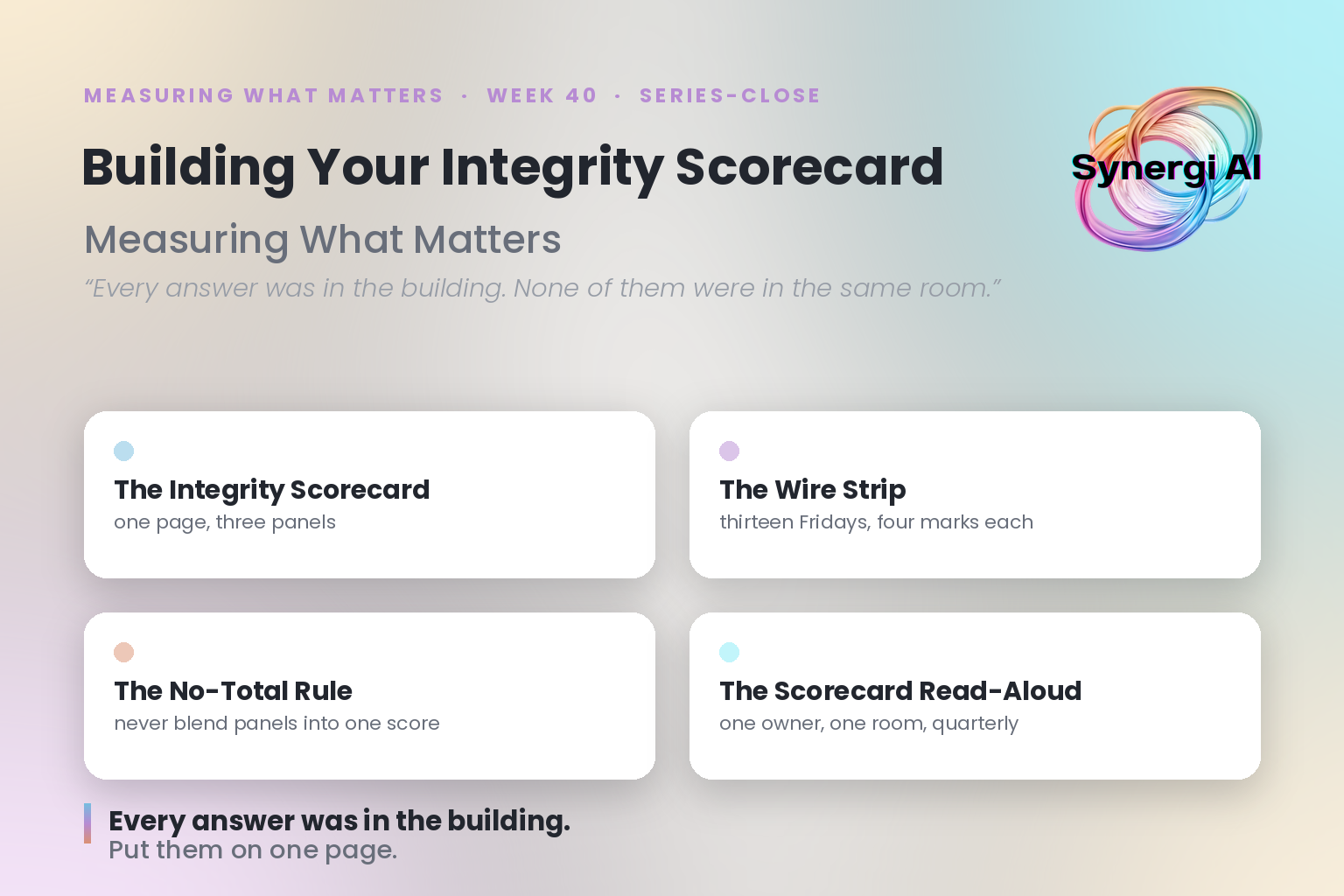
The Integrity Scorecard
The fix is not another instrument. It is one page that holds the three you already have.
The Integrity Scorecard has three panels, top to bottom.
- The Ledger Panel. Filled in quarterly. Profit gets one number. People gets three answers: the Power-Outage Test, the human-touch rate, and "better or just faster?" Purpose gets the Read-Aloud Test score out of ten, plus what the system accepted that a person would have turned down.
- The Wire Strip. Filled in every Friday. Thirteen columns, one per week of the quarter. Four rows, one per wire. Mark a box when a wire trips. One mark is a Tuesday. Three in a row is a trend, and now you can see it at a glance.
- The Tally Panel. Filled in at the quarterly review. Every Close Call Log entry since the last review, counted by tier. Each High-tier catch gets one line and the name of the person who made it.
Then one rule. It matters more than the layout.
The No-Total Rule. Never blend the panels into a single score. A blended number is the single-line trap in a nicer suit. It lets a strong ledger hide a quiet wire strip. Three panels, read side by side, each one free to say "not yet."
Build Yours This Week
- Name the owner. The one name from the system's charter fills in the page. Nobody else.
- Keep it to one page. If it spills onto a second sheet, cut. A scorecard you can't hold in one hand doesn't get read.
- Print the Wire Strip. Thirteen blank columns. Fill in the first one this Friday.
- Carry over last quarter. Ledger answers into the top panel. Close Call Log into the bottom.
- Read it aloud once a quarter. One owner, one room, forty-five minutes. Same table as the Three-Line Review. Say the names.
The brokerage owner printed hers that afternoon. Eight Fridays on, the strip showed the Zero Override repeating, and she saw it in seconds instead of forty minutes. She put one line back in the workflow: no delay notice goes out until someone has changed a word or written down why not.
Earlier in This Series
- The Hidden Cost of Misalignment: Foundation #5, where the cost of drift lives in absence.
- The Close Call Log: the record the Tally Panel draws from.
- The Triple Bottom Line of AI: the three lines the Ledger Panel keeps.
- Leading Indicators: the four wires the Wire Strip records.
- The Counterfactual Question: the tally that credits what never happened.
Where This Leads
The Integrity Metrics arc taught you to see your integrity. The Strategic Integrity arc taught you to price it. The Ecosystem Intelligence arc taught you to keep it in rooms you are not standing in. This arc taught you to count it: three lines, four wires, one tally.
Alone, they are instruments. On one page, they are a practice.
Next week the series turns from measuring to practicing: how a page like this becomes a daily, weekly, and quarterly rhythm.
For now, pick one system. Print one page. Fill in the first Friday.
Make today your masterpiece. And put the count on one page.