A founder told me last year that his integrity had cost him a hundred and eighty thousand dollars.
He had the number to the dollar. It was a contract he'd walked away from — a good one, from a client who wanted something he wasn't willing to do.
Then I asked him what his integrity had earned him that same year.
Long pause. "I've never run that number."
The Only Number You've Been Keeping Is the Cost
That's the asymmetry, and nearly every values-driven leader I've worked with is living inside it. You can quote the price of your integrity precisely, because a refusal has a date, an amount, and a name attached to it. The return has none of those. It arrives disguised as an ordinary good year.
So it goes uncounted. And a thing that goes uncounted eventually gets argued with — usually in the third quarter, usually by someone reasonable, usually right after you've walked away from something large.
Three weeks of this arc have been naming what integrity actually does. It wins the deal — the Integrity Moat. It prices the deal — the Trust Premium. It decides who's even in the room — the Self-Selecting Customer.
All three have been showing up in your financials the entire time. Just never on a line with their name on it.
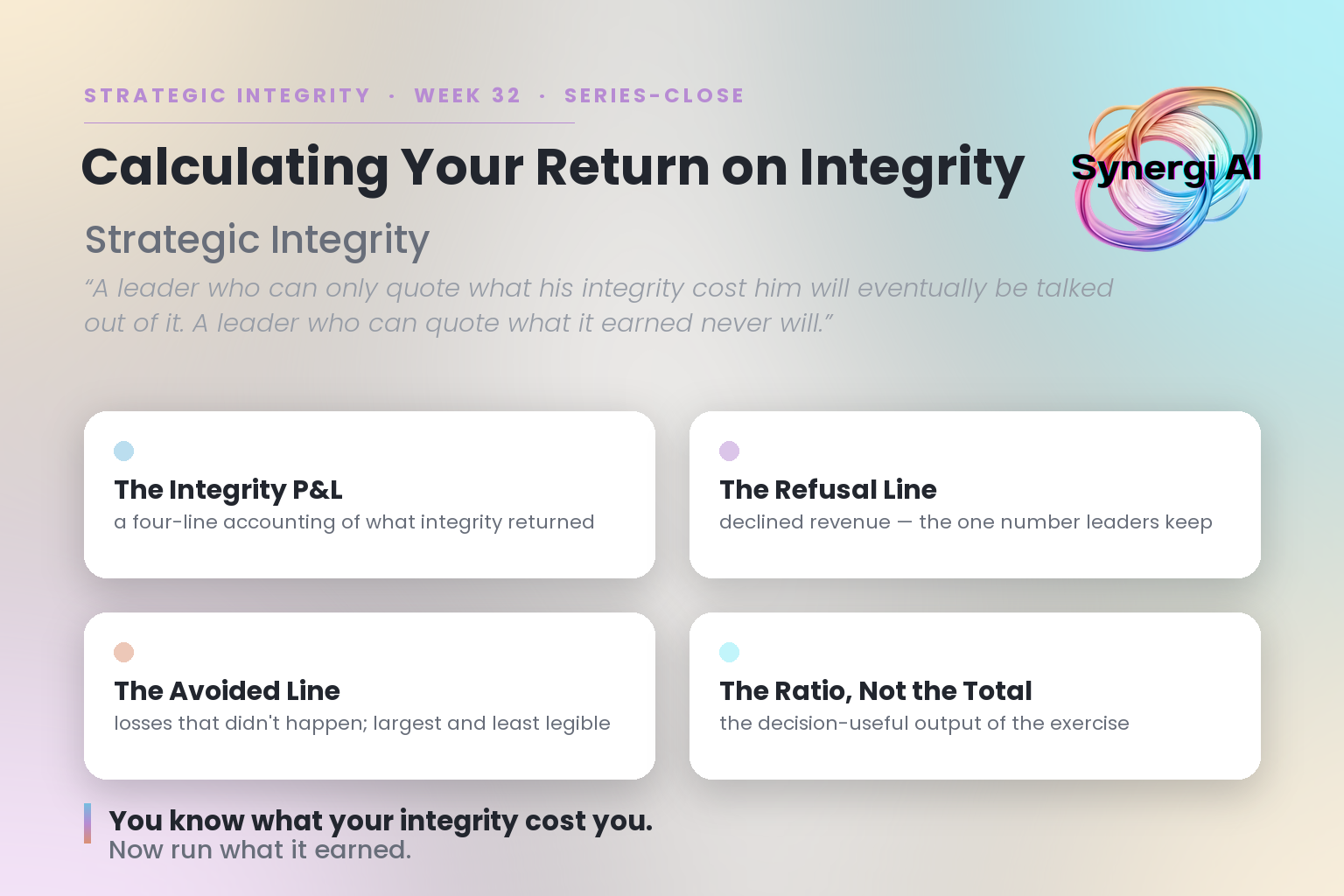
The Integrity P&L
Four lines. Every one of them from records you already keep.
Won. Deals closed where trust was the deciding factor — the ones where the client told you, in some form, we picked you because we believed you. Not the deals you won on price or timing. Just those. Count them, and total the revenue.
Priced. What you charged above what an equally capable but unproven competitor could have charged for identical scope. If you've never named that gap, use your last renewal increase that closed without a negotiation. That number was the premium.
Kept. Your churn on trust-sourced clients against everyone else. Run both rates. The difference, multiplied by your average account value, is retention you earned rather than bought.
Avoided. The losses that didn't happen — the incident you disclosed early and fixed for a fraction of what it would have cost discovered late. This line is the largest and the least legible, because it's measured in an event that left no record. Estimate it honestly. Leaving it at zero isn't conservative. It's just wrong.
Then, on the other side, one line only:
Refused. The revenue you declined. His hundred and eighty thousand.
Thirty Minutes and Last Year's Records
You don't need a model. Pull last year. Work the four lines in order — Won, Priced, Kept, Avoided — then set the Refusal Line beside them.
A forty-person commercial insurance brokerage I ran this with came out at roughly five hundred thousand counted, against a hundred and eighty thousand refused — and that was before the avoided line, which they estimated at more than either.
The point of the exercise isn't the total. It's the ratio. Because the next time someone in your leadership meeting suggests your standards are getting expensive, you won't be defending a principle.
You'll be reading a number.
What It Earned
The Integrity Metrics arc taught you to see your integrity. The Bright Lines and Guardrails arc taught you to defend it. The Personal Alignment arc taught you to align yourself first. This arc taught you that it competes, that it prices, and that it chooses.
This week it does the last thing left. It accounts for itself.
Next week the series turns outward again, into the Ecosystem Intelligence arc — what happens when the values you've now priced have to hold across every AI agent in your operation, not just in the room where you happen to be standing.
But run the four lines first. A leader who can only quote what his integrity cost him will eventually be talked out of it. A leader who can quote what it earned never will.
Make today your masterpiece. And put a number on the thing you were never going to trade anyway.