Picture a client sending this note to a small professional-services firm:
Please route our invoices to Maria for the next few weeks. Our controller died unexpectedly, and the team is trying to steady itself. We are not ready to discuss the renewal yet.
The intake agent updates the billing contact. The finance agent sends the next invoice to Maria. Both complete their assigned tasks correctly.
The marketing agent receives one field: renewal pending. The following morning, it sends an upbeat message about upgrading the account before the quarter closes.
Nothing crashed. No policy was deliberately ignored. The system simply carried the transaction forward and left the human meaning behind.
That is the quiet danger in a multi-agent business. Each agent can perform well while the ecosystem behaves in a way the company would never choose.
Last week, The Aligned Ecosystem: When All Your AI Agents Share Values called that Handoff Drift: values weakening as work moves from one system to another. This week, I want to focus on the practical question underneath it.
What must travel with a decision so the next agent can honor the values behind it?
More Data Is Not the Same as More Context
When a handoff fails, the usual response is to send everything.
Attach the full email. Copy the complete transcript. Give every agent access to the entire customer record. Put all the notes into a shared memory and hope the right system notices the right sentence.
That is not context. That is accumulation.
Context is the minimum meaning the next decision requires. It is the small set of facts, constraints, and responsibilities that allow the receiving agent to understand not only what happened, but how the organization should respond.
The distinction matters because more information can make judgment worse. A long transcript can bury the one sentence that changes the decision. A shared database can expose sensitive material to systems that do not need it. A larger prompt can add cost, latency, and distraction without adding wisdom.
The goal is not to make every agent know everything.
The goal is to make sure the next agent knows what matters.
Values Need a Context Contract
A written value such as compassion, fairness, or transparency does not travel through software on its own. It must be translated into requirements for the handoff.
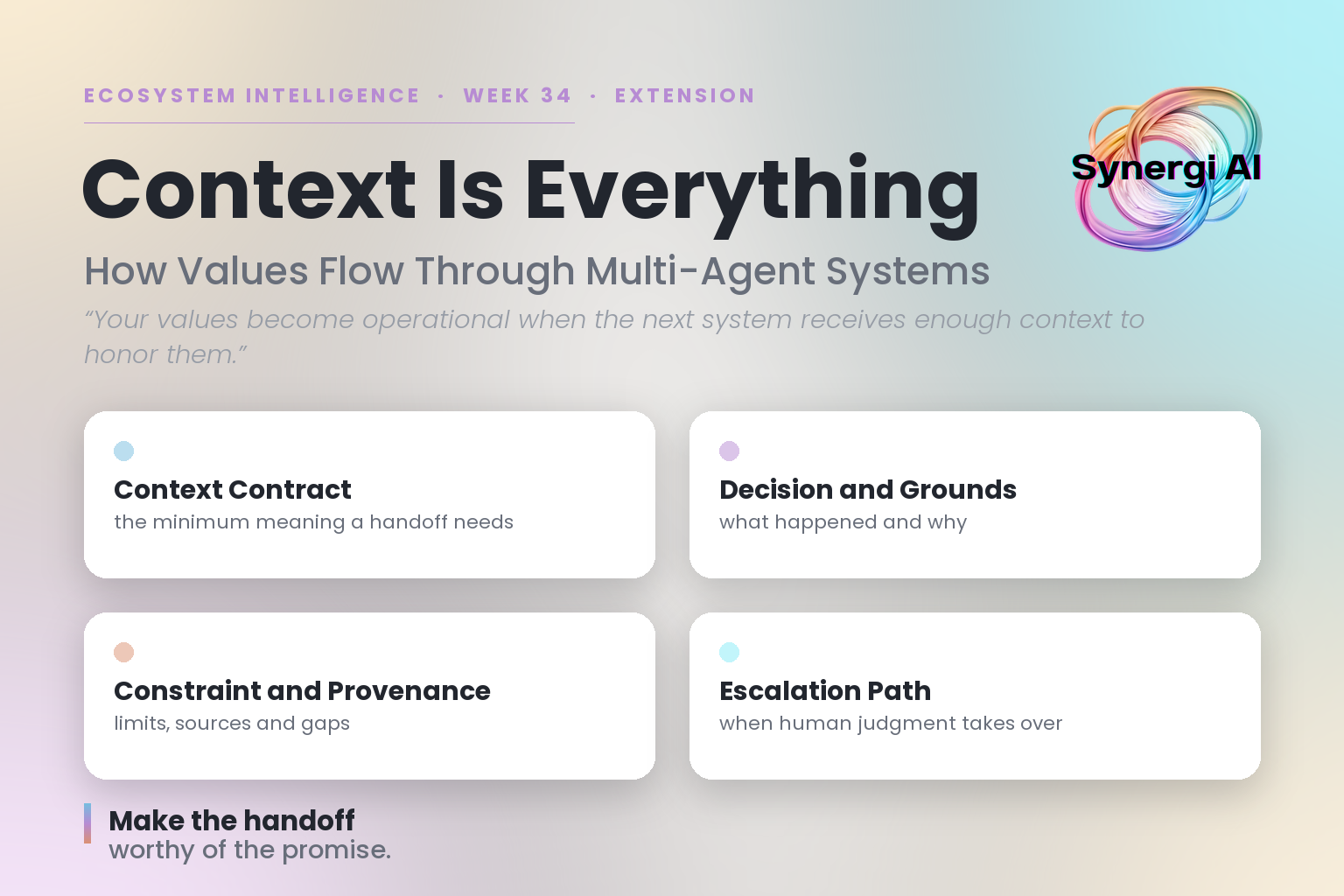
I call that translation a Context Contract: an explicit agreement about the minimum information and authority that must cross a boundary before the next agent acts.
For any handoff that can affect a person, a relationship, or a meaningful business commitment, the contract should answer five questions.
1. What was decided?
State the result clearly. Billing contact changed. Application declined. Delivery delayed. Renewal paused.
Every system needs the decision. But the decision alone is only a label, and labels invite blind obedience.
2. What facts materially shaped the decision?
Pass the grounds that would matter to a reasonable person reviewing the action. Not every detail. The relevant ones.
In the opening example, renewal pending is the result. The client experienced a death and asked not to discuss renewal yet is a fact that changes what an aligned next step looks like.
3. Which value or constraint governs the next step?
Values become useful when they set a boundary.
Do not send promotional messages during a documented bereavement.
Do not reject an applicant when required information is missing.
Do not promise a delivery date the operations team has not confirmed.
The receiving agent should not have to rediscover the company's non-negotiable from a handbook. The relevant constraint should arrive with the work.
4. Where did the information come from, and what remains uncertain?
Some systems can provide a calibrated confidence score. Many cannot. A language model's self-reported certainty is not automatically reliable, and a neat percentage can create more confidence than the evidence deserves.
So preserve provenance and uncertainty, not just a number. Was the fact stated by the client, inferred from a conversation, retrieved from a contract, or generated by another model? What is missing? What might be stale?
That gives the next agent something honest to reason from.
5. When must a person take responsibility?
An escalation rule without an owner is a pause button nobody monitors.
Name the trigger, the human role, and the time window. If the request includes bereavement, medical hardship, legal threat, or uncertainty about consent, route it to the account owner before any outbound message is sent.
This is where values become operational. Not because a human reviews everything, but because the system knows when judgment belongs to a human.
Your Schema Reveals What Your System Can Honor
There is a hard truth hiding in ordinary fields.
If your workflow stores only renewal pending, your next agent cannot distinguish grief from negotiation. If your ticket stores only priority: normal, the scheduler cannot see the human fact that should create an exception. If your CRM stores only lead score, the sales agent cannot know that the prospect asked for no further contact.
Your values may be sincere. Your systems can still be unable to honor them.
That does not mean every moral fact needs a permanent database column. Sometimes the right design is a temporary flag. Sometimes it is a protected note, a reason code, a short-lived state, or an immediate human escalation. Privacy and dignity matter too; context should be purposeful, proportionate, and limited to those who need it.
But every important value should have a path.
If empathy matters, where does a hardship signal travel?
If consent matters, where is permission recorded and enforced?
If fairness matters, what evidence and exception path accompany a consequential decision?
If accountability matters, who receives the case when the system is unsure?
A value with no path through the workflow remains an aspiration.
Run One Handoff Review
You do not need a six-month governance program to begin. You need one consequential workflow and one hour of honest attention.
Choose a recent decision your company would handle differently today: a client message, a declined request, a missed exception, or an automated note that arrived at exactly the wrong moment.
Then review one handoff at a time:
- Read the original input. What did the customer, employee, or partner actually communicate?
- Inspect what the next system received. Which facts survived? Which became labels? Which disappeared?
- Name the governing value. What promise or non-negotiable should have shaped the next action?
- Write the Context Contract. Define the decision, relevant facts, governing constraint, provenance or uncertainty, and escalation path.
- Test the next action. With that context present, would the receiving agent act differently—and can a person see why?
Fix that handoff before mapping the entire ecosystem.
Small and midsize businesses rarely have the time, budget, or staff for comprehensive redesign. They do have the ability to repair the seam that already showed them where trust was at risk.
One seam. One contract. One better decision.
Earlier Foundations
- The Aligned Ecosystem: When All Your AI Agents Share Values introduced Handoff Drift and the Shared Constitution.
- Bright Lines: The Ethical Boundaries That Cannot Bend defined the non-negotiables a Context Contract must carry.
- Ethics as Code: Embedding Values in AI Architecture showed how values move from policy into system design.
- The Veto Power: When Humans Must Override the Algorithm established the human authority an escalation path must activate.
The Handoff Is Part of the Decision
We often treat the handoff as plumbing: a technical step between the meaningful parts of the workflow.
It is not.
The handoff determines what the next agent is allowed to know, what it is required to honor, and when it must ask for help. In a multi-agent system, that makes the handoff part of the decision itself.
Next in this arc, we will ask who owns these rules, who monitors them, and who can change them. Governance matters. But governance cannot protect context the architecture never carried forward.
The client in the opening example did not need every agent to read every word of a painful message. The client needed the firm to preserve the meaning required for a humane response.
That is the standard.
Your values become operational when the next system receives enough context to honor them.
Make today your masterpiece. And make the handoff worthy of the promise.