A managing partner I coach called me at 5:40 on a Thursday. Professional services firm, forty people.
She said, "I made a decision at four o'clock today that I never would have made at nine."
Nothing dramatic. She had approved a client concession she had spent three weeks holding the line on. Not because the facts changed. Because she was tired, and saying yes was lighter than saying no one more time.
"I didn't change my mind," she told me. "I just ran out of the version of me that could hold it."
That is the whole subject of this week.
Two weeks ago the series turned inward. We named the calendar as the leader's truest values statement. Last week we built the routine — twelve minutes a day, three bookends and a check — to keep the calendar pointed where you said it should point.
But there is a failure mode the routine does not catch. You can anchor your morning perfectly, defend your named hours, and still make your worst decision of the week at four in the afternoon.
Because your values did not drift. Your judgment did.
The Aligned Mind Has a Half-Life
Decision fatigue is not a character flaw. It is a well-documented drain. Every choice you make draws down a finite reserve, and as the reserve empties, the mind starts to default — to whatever is fastest, easiest, or least likely to require one more hard conversation.
Here is the dangerous part: what does not change is your principles. They are intact at 4 PM. You could recite them. What you have lost is the capacity to apply them under pressure. The aligned mind in the morning and the depleted mind in the afternoon believe the same things. Only one of them can act on them.
So the leader who wins the morning can still lose the day — not to a competitor, not to the market, but to the twentieth judgment call in a row.
What AI Changed About the Afternoon
AI is very good at clearing the light decisions. The routine approvals, the first drafts, the "which of these three is fine" calls — the tool takes them off your plate. That sounds like pure relief, and mostly it is.
But watch what it leaves behind. The decisions AI removes are the easy ones. The decisions AI cannot make — the ones loaded with your values, your relationships, your name on the outcome — stay exactly where they were. On your plate. Which means the plate that used to hold a mix of light and heavy now holds nothing but heavy.
Your decision count went down. Your decision density went up. Every remaining call costs more, and the tank drains faster than it used to. AI gave you back the hours. It did not give you back the judgment those hours now demand.
So protecting the aligned mind is no longer optional hygiene. It is the discipline that decides whether the hardest calls of your week get your best self or your most depleted one.
Protecting the Aligned Mind
Four moves. None of them require more willpower. They require better sequencing.
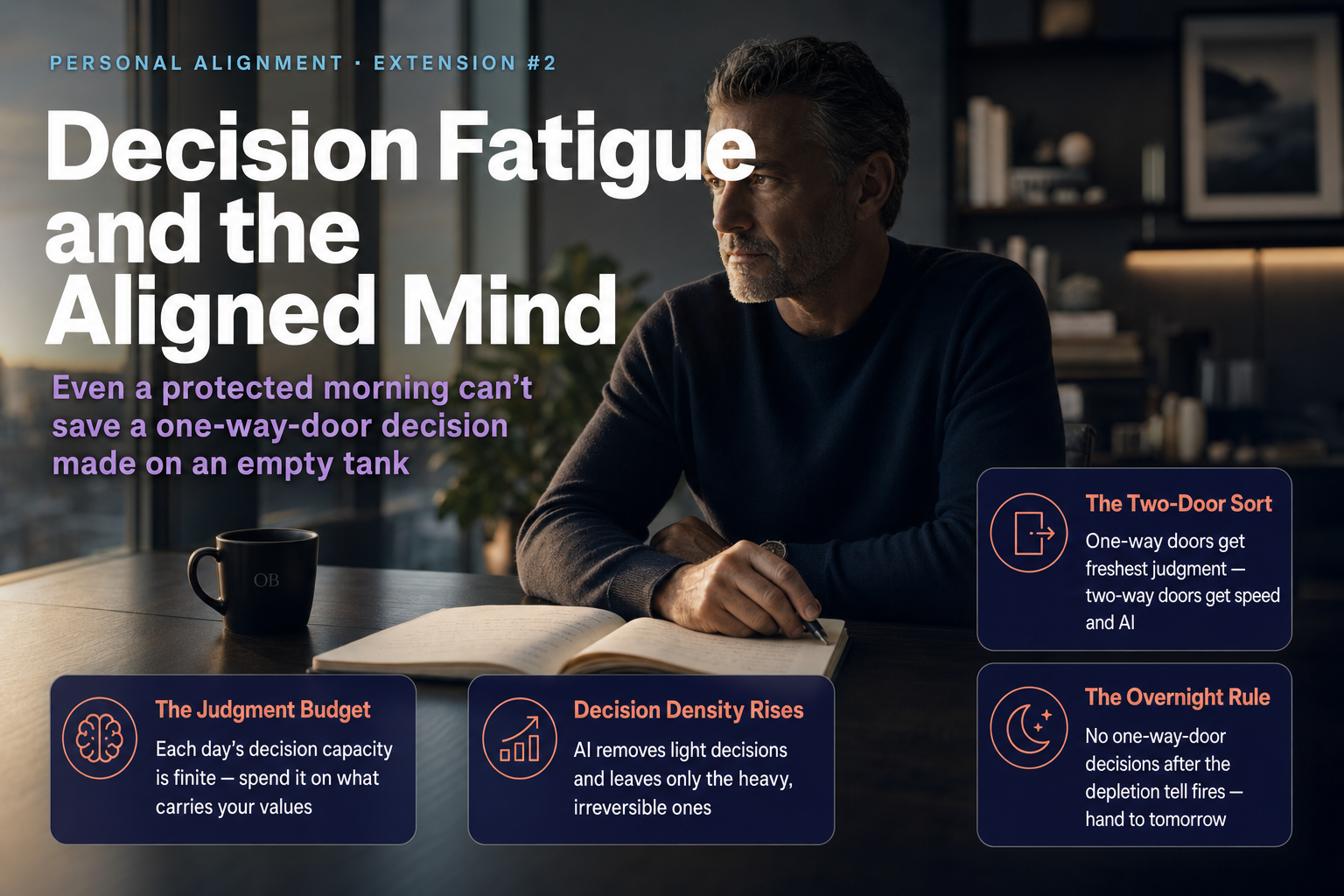
Decide the Heavy Things First. Your judgment is a budget, and it is fullest in the morning. So spend it there. Put the irreversible, values-weighted decisions in the named morning hours the Morning Anchor already protects. Push the reversible and the routine to the afternoon. Most leaders do this exactly backwards — they clear the small stuff first to reach a clean desk, then arrive at the heavy decision with an empty tank.
The Two-Door Sort. Before any decision, ask one question: is this a one-way door or a two-way door? A two-way door is reversible — delegate it, or let AI draft it, and move on. A one-way door is irreversible — the client you let go, the hire you make, the principle you bend. These get your freshest judgment and never your most depleted. If you protect only one category of decision in your whole week, protect the one-way doors.
Know Your Depletion Tell. Every leader has a signal that the tank is empty. For most, it is the quiet moment when "what's fastest" replaces "what's right." Name yours. Once you can feel it arrive, you can stop trusting the judgment behind it. The tell is not weakness. It is your early-warning system.
The Overnight Rule. When you hit a one-way door after the tell has fired, you do not decide tired. You hand it to tomorrow's Morning Anchor. Sleep is not a stalling tactic. It is a judgment-restoration system that runs for free every night. The decision that felt impossible at 6 PM is often obvious at 8 AM — not because the facts changed, but because the mind reading them is full again.
What the Practice Actually Does
This does not give you more judgment. It spends the judgment you have on the decisions that carry your name.
You will still get tired. There will still be days the tank empties by three. The point is not to be fresh all day — no one is. The point is to make sure that when your judgment is at its best, it is aimed at the decisions that deserve it, and when it is at its worst, it is only touching the ones you can undo.
And this is exactly where AI earns its place. Put it on the two-way doors — the reversible pile — so your budget goes to the one-way doors. Let it widen the doorway: surface the options, model the consequences, pressure-test your reasoning. Just do not let it walk through the one-way door for you. It carries its training. You carry your values. Only one of you should be making the call you cannot take back.
The Foundation Beneath the Practice
Last week we said the practice is the foundation beneath the leader. This week we say the leader's judgment is what the practice exists to protect.
A routine that anchors your morning and then spends your sharpest thinking on four o'clock trivia has protected the calendar and lost the point. The named hours are not the goal. They are the container. What goes in them — your best judgment, aimed at the decisions that carry your values — is the point.
Guard the mind that makes the calls. Everything downstream depends on it.
The May arc taught you to see your integrity. The June arc taught you to defend it. This arc asks whether the person who runs the architecture is aligned with it — and this week protects the one resource that alignment actually runs on: the quality of your judgment when the decision matters most.
Make today your masterpiece. And make your heaviest decisions while the light is still good.