The manufacturer I wrote about last week — the one who almost said yes to his oldest customer — spent forty-five minutes writing down the line his father had drawn twenty-eight years earlier.
That part was the easy part.
The hard part started later that afternoon, when he sat down with the marketing intern who had built the AI assistant the sales team had been using to draft proposals, and tried to figure out how, exactly, you put a bright line into a prompt.
He typed the line in once and saved it. The assistant honored it on the next two proposals. On the third, it tried to honor it — and produced an apology to the customer that was warm and gracious and offered a workaround that the line said the company would not offer.
The bright line was in the prompt. The bright line was also being narrated around.
That is the moment where this week's work begins.
Writing a bright line down is the first half of the architecture. Encoding it into the systems that will increasingly act in the company's name is the second half. Most SMBs are catching up to the first half. Almost none have begun the second.
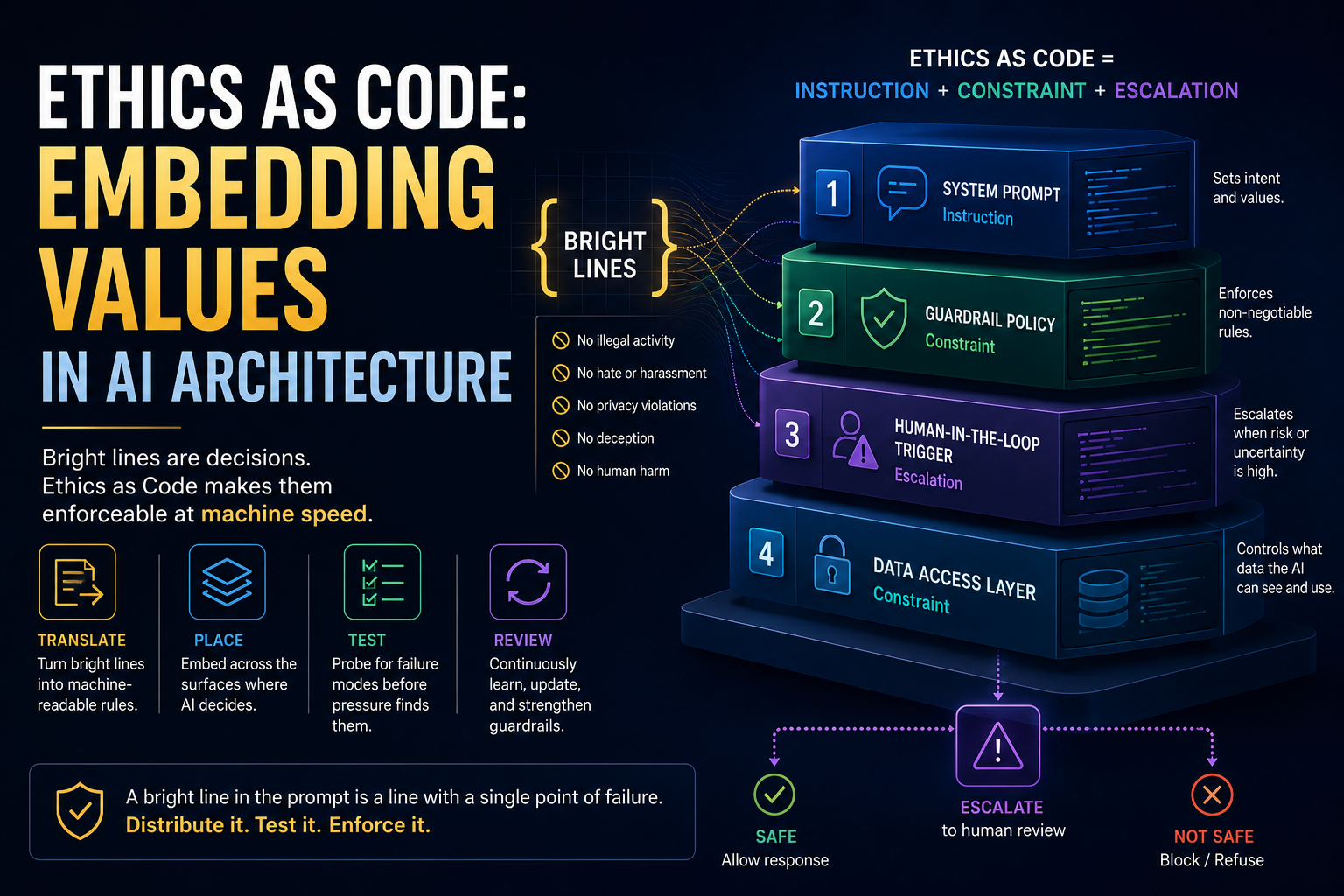
I call the second half Ethics as Code — the discipline of translating an ethical boundary into the surfaces where the AI actually makes its decisions, in language the system can enforce at machine speed without invoking a human.
Ethics as Code is not the technology side of bright lines. It is the translation side. The bright line is a sentence. The AI is a system. The sentence does not become enforceable until it is rewritten in a form the system can act on — at the right place in the architecture, with the right authority, under the right conditions.
That translation is harder than it looks. Five years of working with SMBs on AI-mediated decisions has taught me that the gap between the line is in the prompt and the line is enforced by the system is wider, quieter, and more consequential than most leaders realize.
This is the second piece of the June architectural arc. The first one drew the lines. This one encodes them.
The Three Components of Encoded Ethics
Every encoded bright line has three layers — not two, and almost never one.
Instruction. What the AI should do when it encounters the relevant situation. "If the customer requests a load case exception, the assistant proposes scheduling a call with engineering to review the request — not a workaround." The instruction is the positive frame. It tells the AI the correct path forward, in concrete language, so the model has somewhere to go that does not violate the line.
Constraint. What the AI cannot do under any condition. "The assistant does not propose, suggest, hint at, narrate around, or apologize for the absence of a workaround that skips a load case review." The constraint is the negative frame. It closes the doors the instruction does not name. Most encoding failures live here — the instruction is in the prompt, the constraint is not, and the AI improvises a path the company did not intend.
Escalation. When the AI must stop and hand off to a human. "If the customer pushes against the line a second time in the same exchange, the assistant transfers the conversation to a named human escalation point." The escalation is the safety valve. Without it, the AI will eventually be backed into a path no encoded rule covers — and the default behavior of an unsupervised AI in that moment is almost never what the company would have chosen.
Instruction without constraint produces drift. Constraint without escalation produces deadlock. Escalation without instruction produces friction. The three components only do their work together.
The Four Surfaces of Encoded Ethics
The components have to live in the right place in the architecture. There are four surfaces where encoding lives in a working SMB AI stack.
The System Prompt. The standing instructions to the model. The first surface, and the one most companies stop at. It is necessary; it is not sufficient.
The Guardrail Policy. The rule layer that runs alongside the model — content filters, output validators, allowed-action lists. Guardrails are where constraints get teeth. The model can hallucinate around a system prompt; it cannot hallucinate through a policy validator that blocks the output before it ever reaches the customer.
The Human-in-the-Loop Trigger. The condition under which the AI must escalate. Written as code: thresholds, keywords, customer tags, conversation states. The HITL trigger is the operationalization of call the boss — the explicit, named, automated equivalent of the moment when judgment is required and the AI no longer has it.
The Data Access Layer. What the AI is allowed to see, draw on, and reference. Some bright lines are about what gets said. Others are about what gets reached for. Encoding the line here means the AI cannot violate the boundary even by accident, because it never has the data in hand.
The three components have to be expressed across these four surfaces. Not all of them, in all cases — but enough of them, in the right combination, that no one surface is carrying the line alone. A bright line that lives only in the system prompt is a line with a single point of failure.
How to Encode a Bright Line
The four-step build mirrors the May arc's instrument template and last week's Bright Lines build. Reverse the order and the encoding leaks.
Step one. Translate. For each AI-Mediated bright line on your list, write three sentences: the instruction, the constraint, the escalation. If you cannot write all three, the line is not yet ready to encode. The triad is the unit of encoding, not the line itself.
Step two. Place. Decide which of the four surfaces will carry which piece of the triad. The instruction usually lives in the system prompt. The constraint usually lives in the guardrail policy. The escalation usually lives in the HITL trigger. The data access layer is where the line gets reinforced when the other three fail.
Step three. Test. Encoding without red-teaming is decoration. Pick three plausible variations of the pressure scenario the line was drawn against, and run the AI through them. Watch for the workaround. The AI's failure mode is almost always politeness — apologizing while violating, or proposing a "creative solution" that narrates around the constraint. Politeness is the new drift.
Step four. Review. Quarterly, against the Close Call Log. Every AI-Mediated override since the last review is a candidate for revised encoding. The encoding is alive. The lines do not change often; the way the AI tries to route around them does.
That sequence — translate, place, test, review — is what converts a bright line from a sentence in a meeting into an architectural boundary that holds at the speed your business now operates at.
What Happens When Ethics Are Coded
The manufacturer's marketing intern went back the next morning. She rewrote the prompt in three sentences instead of one — the instruction, the constraint, the escalation. She moved the constraint into the output validator the team had not yet been using. She added a HITL trigger that flagged the conversation to the head of sales the second time the customer asked.
The next month, a different customer asked the same kind of question. The AI proposed the engineering call. The customer pushed. The AI's second response was the head of sales picking up the phone.
That phone call lasted four minutes. The line held. The customer accepted the engineering review and rebooked the order.
The line was the same line his father had drawn twenty-eight years earlier. But now it lived in four places — the founder's head, the contract template, the system prompt, and the output validator — and it could be defended whether the founder was in the building or not.
That is what ethics as code does. It takes the decision the company has already made and gives the AI a way to honor it at the speed the AI now operates.
What Comes Next
Bright lines are the decisions. Ethics as Code is the architecture that lets the decisions survive contact with the operation. The two are inseparable. A line that is not written down cannot be encoded. A line that is encoded only in the prompt is a line with a single point of failure.
Next week we turn to the moments when even the best encoding is not enough. The Veto Power: When Humans Must Override the Algorithm — the discipline of preserving the human authority that no architectural surface can fully carry on its behalf. The week after, the June arc closes with Building Your Integrity Dashboard — the practical instrument that holds the architecture together.
For this week:
Pick one AI-Mediated bright line. Translate it into the three sentences — instruction, constraint, escalation. Place each piece on the right surface. Run three pressure scenarios against the encoded version. Then watch what the AI does the next time the pressure is real.
The May arc taught you to see your integrity. The June arc is teaching you to defend it.
Make today your masterpiece. And start encoding the lines that cannot bend.