A COO called me last week and said something I've been turning over ever since.
"Nothing's wrong. And that's exactly what's worrying me."
Her company had been running AI-driven operations for eighteen months. Metrics were strong. No customer complaints of note. No team escalations. No headlines. Everything, by every external measure, was working.
And yet.
She couldn't tell me why she didn't trust it. Just that she didn't.
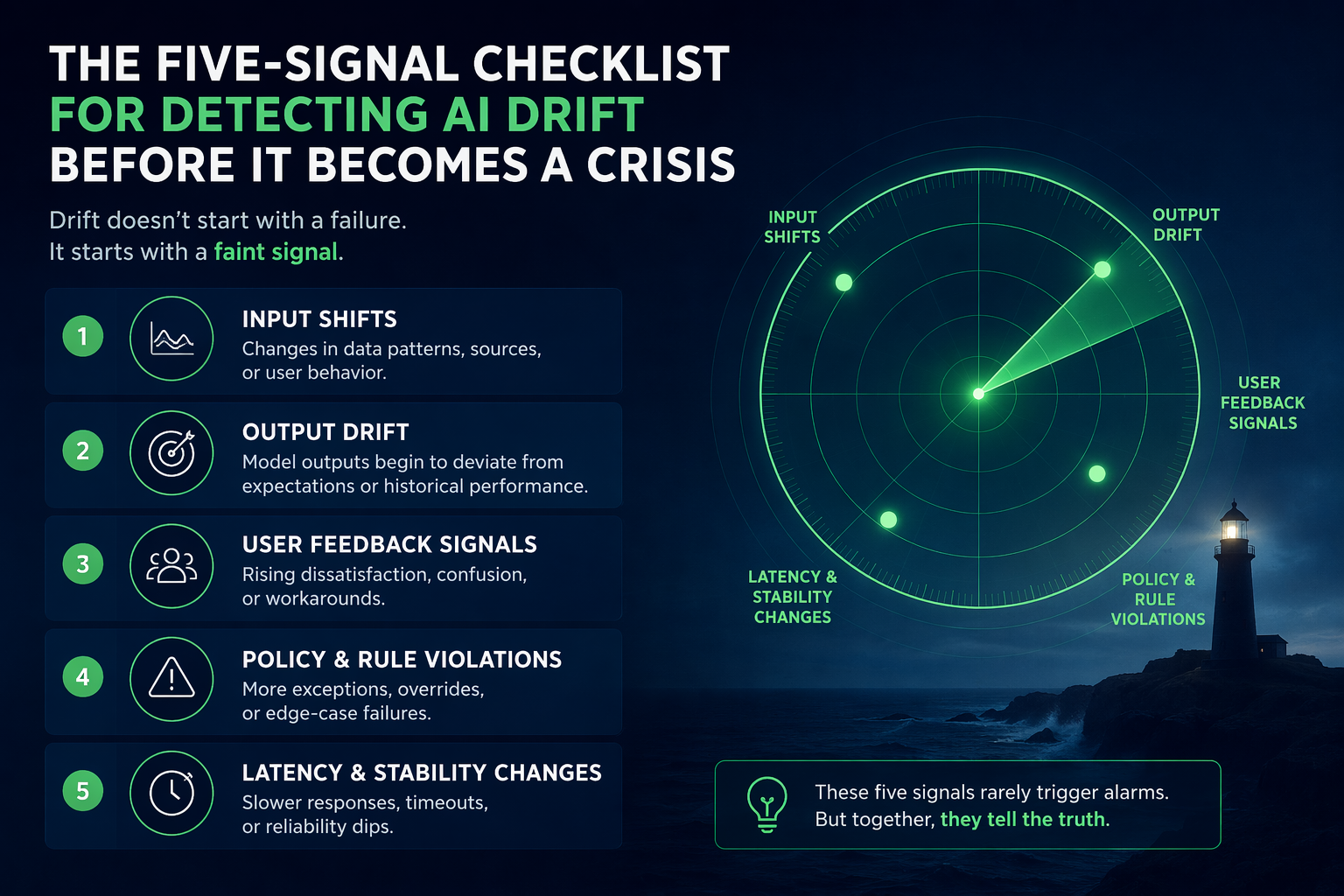
Here's what I've learned: drift is rarely loud. By the time a values failure becomes visible as a crisis, it has usually been operating inside the system for months. What you're looking for, if you're looking well, are the quieter tells.
These are five of them.
The Five Warning Signs
1. Your exception log is empty. No overrides. No escalations. No flagged cases. In a healthy AI operation, your team should be pushing back on the system somewhere between weekly and daily. An empty log doesn't mean the system is perfect — it means the people closest to it have stopped fighting for the values the system should be reflecting. Silence on the floor is not consensus. It's resignation.
2. Your team's language has shifted from values to efficiency. Listen to how your people explain AI decisions. If the dominant frame is "it optimized for what we asked it to" instead of "it reflected who we said we were" — you are watching your vocabulary drift before your systems do. Identity language always fades before identity itself does.
3. Your gut and your dashboard are telling different stories. Operational metrics are strong. The numbers have never been better. And yet something about how the company feels has changed, and you can't put your finger on it. Don't dismiss that. In my experience, the gap between the metrics and the felt sense is where drift lives longest. The dashboard is usually the last thing to catch up — not the first.
4. Long-term customers are leaving quietly. They don't complain. They don't write angry emails. They just stop renewing. Or they stay, but they stop referring. The customers who originally chose you for your values are the first to sense when those values have loosened — and they rarely tell you. They just move on. If your retention is shifting at the edges even as your topline looks healthy, pay attention.
5. You cannot name a recent case where the AI chose the harder path for values reasons. In the last quarter, can you point to a single decision where your AI took the slower, more expensive, or less efficient route because your values required it? If the answer is no, that is not a sign your values are being served easily. It is a sign your values are no longer in the loop. Values that never cost anything were never operating.
What to Do With This List
None of these signs alone means the system is broken. One is a question worth asking. Two is a pattern worth investigating. Three or more is a conversation you need to be having at the executive level — because at that point, you are no longer watching drift. You are watching your culture quietly rewrite itself through the system that executes it.
Run this list against your operation. Bring it to your next executive review. Ask the hard version of the question: what is the specific case that made you say yes this quarter? What is the specific case that would make you say no if one appeared today?
Drift does not arrive loudly. It arrives in patterns that look like progress until they don't.
These are the tells. The work is learning to see them early — while a course correction is still a conversation, not a crisis.
Because the AI is not the thing drifting. The values are. And the values are yours.
Make sure they are still the ones you chose.