A founder I work with called me the week after he lost a bid. Logistics-software company, forty people, competing against a rival half his price.
"We lost on price," he said. "Or so I thought."
A week later the prospect's operations director called him back. Not to negotiate. To tell him they'd signed with him anyway.
He asked why. The answer wasn't about the product. "You were the only vendor who showed us your AI guardrails document before we asked for it. The other two didn't have one to show."
That document wasn't built for the pitch. It was six weeks old, written in June, for no audience but his own team. He'd built it the way this series taught him to — as a Bright Line, a private discipline, never intended for a prospect's desk.
It won him the deal anyway.
The Work Was Never Meant to Be Seen
For twenty-eight weeks this series has been building something inward. We built instruments to see integrity — the Integrity Yield, Trust Velocity, the Close Call Log. We built a defense layer to protect it — the Bright Lines, the encoding, the veto power. And a month ago we turned the lens on the leader — the calendar, the daily practice, the judgment, the audit that closes the loop.
All of that work shared one quality: it was private. None of it was built to be shown to a customer. It was built to be true, whether anyone was watching or not.
This week, that changes. Not because the work changes — the work stays exactly as private and unglamorous as it has always been. What changes is what happens to it once it leaves the building.
The founder didn't write his guardrails document to win a deal. He wrote it because Week 21 told him to draw lines that cannot bend, and he did the unglamorous work of actually drawing them. The market found it anyway, and paid a premium for what it found.
Integrity, done right, does not stay private. It leaks into the market as a competitive advantage — whether you planned for that or not. This arc is about planning for it.
Why Capability Stopped Being the Advantage
Here is what has shifted underneath every business reading this.
AI has made competence abundant. The draft that used to separate a great firm from an average one now takes minutes for both. The analysis that used to require a senior team now arrives, credibly, from a tool anyone can license. Your smallest competitor can produce work today that would have required your best people eighteen months ago.
This is not a complaint about AI. It is the honest, structural fact this entire series has been building toward: when capability becomes cheap and universal, capability stops being what buyers use to choose between you and the next vendor. They cannot use it — because on the surface, you increasingly look the same.
So buyers ask a different question. Not "can you do this." Almost everyone can do this now. The question becomes: can I trust you with it.
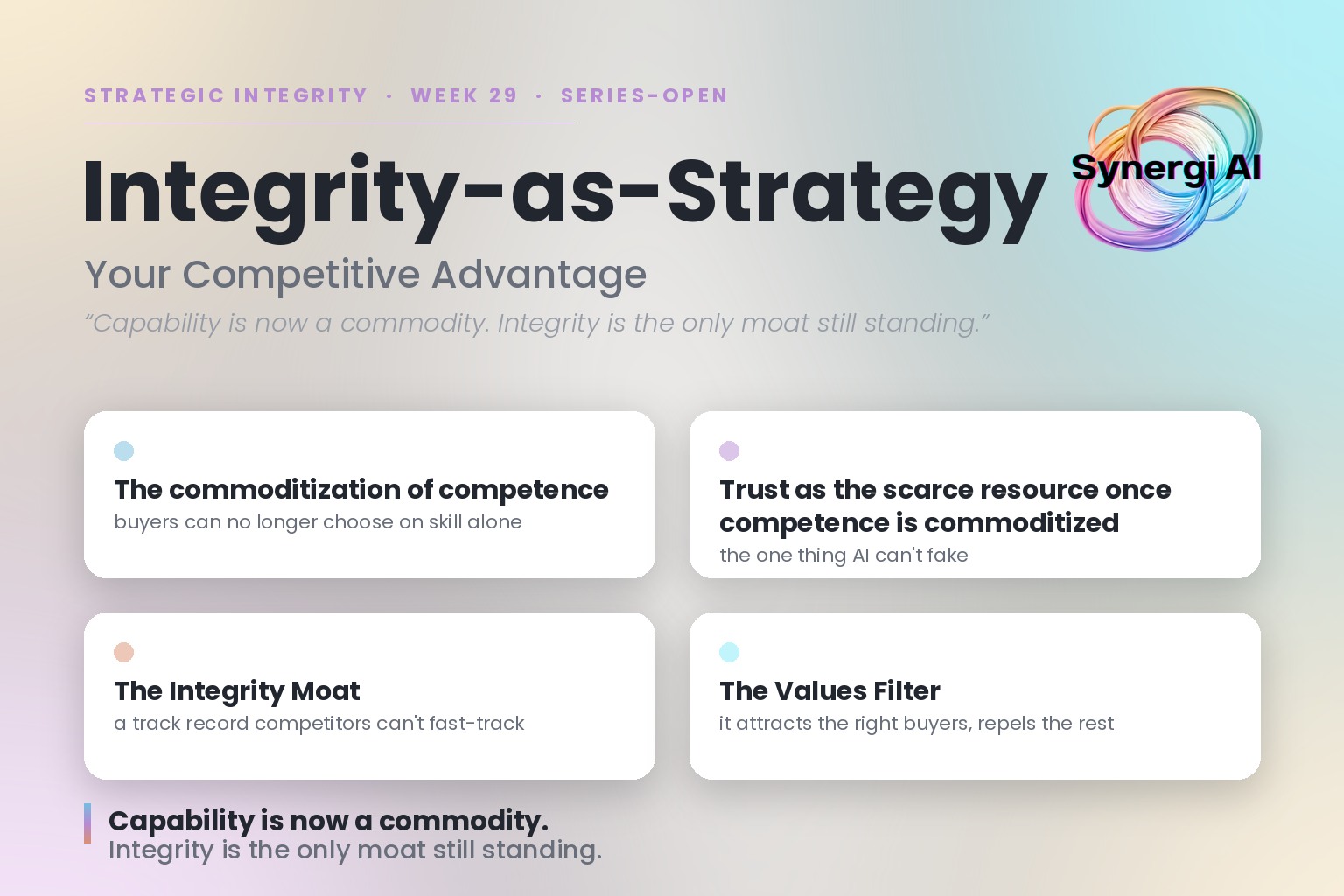
Trust does not get commoditized by AI. It cannot be prompted into existence. It is not a feature you can ship in a sprint. It is a track record, accumulated the slow way, and it is the one thing your cheapest, fastest competitor cannot copy overnight — no matter how good their model is.
This is the inversion at the center of Integrity-as-Strategy: as competence gets cheaper, trust gets scarcer, and scarcity is where the pricing power lives.
The Integrity Moat
A moat was never built to make a castle better than the one across the field. It was built to make the approach expensive, regardless of how good the attacking castle was.
Integrity works the same way in a market where AI has leveled capability. A competitor can match your output in a quarter. They cannot match eighteen months of kept promises in a quarter — because a track record cannot be assembled faster than the events that create it. Every commitment you've kept, every hard call you made when the easy call would have been more profitable, every Bright Line you actually held under pressure — none of it can be reverse-engineered by a competitor who simply decides to try harder next quarter.
That is a moat. It is slow to build and nearly impossible to fake convincingly, which is exactly why it still works after everything else has been commoditized.
The Bright Lines you drew in June and the veto calls you made in the weeks after were never marketing. That is precisely what makes them valuable as marketing now. A document written to be seen reads like a document written to be seen. A document written because you meant it reads like something else entirely — and buyers, especially the good ones, can tell the difference.
The Values Filter
Not every customer is worth winning, and integrity-as-strategy has a second effect most leaders don't expect: it repels the buyers you didn't want.
The prospect who chooses on price alone, every time, is rarely your best long-term customer — they will leave the moment someone quotes lower, because price was the only relationship you ever had. But the buyer who reads your guardrails document before signing, who asks what you won't do with their data as carefully as what you will, is signaling something important: they intend to be a partner who cares whether you're still standing in three years. Those are the buyers who refer you, renew with you, and forgive you the one mistake every vendor eventually makes.
Visible integrity does not just attract better customers. It functions as a filter — it self-selects the relationship in both directions before either side spends a dollar. The vendor who hides their practices attracts buyers who don't ask. The vendor who shows their practices attracts buyers who do. You get to choose which room you'd rather be standing in.
The Compounding Trust Account
Trust behaves like a financial account, but the interest rate is not symmetrical.
Deposits accrue slowly: a promise kept on time, a guardrail that held when it was inconvenient, a mistake disclosed before the customer found it themselves. Each deposit is small. None of them, alone, wins you a deal. But they compound — quietly, the way the Trust Velocity metric from earlier in this series was built to track — into a reputation that eventually precedes you into the room.
Withdrawals do not follow the same math. One breach — one hidden AI failure, one broken commitment, one Bright Line crossed and covered up rather than disclosed — costs more than dozens of deposits earned. The account does not forgive proportionally. This is the same asymmetry the Close Call Log was built to document: the crisis that didn't happen is invisible, but the one that does happen is instantly and permanently visible, and no discount buys back the balance.
This is why Integrity-as-Strategy is not a campaign. It is an account you have been funding, one kept promise at a time, since Week 17 — whether or not you intended to spend it on anything. Now you can.
Turning Private Integrity Into Public Position
You do not need a rebrand. You do not need a new department, a trust-and-safety hire, or a certification badge for your homepage. You need to stop hiding work you already did — work that, in most companies, is currently sitting in an internal drive, unread by anyone who might pay for it.
Publish what you can share. The Bright Lines document that has been sitting in an internal folder since June is, with light editing, a client-facing asset. Most competitors don't have one. Simply having one, dated, specific, and boring in the way real policy is boring, does work that no slogan can.
Tell the close call, sanitized. Every leader who ran the Close Call Log has at least one story of a crisis that didn't happen because a line held. Told honestly — without naming the client, without turning it into a brag — that story is proof no case study manufactured for marketing can match.
Show the veto, don't just claim it. If your organization has a real instance of a human overriding an AI recommendation for good reason, that is the single most persuasive fact you own. It answers the only question sophisticated buyers are actually asking: what happens when your AI is wrong, and who catches it?
Reframe the sales conversation. Stop competing on what your AI can do — everyone's AI can do roughly that now. Compete on what your AI won't do, and how you know, and what happens the day it almost does anyway.
None of this requires new work. It requires noticing that the private work already done is the most valuable thing in the building, and it has been sitting in a drawer.
A Second Data Point
I want to be careful here, because one story is an anecdote, not a pattern. So consider a second.
A healthcare clinic I advise — twelve providers, values-led from day one — went up against a chain with more capital and a slicker AI-scheduling pitch. The chain's system was, by any technical measure, more capable. It offered more automation, more features, more of the "AI-forward" language patients now expect to hear in a sales conversation.
The clinic won the contract anyway, and the reason echoed the logistics founder's almost exactly. Their intake AI's guardrails — the ones built quietly, months earlier, so the system would never make a clinical judgment call that belonged to a human — were sitting in a one-page document they handed over without being asked. The health system's procurement team had been burned before by a vendor whose AI overstepped. They weren't buying features. They were buying the evidence of a line that would hold.
Two industries, two unrelated founders, the same pattern: the private integrity work, shown rather than claimed, closed the deal that capability alone could not.
The One Condition
Integrity-as-Strategy only works under one condition, and it is not negotiable: the integrity has to be real before you try to sell it.
The moment integrity is manufactured for advantage rather than demonstrated as a track record, it stops being a moat and becomes a marketing claim — and buyers who have been burned before can smell the difference between a policy that governs behavior and a policy written to be read. This arc only works because the last twenty-eight weeks were not performance. The founder's guardrails document won the deal precisely because it wasn't written for anyone. That is the only kind of integrity a market will actually pay for.
If you have been doing the quiet work — the metrics, the lines, the calendar audit — you already have the asset. This arc is simply permission to stop hiding it.
What Comes Next
Over the coming weeks, the Strategic Integrity arc gets specific: why aligned companies command higher prices even against cheaper competitors, how the right customers self-select toward you before you've said a word, and how to actually calculate the return your integrity has been generating all along.
But it starts here, with the reframe underneath all of it.
The Integrity Metrics arc taught you to see your integrity. The Bright Lines and Guardrails arc taught you to defend it. The Personal Alignment arc taught you to align yourself first. This arc asks the question all of that private work was quietly preparing you to answer: what happens when your integrity stops being a discipline you practice alone, and starts being a position the market pays for?
Capability is now a commodity. Integrity is the only moat still standing.
Make today your masterpiece. And start letting your integrity compete.