The managing partner of a thirty-five-person insurance brokerage told me his AI had "learned the business." He meant it as good news.
The system drafted renewal recommendations for his account managers. The first month, they rewrote nine drafts out of ten. By the fourth month, they were rewriting one. He read the falling number the way anyone would: the system was getting better.
Then a client of twenty years called him directly. Her renewal had come through with two coverages she had never asked for and one she had specifically declined the year before. The account manager had sent it as drafted. When the partner asked why, the answer was honest and quiet: "It's usually right now."
Nothing on his quarterly page would have caught that for another eight weeks. But the signal had been sitting in plain sight since month two. The rewrites had stopped.
The Quarter Is Too Late
Last week I gave you three lines to keep on every AI system — profit, people, purpose — and a forty-five-minute review to fill them in once a quarter. Keep doing that. It is the ledger.
But a ledger is a lagging measure. It tells you what already happened. By the time the Read-Aloud Test scores a seven, the seven has been true for weeks. By the time your team fails the Power-Outage Test, the capability is already gone.
Foundation #5 in this series made a claim I have come back to more than any other: the hidden cost of misalignment lives in absence. Standard metrics count what happened. Drift is mostly what stopped happening — the pushback that used to come, the question that used to get asked, the edit that used to get made. No dashboard reports an absence.
So the early warning system cannot be a number. It has to be a habit of noticing what stopped.
Every coach I ever admired understood this. John Wooden barely looked at the scoreboard during a game. He watched the feet. The score was going to lag the footwork by ten minutes, and ten minutes was the whole game.
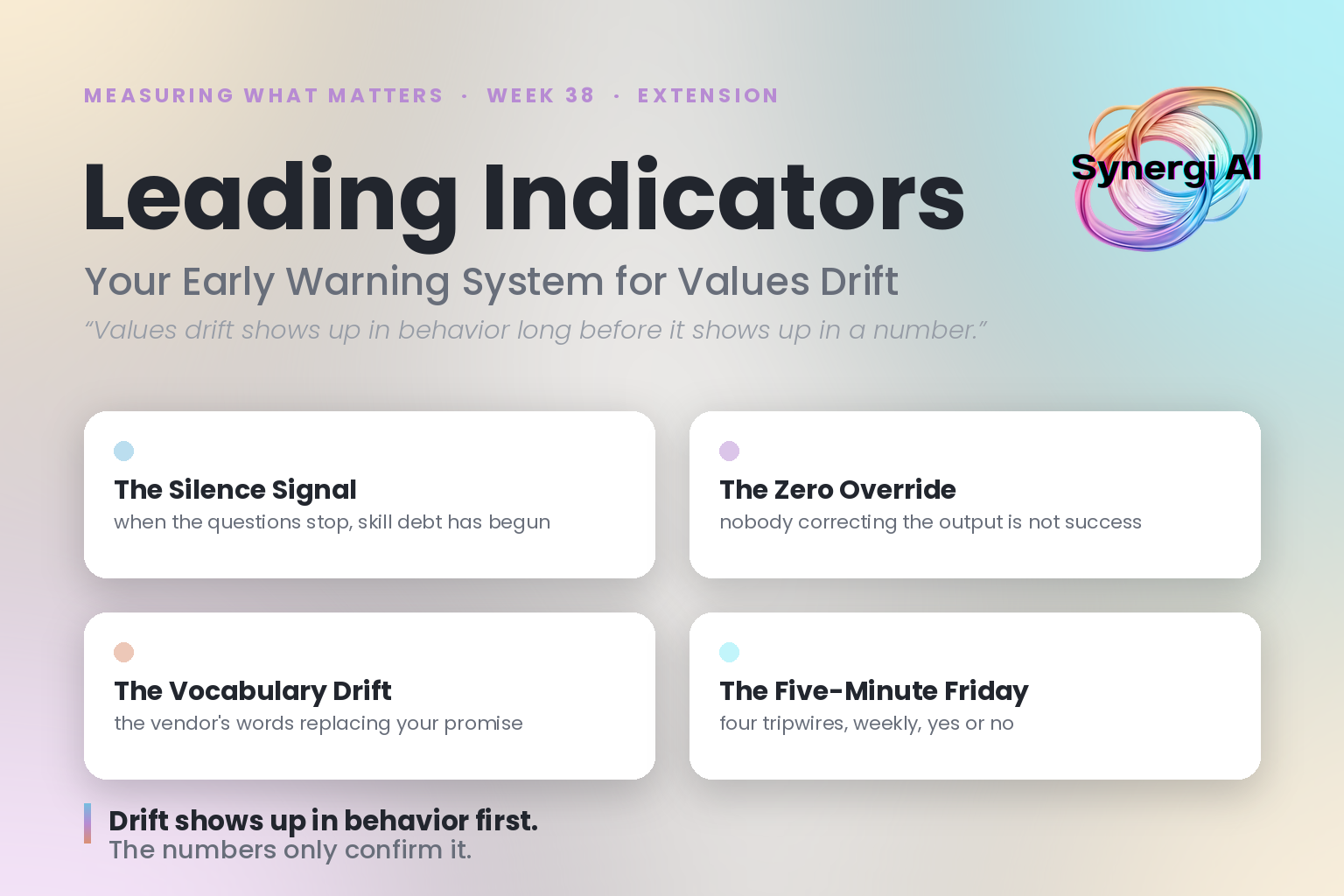
Values drift shows up in behavior long before it shows up in a number. The numbers only confirm it.
Four Tripwires
A leading indicator is not a metric you report. It is a tripwire you set. Here are the four I have found most reliable, one for each place drift enters a small company.
1. The Silence Signal
Watch the questions. When people first work alongside a system, they interrogate it. Why did it price it that way? Why that coverage? Why this reply and not the other one?
Then, somewhere around the third month, the questions thin out. Not because the answers got worse. Because the people stopped expecting to need them.
That silence is the earliest signal of skill debt you will ever get. It arrives months before anyone fails a Power-Outage Test. The juniors in last week's plumbing shop stopped asking why a quote came out high long before anyone noticed they could no longer build one.
So count the questions. Not precisely. Just notice when the room goes quiet.
2. The Zero Override
Watch the edits. Every system that drafts, recommends, or decides on your behalf gets corrected by a human at some rate. That rate should fall as the system improves. It should never reach zero.
A zero override rate means one of two things. Either the system is now perfect — or the people have stopped checking. In eleven years of watching this, I have not once seen the first one.
The brokerage's rewrites went from nine in ten to one in ten. The system had improved. It had not improved that much. The gap between what the system earned and what the team granted was the drift, and it was visible in month two.
3. The Vocabulary Drift
Watch the words. Every company has a way of talking about its customers that carries its promise inside it. What they actually need. What we'd tell them if they were family. The vendor's dashboard has words too: conversion, ticket, throughput, recommendation.
Listen for the day your people start using the vendor's words for your customers. "The recommendation went out." "The ticket closed." When the language of the promise gets replaced by the language of the tool, the purpose line is about to move — and the Read-Aloud Test will catch it in a month, but the vocabulary caught it today.
Language drifts first. It always has.
4. The Unearned Improvement
Watch the good news. This is the counterintuitive one. When a number on the profit line improves — and you cannot point to a decision anyone made that caused it — something else decided for you.
Ticket size rising with no pricing change. Close rate climbing with no new offer. Renewal revenue up in a quarter when nobody trained anyone. Each of those is true, and each of those was, in the brokerage and the plumbing shop and a dozen other places, the purpose line leaking upward into the profit line, where it looked like a win.
Unearned improvement is not a gift. It is a question you have not asked yet.
The Five-Minute Friday
None of this replaces the quarterly review. It sits in front of it.
Every Friday, five minutes, with the person who owns the system. Four questions, each answered yes or no:
- Did anyone ask the system "why" this week? (If no — Silence Signal.)
- Did anyone change something it produced? (If no — Zero Override.)
- Did we describe a customer in the vendor's words? (If yes — Vocabulary Drift.)
- Did a number improve that nobody decided to improve? (If yes — Unearned Improvement.)
Then the rule, and it is simple. A tripped wire moves the Read-Aloud Test up. You do not wait for the first Monday of the month. You pull ten decisions that afternoon and read them aloud. Most weeks, nothing trips and the check is over in four minutes. The week something trips, you have bought yourself the eight weeks the quarterly page would have cost you.
The brokerage partner runs it now with each account manager on Friday afternoons. He put one line back into the workflow: no renewal goes out until the manager has changed at least one thing or written one sentence explaining why nothing needed changing. The override rate came back up to three in ten. The system did not get worse. The people got present again.
He also started listening for the word "recommendation" in his own office. He says he hears it less. He says he hears "what she actually needs" more.
Earlier in This Series
- The Hidden Cost of Misalignment: Why Integrity Is the Foundation of Sustainable SME Growth — Foundation #5, which established that the cost of drift lives in what stops happening. This article extends that claim into a weekly practice.
- The Close Call Log: Documenting the Crises That Didn't Happen — the instrument for what nearly went wrong; a tripped wire is a close call caught one stage earlier.
- The Triple Bottom Line of AI: Profit, People, and Purpose — last week's three lines and the quarterly review these tripwires sit in front of.
Where This Leads
The Integrity Metrics arc taught you to see your integrity. The Strategic Integrity arc taught you to price it. The Ecosystem Intelligence arc taught you to keep it in rooms you are not standing in. Last week gave you the three lines to count.
This week is about time. Every one of those measures reports after the fact. The tripwires are how you hear a line beginning to move while there is still a week left to do something about it — because at your size, you do not have a quarter to spare and an analyst to spend it.
Next in the series, we take on the hardest measurement of all: the counterfactual. What did not happen because you did right — and how you put a number on a crisis that never arrived.
For now, pick one system. Set four wires. Give it five minutes on Friday.
Make today your masterpiece. And count what stopped happening.