The managing partner of a seventy-person regional staffing firm called me about a candidate she never met.
The woman had applied for a warehouse-supervisor placement. She had eleven years of relevant experience, a strong referral, and a felony conviction from 2009. The firm has a written policy — one the partner wrote herself, years before any of this — that a candidate with a record older than a decade gets a human conversation before anyone says no. It is one of the few things she considers non-negotiable. It is the reason two of her best placements have jobs.
The candidate was rejected in nine minutes. No human ever saw the file.
We traced it. Her sourcing agent pulled the application and scored it. The screening agent read the score, applied the client's compliance filter, and marked the file ineligible. The outreach agent read "ineligible" and sent a courteous, well-written decline. Three systems. Nine minutes. No error anywhere.
"Every one of those tools was set up correctly," she told me. "I checked. I checked twice."
She was right. That was the problem.
You Don't Have an AI. You Have an Ecosystem.
Ask most SMB leaders how many AI systems they run and you'll get a number that's wrong by a factor of five.
They'll name the obvious one — the assistant, the copilot, the chatbot on the website. They won't name the scheduling logic inside the CRM, the summarizer in the help desk, the drafting engine in the proposal tool, the categorization model in the bookkeeping platform, the ranking system in the applicant tracker. None of those arrived as "an AI decision." They arrived as features, inside software the company already used, switched on by a vendor update nobody read.
That is how an ecosystem gets assembled — not chosen, accumulated. One tool at a time, each solving a real problem, each evaluated on its own merits by whoever owned that function. Which means that by the time a company has eight or ten of them, nobody in the building has ever looked at the whole and asked what it collectively believes.
For thirty-two weeks this series has been building alignment in the singular. See your integrity. Defend it. Align yourself first. Let the market pay for it. All of that assumed one thing that was quietly true until recently and is no longer true at all: that when you aligned your AI, you were aligning a system.
You aren't. You're aligning a population. And a population doesn't inherit your values the way a single tool does — one careful setup at a time. It has to be architected.
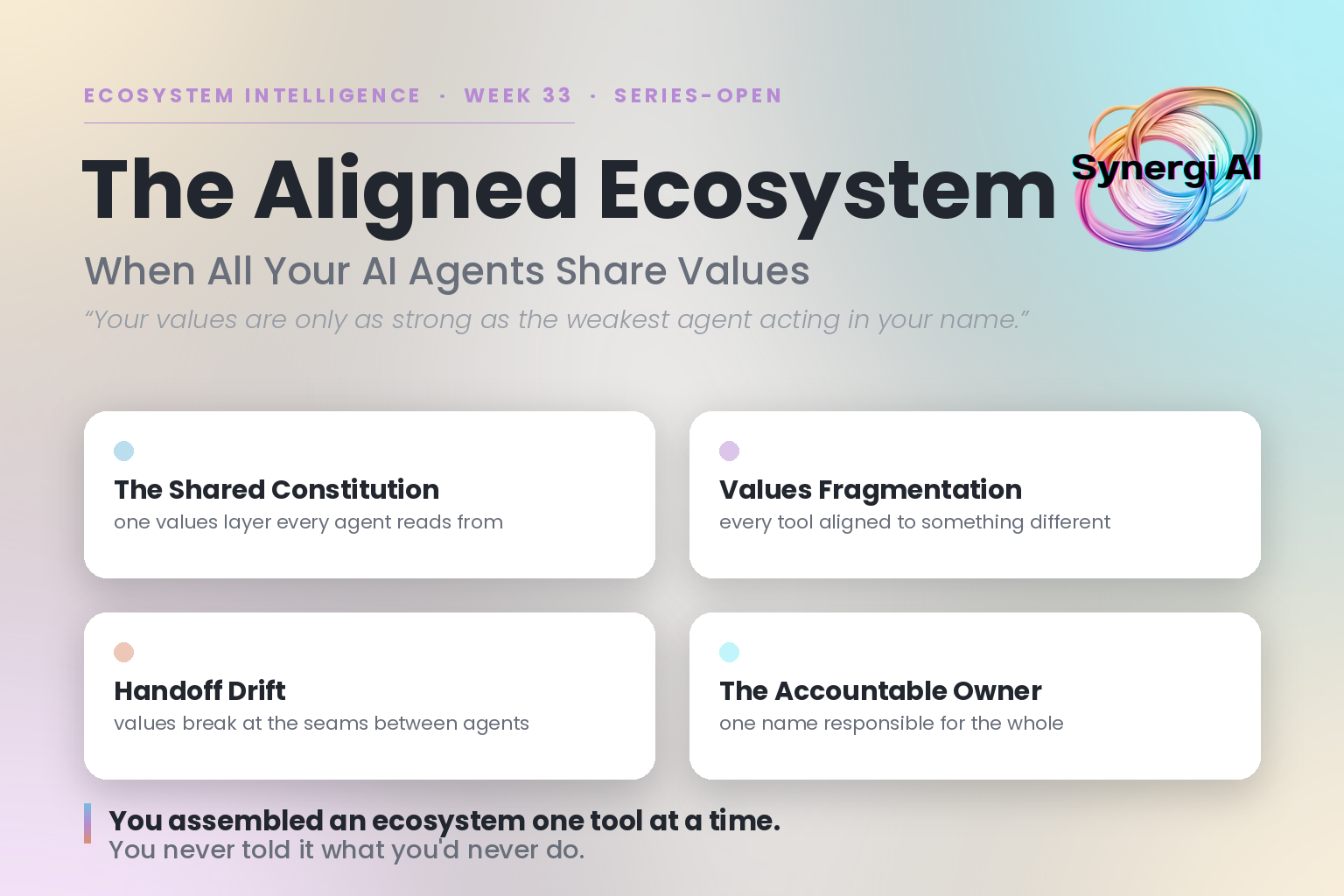
Values Fragmentation: The Default State
Here's what a company actually owns when nobody has designed the whole.
Every AI tool ships with values already installed. Not stated ones — implied ones, baked into defaults by a vendor who was optimizing for a market, not for you. An applicant tracker's default is throughput. A support-triage tool's default is deflection. A sales copilot's default is conversion. A bookkeeping categorizer's default is tidiness. None of those are wrong, exactly. They just aren't yours, and no one ever asked whether they should be.
Then each tool gets configured by whoever owns that function. Operations sets the ATS. Marketing sets the content engine. Finance sets the categorizer. Each of them configures thoughtfully, within their own domain, according to what they understand the company to care about. Each of them is right about their piece.
This is Values Fragmentation: a company where every AI tool is aligned to something, and no two tools are aligned to the same thing. It is not a failure state. It is the default state — the condition every organization arrives at automatically unless someone actively prevents it. And it is nearly invisible, because every individual audit comes back clean. That's the trap in the staffing story. She checked twice. Both times she was checking components.
An ecosystem cannot be audited one tool at a time, for the same reason a conversation cannot be understood one word at a time.
The Shared Constitution
The fix is not more careful configuration. It's a change in where the values live.
Right now, in most companies, values live in eight or ten places at once — as settings, prompts, filters, and thresholds scattered across systems that were never designed to agree with each other. Change your mind about something and you'd have to remember all eight. Nobody does. So the stack slowly ratchets toward whatever the loudest recent configuration happened to say.
A Shared Constitution is a single written document of what your organization will and will not do, that every AI agent is configured against — not one of many inputs, but the one they all read from.
It doesn't need to be long. The best one I've seen at a fifty-person company ran to a page and a half. What it needs is to be singular — one artifact, one owner, one place where a change gets made once and propagates everywhere. That is the entire structural difference between a company with values and a company with a values layer.
If you built a Bright Lines document back in the Bright Lines and Guardrails arc, you already have the raw material. What that arc gave you was a boundary. What this arc asks you to do is make it a dependency — something every system in the building is downstream of, rather than a document one department consulted once.
The test is simple and slightly uncomfortable. Pick one non-negotiable. Ask where it is written down in a form a machine can act on. If the answer is "in three places, slightly differently," you have fragmentation. If the answer is "in my head," you have something worse — a value that has never once governed a decision made without you in the room.
Handoff Drift: Where Values Actually Break
Now the part almost nobody instruments.
Values rarely fail inside an agent. They fail between agents — at the seam where one system's output becomes another's input. And the reason is mundane: what passes across that seam is a conclusion, not the reasoning that produced it.
The screening agent in the staffing story didn't discard the candidate's referral, her eleven years, or the age of her conviction. It resolved all of that into one word — ineligible — because a single token is what the next system was built to consume. The outreach agent received a word. It could not have known there was a human-review rule attached to the circumstances behind it, because the circumstances didn't survive the handoff.
Handoff Drift is the loss of values-relevant context at the boundary between two AI systems, where a rich judgment is compressed into a flat result that the next system treats as settled fact. Every additional agent in a chain is another opportunity for it. The compounding is quiet, because at each step the receiving system is behaving impeccably — it is trusting its input, exactly as designed.
This is why "we reviewed all our AI tools" produces false confidence. Reviewing tools examines the places where the values mostly hold. The failures live in the connective tissue, which belongs to no vendor, appears in no audit, and has no owner.
There's a practical rule that falls out of this, and it's the most portable thing in this article: at any handoff that can end a relationship — a rejection, a cancellation, a denial, a closure — the agent must pass forward the reason, not just the result. Not for the machine's benefit. For the human who might need to catch it.
The Accountable Owner
Ecosystems fail on ownership before they fail on technology.
In most SMBs, every AI tool has an owner and the ecosystem has none. Operations owns the ATS. Marketing owns the content engine. Support owns the triage bot. Ask who owns the way these systems behave together and the honest answer is the founder, in the sense that she'll be the one apologizing.
The Accountable Owner is a single named person responsible for the behavior of the ecosystem as a whole — not for any individual tool, but for whether the tools, in combination, still act like the company. In a company of twenty this is the founder, formally and deliberately, with time on the calendar for it. In a company of two hundred it is someone with standing to say no to a department that wants to bolt on a system that doesn't read from the Constitution.
This is the smallest structural change in this article and the one most likely to actually get made. It requires no software, no budget, and no vendor conversation. It requires a name.
The Ecosystem Intelligence arc will spend a later week on what that person actually does — the governance layer, and the uncomfortable question of who watches them. For now the requirement is only that the role exists, because an ecosystem with no accountable owner doesn't drift slowly. It drifts at the speed of whatever gets installed next.
Where to Start This Week
Four moves, in order, none of which requires new software.
Inventory what's actually running. Not the AI tools you bought — every system in the building with a model inside it, including the features that arrived in an update. Most leaders find between two and three times what they expected. The list itself is usually the most sobering artifact of the exercise.
Write the Constitution short. One page. What you will never do, what always requires a human, and who decides when it's ambiguous. Do not attempt comprehensiveness; a short document that governs beats a thorough one that gets filed.
Map the handoffs, not the tools. Draw the arrows. Where does one system's output become another's input? Mark every arrow that can terminate a relationship with a customer, a candidate, or an employee. Those are your exposure points, and there are fewer of them than you fear — usually three to five.
Name the owner. One person. On the org chart. With the standing to reject an addition to the ecosystem.
The staffing firm did all four in about six weeks. The concrete output was unglamorous: their screening agent now passes forward the reason alongside the result, and any decline touching one of four defined circumstances routes to a person before it sends. It costs them roughly forty minutes a week.
A Second Data Point
One story is an anecdote. So consider a second, from an industry with nothing in common with the first.
A fifty-person specialty food manufacturer runs three AI systems that would appear, on any inventory, to be unrelated: a quality-inspection model on the line, a supplier-scoring tool in procurement, and a customer-communications assistant in account management.
Last spring the inspection model flagged a production lot for review — not a failure, a flag, which under their own policy means the customer hears about it before the shipment moves. That policy exists because the founder believes, with some heat, that customers find out from you or they find out from a lawyer.
The communications assistant, drafting the week's routine shipment confirmations from the fulfillment record, sent a clean note. The fulfillment record had no field for "flagged." The lot moved. Nobody lied, nobody erred, and no system malfunctioned. The company simply did, in the aggregate, the exact opposite of the thing its founder cared most about.
Two industries. Two sets of correctly configured tools. The same failure: values held at every node and evaporated at every seam.
What This Arc Is For
The Integrity Metrics arc taught you to see your integrity. The Bright Lines and Guardrails arc taught you to defend it. The Personal Alignment arc taught you to align yourself first. The Strategic Integrity arc taught you what it's worth once the market can see it.
Every one of those assumed you were somewhere near the decision.
This arc is about the decisions made without you — at 2:14 in the morning, by a system talking to another system, about a person whose name you will never learn. That is not a hypothetical future. In the staffing firm it took nine minutes, and it was already the present.
Over the coming weeks the arc gets specific: how values actually propagate through a multi-agent system, who governs the governors, and how to build a single agent that carries your values on purpose rather than by accident.
But it starts here, with the reframe underneath all of it. You did not buy an ecosystem. You assembled one, one reasonable decision at a time, and you never wrote down what it was supposed to believe.
Your values are only as strong as the weakest agent acting in your name.
Make today your masterpiece. And make sure your values are the same in every room you're not standing in.