The owner of a seventy-person landscaping company called me the week her crews parked the mowers. The snow contracts hadn't started. The shop was quiet, and she had cleared the long table in the break room.
On it she had laid out everything she'd built since spring. A charter for the estimating assistant that drafts her quotes. A laminated card with her promise on it. A Close Call Log with fourteen entries. A Scorecard, four pages deep. A list of bright lines. A stack of notes from a team session. A sheet of Friday checks. A customer-callback count she had kept every month since May.
Eleven pieces, give or take. All of it good work. She had done every bit of it.
"I'm proud of this," she said. "I also can't tell you whether it's a system or a pile."
I looked at the table for a while. Then I said the honest thing.
"Neither can I. Not yet. But there's a way to find out."
A pile has parts. A system has connections.
The Pile Problem
Look back over the year with me. This series has handed you a great many things.
A way to see drift before it becomes damage. A log for the crises that never happened. Lines your AI may never cross, and a person who can stop it. A charter for each system. Three lines at your quarterly review, four wires on Fridays, a tally of what you prevented, a one-page Scorecard. A rhythm to keep time with all of it. A promise sentence your team wrote in its own words. A weekly rep to train judgment. An annual audit to prove it was real.
That is a lot of instruments. And I built each one for a reason. Here is the trouble.
Each one was built to solve the problem in front of us that week. We added them in the order of the pain, not the order of the design. That is how every useful toolkit grows, in shops and in software alike. The tools arrive one at a time, each one earning its place.
And then one day you have a table full of good things and no way to say how they work together.
I call that state a pile. A pile is not a failure. It is the natural shape of anything built by solving one problem at a time. But a pile has a cost, and it shows up late. When something goes wrong, nobody knows which piece should have caught it. When something changes, nobody knows which other pieces change with it. And when you are busy, which is always, you keep the pieces that are easy and drop the pieces that matter, because from the outside they all look alike.
The cure is not more tools. It is seeing what you already own as one thing.
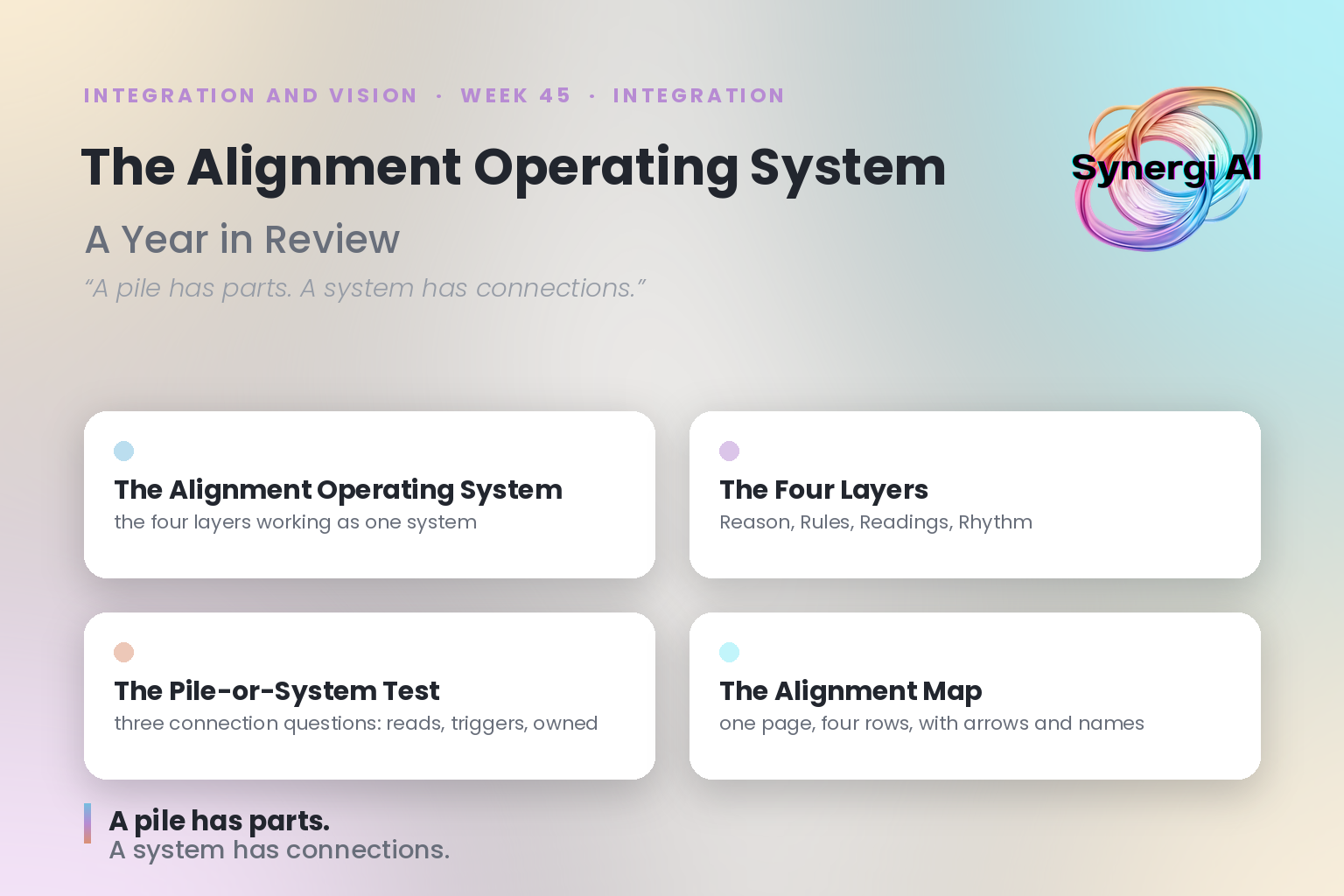
I call that one thing your Alignment Operating System.
What an Operating System Does
You do not need to be technical to follow the idea. Your phone has an operating system. You never think about it. It is the quiet layer that decides which app gets the screen, which one gets the battery, and what happens when two of them want the same thing. The apps are the visible work. The operating system is what makes the apps behave like parts of one phone.
An Alignment Operating System does the same job for your values. It is the quiet arrangement that decides what your AI is for, what it may never do, how you know how it's doing, and what happens on a Tuesday when nobody is thinking about any of this.
It is not software. For most of the companies I work with, it fits on one page of paper.
It has four layers. I have been walking you through them all year without giving them a single name. Here they are.
The Four Layers
Layer One: The Reason
Everything starts with why. Why does your company use AI at all, and what is it supposed to serve?
The first arcs of this series lived here. We began with what it means to be human and with the judgment gap: the things a machine can draft but cannot decide. We wrote a manifesto. And we asked what it looks like to return technology to its proper place.
The output of this layer is a conviction. You can say it in a sentence: AI is here to serve our people and our customers, and never the other way around. Every layer above it borrows its authority from this one.
Layer Two: The Rules
A reason is not enough. It has to become commitments someone can check.
This is where the year got concrete. We named the drift that starts when nobody owns the alignment layer. We drew Bright Lines that cannot bend, and gave a person the Veto Power to hold them. We wrote a charter for each AI system, with a named owner. And a few weeks ago your team wrote its own promise sentence.
The output of this layer is a short list of things your company has said out loud. Few words. Real names beside them.
Layer Three: The Readings
Rules drift unless something reads them against reality. This layer is the instruments.
The Close Call Log records the crises that didn't happen. The three lines tell you whether a system is paying its way in profit, people, and purpose. The four wires warn you early. The Counterfactual Tally credits what never happened. And the Integrity Scorecard holds all of it on one page.
The output of this layer is a reading. Not an opinion. A number, a mark, a line in a log.
Layer Four: The Rhythm
Readings that nobody takes are just paper. The last layer is how often, and by whom.
The Alignment Rhythm puts a look on every morning, wires on every Friday, and a read-aloud every quarter. The Judgment Rep trains your people to use the promise when you aren't in the room. And the Annual Integrity Audit checks whether any of it is real.
The output of this layer is a habit. It is the layer that keeps the other three alive on your worst week.
So there are four layers: Reason, Rules, Readings, and Rhythm. The Reason tells you what matters. The Rules say what you have promised. The Readings show what is happening. The Rhythm makes sure you keep looking.
Four layers is not a complicated idea. But look at what the landscaping owner saw when she put her table next to it.
The Pile-or-System Test
I took a marker to the break-room whiteboard and drew four rows, one for each layer. I asked her to put each of her eleven pieces on the row where it belonged. That took ten minutes and settled a few arguments with herself.
Then I asked the question that turns a pile into a system. For every piece, answer three things.
- What does it read? Which piece, in another layer, feeds it?
- What does it trigger? When it says something, what changes, and where?
- Who owns it? One name. Not "the team."
I call these the Three Connection Questions, and together they are the Pile-or-System Test. A piece that can answer all three is part of your system. A piece that cannot answer one of them is decoration.
The owner drew arrows as she answered. A Close Call Log entry reads the charter and, when it matters, adds a line to it. The Scorecard reads the log and the wires, and it triggers the quarterly verdict: this system stays, changes, or goes. The quarterly read-aloud rereads the promise. The Judgment Rep reads the promise and writes new lines into the charters. The audit reads everything and picks three fixes.
Most of the board filled in quickly. That was the good news. Then she hit three pieces with no arrows at all.
- The callback count. She had logged how many customers phoned back after an estimate, every month since May. The number went onto a page. Nothing read it. Nothing changed because of it.
- A bright line with no owner after five o'clock. The line said the estimating assistant never quotes a price it cannot explain. Her office manager could stop a quote at noon. But quotes went out at six, and nobody on the evening shift knew they were allowed to stop one.
- The Friday checks. She did them faithfully. Her crew leads had no idea they existed, so the one conversation they were meant to feed never happened.
Three pieces, three different breaks. One read nothing, one had no one to trigger it, one fed no one. None of them was broken in the way a tool breaks. Each was simply disconnected, and a disconnected piece looks exactly like a working one until the day you need it.
That, I think, is the whole lesson of the year. Alignment rarely fails because a tool is bad. It fails at the joints.
Three Ways a Piece Comes Loose
Since that afternoon I have seen the same three breaks in nearly every company that tries this test. Learn their names and you will spot them quickly.
The Orphan Reading. An instrument that measures something nobody acts on. The callback count was one. Orphan readings are the most common break, and the most flattering, because they make you feel measured. If a number can move and nothing changes when it does, it is an orphan.
The Ownerless Rule. A commitment with no person who can enforce it at the moment it matters. A bright line with no one to hold it after five o'clock is a wish. Check the hours, the shifts, the weekends, the vacations. A rule is only as strong as its least-covered hour.
The Silent Beat. A habit that happens but reaches no one. The Friday checks were a silent beat. Someone was doing the work, and the people the work was for never heard from it.
You can run this inspection on your own table in an afternoon. Take each piece. Ask the three questions. If the answer to reads is nothing, you have an orphan. If the answer to owns is blank or a team, you have an ownerless rule. If the answer to triggers is nobody, you have a silent beat.
Then do the thing that surprises people. Don't rush to add anything.
Fewer Pieces, More Connected
When we finished the board, the owner looked at the three loose pieces and asked, "So I need three more tools to fix these?"
No. She needed three decisions.
For the callback count, she made a choice. She wired it into the Scorecard as a reading under the people line, so it would be read every quarter beside the other numbers. If a rising count of callbacks meant her estimates were confusing customers, she wanted to know by August, not by Christmas.
For the bright line, she named an evening owner. A crew-lead rotation, two names, a phone number on the laminated card. Now a quote could be stopped at six as easily as at noon.
For the Friday checks, she did the simplest thing. She read the results aloud at the Monday crew meeting, in under a minute. A silent beat found its audience.
She added no new instrument. By the end of the afternoon she had actually retired one, a monthly summary no one read, because it duplicated the Scorecard. She went from eleven pieces to ten. And every one of the ten could answer the three questions.
"It looks like less," she said, standing back from the board.
"It is less," I said. "It's also worth more."
Build Your Alignment Map This Week
You do not need a break room or a whiteboard. You need forty-five minutes and one sheet of paper.
- Draw four rows. Label them Reason, Rules, Readings, Rhythm.
- Write down everything you have built. Every charter, line, log, card, check, and meeting. Put each on the row where it belongs.
- Ask the three questions of each piece. What does it read? What does it trigger? Who owns it? Write the answers next to it, with names.
- Draw the arrows. From each reading to the rule it checks. From each rule to the person who holds it. From each beat to the people who hear it.
- Circle the loose ones. Any piece with a missing arrow is an orphan, an ownerless rule, or a silent beat.
- Make one decision per circle. Wire it, assign it, or retire it. Do not add a new tool until every circle is resolved.
Save the page. I call it your Alignment Map, and it is the most useful single sheet in the whole system. Hand it to your newest hire on their first day. They will learn more about how your company keeps its promises from that page than from any policy.
If you are just getting started and the table is nearly empty, build the smallest version of each layer. One sentence of reason. One promise, one bright line, and one charter. One Scorecard page. One two-minute look every morning. That is a working system you can hold in one hand, and it will serve you better than a large one you cannot keep.
What the Year Taught Me
I opened this series with a question about what it means to be human. I thought, at the time, that the hard part of aligning AI to your values would be knowing what those values are.
It isn't. Most of you already know. The hard part is keeping the connection alive between what you believe and what your systems do on an ordinary Tuesday, when you are tired and the phone is ringing and the quote is due at six.
That is what an operating system is for. It does not make you better. It makes your good intentions run without you standing over them. It carries your values across the hours you can't cover and into the rooms you aren't in.
I learned something similar as a young plumber's apprentice. A house doesn't stay dry because of any single pipe or fitting. It stays dry because the whole system is connected, someone knows where every joint is, and somebody checks the ones that matter on a schedule. The skill isn't in the parts. It's in the joints.
Your technology will change. The tools I named this year will be replaced by better ones, and some by the time you finish reading. The four layers will not. They describe something older than any software: a reason, a set of promises, honest readings of how you're doing, and the habit of looking.
Companies that have all four are not safer because they are cautious. They are stronger because they are connected. When they are tested, which every company is, the pieces answer one another instead of the owner answering for all of them.
Earlier in This Series
- The Annual Integrity Audit: the yearly check that the whole map is real.
- Training Your Team for Judgment, Not Just Compliance: the weekly rep behind the Rhythm layer.
- The Values Clarification Session: where the promise sentence comes from.
- The Rhythm of Alignment: the three beats.
- Building Your Integrity Scorecard: the page that holds the readings.
Where This Leads
The Sustainable Practice arc closed with a way to prove your practice is real. This arc, Integration and Vision, asks what all of it adds up to.
This week you saw the year as one system. Next week we look at one company's system from the inside, so you can see how the layers connect in a business that is not your own.
For now, draw four rows on a sheet of paper. Put everything you've built on them. Find the pieces with no arrows.
Make today your masterpiece. And run your promise as one system.