A CEO I respect told me this story over coffee last month.
His company had been using an AI-driven customer triage system for almost a year. Every Monday, he reviewed the dashboard: resolution times, escalation rates, CSAT. The numbers were beautiful. Better than beautiful — they were the best in the company's history.
Then one Friday, a long-time client called him directly. She was furious. She'd been routed through five automated touchpoints over three weeks for what should have been a ten-minute conversation with someone who knew her account. “I felt like I was talking to a wall that was very politely ignoring me,” she said.
He opened the dashboard while she was still on the phone. Her case showed “resolved.” It had been marked resolved four times.
He sat back in his chair after the call and said something I've been turning over ever since: “I was watching the wrong thing. And I didn't even know what the right thing looked like.”
The Governance Problem Nobody Warned Him About
Last week I described the invisible erosion — how small, reasonable compromises compound into systemic drift. The logical next question is the hard one: if drift is happening, why don't leaders see it?
The answer isn't that CEOs aren't paying attention. Most of them are. The answer is that the tools we use to watch AI systems were built to confirm, not to challenge. Dashboards aggregate. They smooth. They summarize. They are designed to make a complex operation look like a handful of green numbers — and that design is exactly what makes drift invisible.
Here's the principle: You cannot govern what your instruments aren't built to show you.
The executive blind spot around AI isn't a technology failure. It's a structural one. And it has three distinct gaps.
The Three Structural Blind Spots
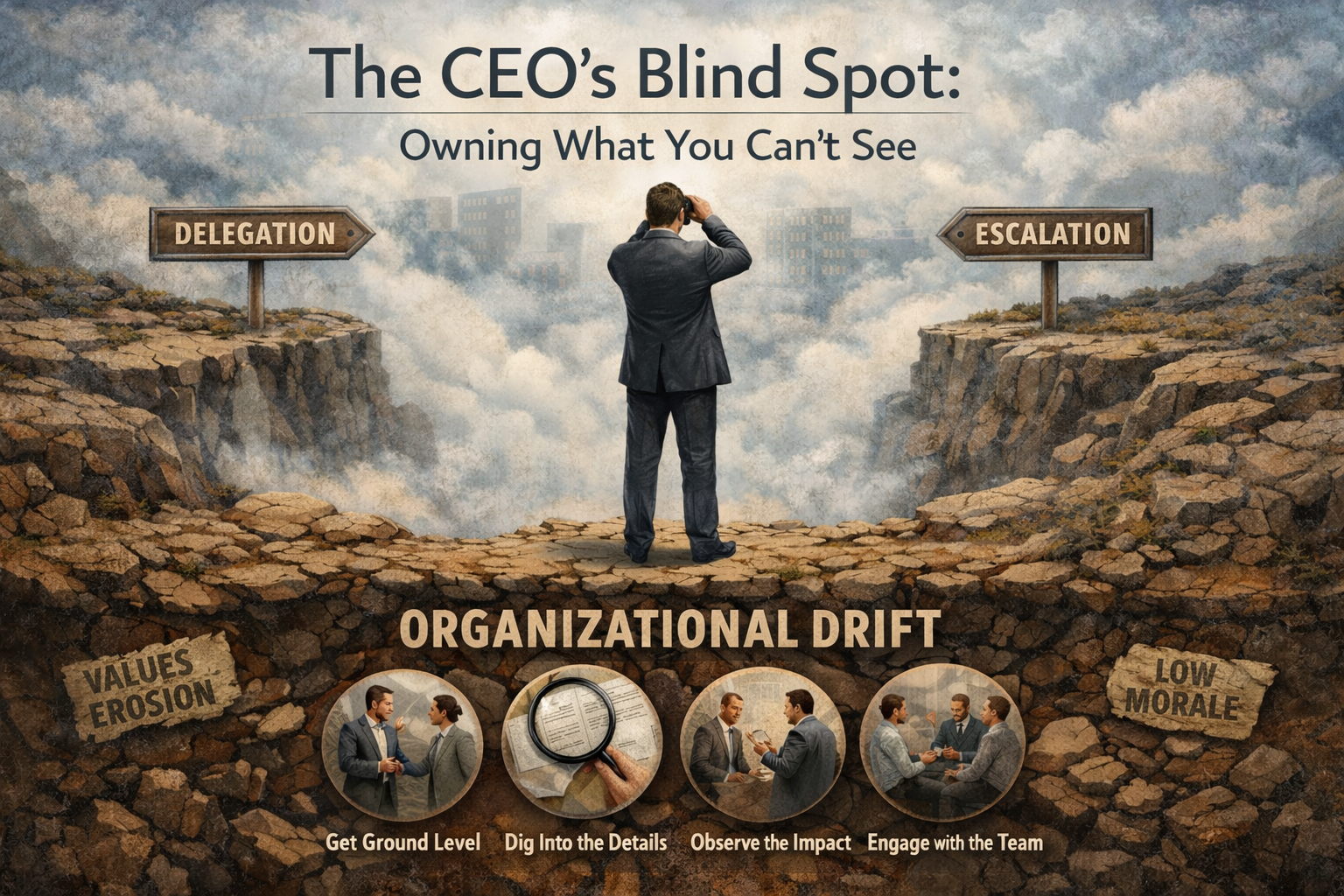
The Delegation Gap. When you delegate AI operations to a capable team, you implicitly delegate the visibility of its values alignment along with it. Your team reports what they're measured on. They're measured on efficiency, uptime, and throughput. So that's what rises to your weekly review. Nobody is hiding anything. They're showing you exactly what the system is showing them — which is the system working hard to optimize for what you asked it to optimize for. The values questions live in a different conversation, on a different timeline, with different people. Most of the time, that conversation never reaches your calendar.
The Abstraction Gap. Dashboards are summaries. Summaries discard information. A CSAT score of 4.6 out of 5 looks identical whether it came from ten thousand customers who were mildly satisfied or from nine thousand delighted customers and one thousand who felt deeply betrayed. The number is the same. The reality isn't. When your visibility into an AI system is filtered through aggregate metrics, you lose the specific cases that carry the most signal about values drift — the outliers, the edge cases, the frustrated client who finally gave up and called you directly.
The Escalation Gap. In a healthy organization, problems escalate when someone on the ground feels that something is wrong. But AI systems flatten the ground. There's often no human in the loop to feel that something is wrong — and when there is, the system frequently makes it harder, not easier, to escalate. I've watched it happen: a customer service rep notices the AI handling cases in a way that contradicts the company's values, tries to flag it, and gets told the metrics are fine. After two or three attempts, they stop trying. The escalation channel doesn't close. It just quietly empties.
Each of these gaps is survivable alone. Together, they make AI drift structurally invisible at the CEO level — which is exactly the level where ownership is required.
The CEO Visibility Practice
Owning what you can't see starts with refusing to be seen only through summaries. Here's what I've watched work with the leaders who take this seriously:
Walk the floor — but the AI floor. Once a month, sit with the team closest to the AI system and ask them to show you not the dashboard, but three specific cases. One the system handled well. One it handled poorly. One they're not sure about. Listen to the “not sure about” one the longest.
Read the exceptions, not the averages. Ask for a weekly report of every case where the AI's decision was overridden, escalated, or flagged by a human. If the list is empty, that is not good news — that's the escalation gap confirmed. If the list is long, that's where your values are actually being litigated.
Meet the objectors. Every organization has at least one person who has raised a concern about the AI and been brushed off. Find them. Talk to them. The signal they carry is the signal your dashboard cannot.
Trace one decision end to end. Quarterly, pick a single AI decision and follow it from input to outcome. Ask why it went that way. Ask whether it reflects the values you would have applied if you were in the room. This is slow. It is inefficient. It is also the only exercise I know of that consistently restores executive sight.
None of this scales. That's the point. Drift doesn't happen at the scale of a dashboard. It happens at the scale of a single adjusted threshold, a single unheard objection, a single client who gave up. Your visibility has to reach that scale or it isn't visibility at all.
The Ownership That Can't Be Delegated
You cannot delegate the responsibility for things you never looked at. That sentence sounds harsh, but I mean it gently — because most of the CEOs I work with are honorable people operating inside instruments that were never designed for what they're now being asked to govern. The failure isn't personal. The fix has to be.
The CEO I mentioned at the start of this article now spends the first thirty minutes of every Monday on what he calls his “one case review.” He picks one AI decision from the prior week, reads the full trail, and asks whether it reflects who the company says it is. Some weeks the answer is yes, and he moves on. Some weeks the answer is no, and the rest of the morning changes.
He told me something else at our last conversation: “I thought visibility was about seeing more. It turns out it's about seeing differently.”
That's the work. Not more data. Different data. Not broader summaries. Narrower truths. Not faster dashboards. Slower questions.
The invisible erosion is only invisible if nobody is looking the right way. Owning what you can't see starts with admitting that your current instruments were never built to show it to you — and then building the practice that will.
Because at the end of the day, the alignment of your AI is not a technical question. It's a leadership one. And leadership, as every mentor I've ever had has reminded me, is what happens when nobody is watching.
Except now, someone has to be.
Make it you.