A few months ago I sat across from the principal of a small engineering firm — thirty-two people, fourteen years in business, the kind of shop that does very good work in a niche too narrow for the giants to bother with.
He had been following the May series. He asked me a question I have not stopped thinking about.
"My team makes good calls every week. The bad outcome doesn't happen. And I have no way to prove the discipline that made it not happen."
He told me about the week he had just finished. A young engineer had flagged a concern in a draft report a senior reviewer almost signed. A project manager had walked back a delivery commitment that would have required cutting a corner the firm doesn't cut. A salesperson had turned down a customer whose timeline assumed an accuracy the work doesn't actually support.
Three close calls in one week. None of them in any log. None of them in any review. None in any onboarding document for the next engineer they hire.
When his senior reviewer retires, he told me, fourteen years of those calls retire with her.
Over the last two weeks we built two instruments. The Integrity Yield — the lagging measurement of what your values pay you back over years. Trust Velocity — the leading measurement of which way the slope of your reputation is moving right now.
This week's instrument captures the one thing the other two cannot.
The crisis that didn't happen.
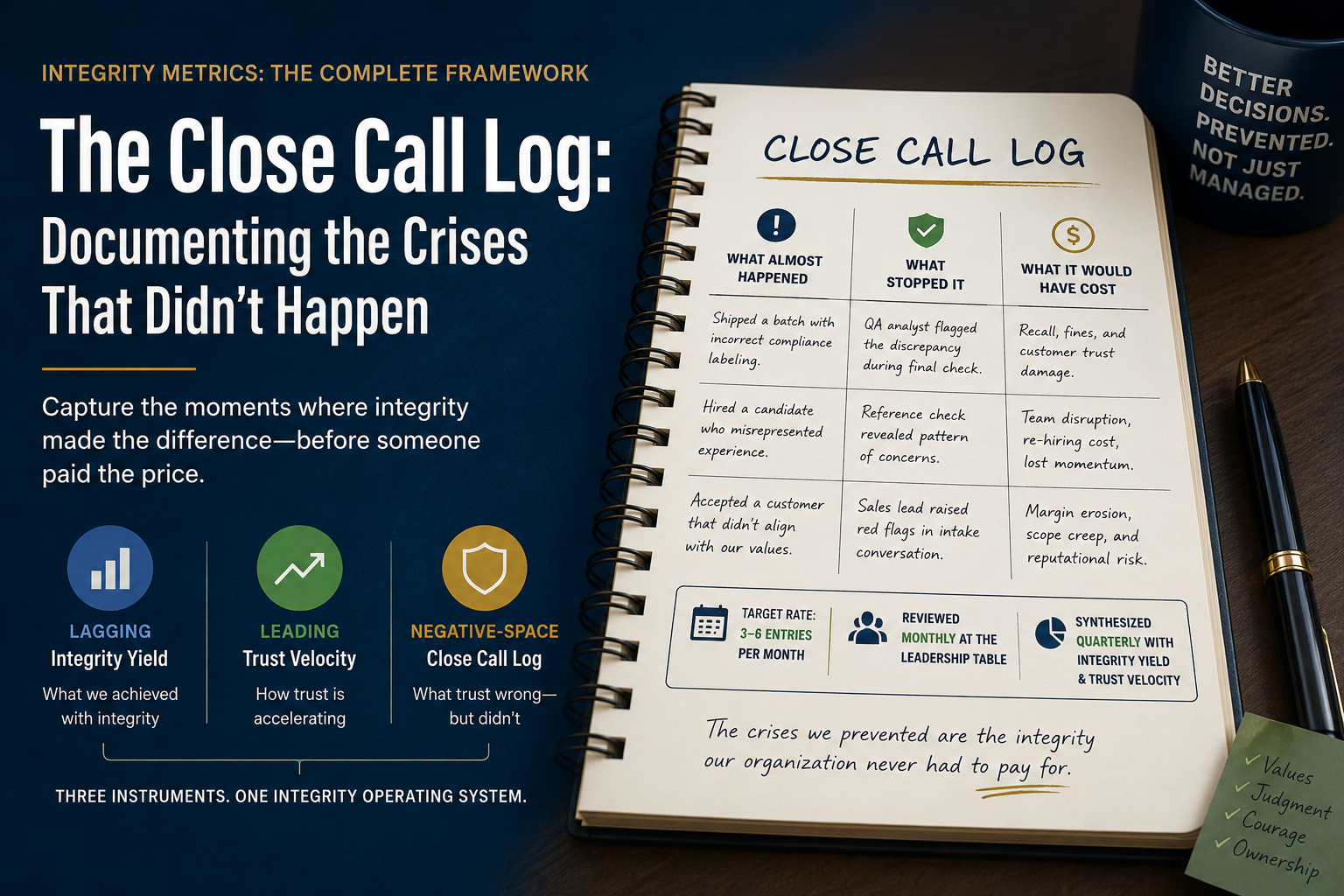
I call it the Close Call Log.
The Negative-Space Problem
Every leadership dashboard measures the things that happened. Revenue. Margin. Deliveries. Wins. Losses. Escalations.
Those are the visible surface of the operation. They show up in the system because they happened in the system.
But the most valuable moments in a values-aligned business are usually the ones where something didn't happen. The bad shipment that never went out. The wrong hire that never started. The customer who was politely declined. The AI recommendation that a human quietly overrode before it ever reached a customer.
These moments cost nothing — and earn everything. They are the proof that the integrity infrastructure is operating. They are the place where the values stopped being a poster and became a decision.
And almost without exception, they vanish without trace.
The Close Call Log is the instrument that catches them while they are still warm.
What a Close Call Log Captures
A close call is any moment in which a values-aligned intervention prevented an outcome the operation would have regretted.
Three fields. That is the whole instrument.
1. What almost happened. One or two sentences. Specific enough that a stranger reading it next quarter would understand the stakes. Almost shipped the revised assembly without re-running the load case. Almost approved the customer whose timeline assumed clean inputs we hadn't validated. Almost let the AI-drafted response go out before someone read the second paragraph.
2. What stopped it. A person, a value, a guardrail, a checklist, a pause — whatever was actually load-bearing in the moment. Name it. The senior reviewer caught it on second pass. Our standing rule that no quote goes out without a sign-off from the engineer of record. The junior engineer didn't sign the page because she didn't feel sure.
3. What it would have cost. Directional. Imprecise. Honest. About forty thousand dollars in rework and four weeks of capacity. The project, the reference, and probably the vertical. Two months of apologies to a customer we couldn't afford to lose.
Three fields. Three to six entries a month for most SMBs. Twenty minutes of leadership time per week.
How to Build the Log
You do not need a system. You need a discipline.
Step one. Pick the capture surface. A shared document, a channel in your messaging tool, a card in your project tracker — wherever the team already is. The cost of the instrument is the friction of capture. Keep the friction near zero.
Step two. Name the trigger. Anyone on the team can log a close call. They do not need permission. They do not need to ask whether it qualifies. If the question did we almost get this wrong crossed someone's mind, that is the trigger.
Step three. Review monthly. Fifteen minutes at the leadership table. Read each entry out loud. Name the value, the person, or the guardrail that did the work. Decide whether anything in the operation should change.
Step four. Synthesize quarterly. At the same review where you read the Integrity Yield and the Trust Velocity, read the count, the categories, and the cost avoided from the quarter's close calls. The three instruments together tell you what your values returned, what they are doing right now, and what they quietly prevented.
What the Log Changes
The engineering principal kept his log for two quarters before he showed it to his team.
By then it had thirty-seven entries. Reading them in sequence took twenty minutes. He told me his senior reviewer cried in the third row of the conference room because she had not realized, until she heard the log read out loud, that the firm she had spent fourteen years protecting was actually building something worth protecting.
The next quarter, the log became part of new-engineer onboarding. The quarter after that, the cost-avoided estimate became a line item in the board package — directional, imprecise, honest — sitting next to the Yield and the Velocity. The board stopped asking why the firm walked away from certain customers.
That is what a Close Call Log does.
It does not give you a forecast. It gives you the receipt for the discipline that quietly stopped the worst version of your year from happening.
The Three Instruments, Together
For five weeks we have been building the same thing.
The Integrity Yield — what values pay back over years. The Trust Velocity — which way the slope is moving right now. The Close Call Log — the crises that didn't happen because integrity was operating.
Lagging, leading, negative-space. Annual, quarterly, monthly. Return, slope, prevention.
Most small businesses run none of them. The few that run all three become almost impossible to dislodge from their markets — not because their offerings are unbeatable, but because their measurement infrastructure has finally caught up with the way values-aligned companies actually compete.
Next month we move from instruments to architecture. June opens Bright Lines and Guardrails — the ethical boundaries that turn the close call from a story into a system.
A small business that logs its close calls is a small business that finally has a record of why it is still here.
Trust compounds quietly. It erodes the same way. And every once in a while, it gets defended in a moment no one would have noticed.
Write those moments down.
Make today your masterpiece. And start logging what almost happened.