The office manager of a fourteen-provider family clinic called it "a Tuesday." That was the whole story, as far as she was concerned, until I asked her to walk me through it slower.
Their AI intake assistant drafts the after-visit summary — medications, dosages, follow-up instructions — from the day's chart notes, for a physician to approve before it reaches the patient portal. That Tuesday, a physician adjusted a blood-thinner dosage out loud, mid-visit, then moved to the next patient before charting the change. The assistant drafted the summary from the chart exactly as it stood: the old dosage. Correct, by every record it could see. Wrong, by five minutes.
The front-desk lead — the clinic's named reviewer for that system — read the draft anyway, the way she reads every summary before it goes out. Something didn't match what she remembered hearing through the exam-room door. She held it. The physician confirmed the change. The summary went out corrected, four minutes late.
Nothing happened. No patient was harmed. No report anywhere in that clinic names what didn't happen that Tuesday.
The Measure You Don't Have
Two weeks ago I gave you three lines to keep on every AI system — profit, people, purpose. Last week, four tripwires that let you hear one of those lines start to move before the quarter confirms it: the Silence Signal, the Zero Override, the Vocabulary Drift, the Unearned Improvement.
Every one of those instruments, tripwires included, shares a limitation. They report on what happened. A tripped wire is a signal that something is already moving. It still leaves you holding a thing that occurred.
The front-desk lead's Tuesday catch is a different animal. Nothing moved. Nothing occurred. The wrong dosage never reached the portal, so there is no drifting line to name and no ledger entry to write. The clinic's next Three-Line Review will show nothing unusual, because a catch that works leaves no trace on any report built to count events.
That is the hardest measurement problem in this series: how do you keep score of a thing that never happened?
The hardest thing to measure in your business is the thing that never happened.
Foundation #5 argued back in the spring that the cost of drift lives in absence. This is the other half of that claim. The value of integrity lives in absence too — in the crisis that never reached the client, the relationship that didn't end on a Tuesday because someone asked one more question. None of it shows up as revenue. All of it protected revenue that would otherwise have walked out the door.
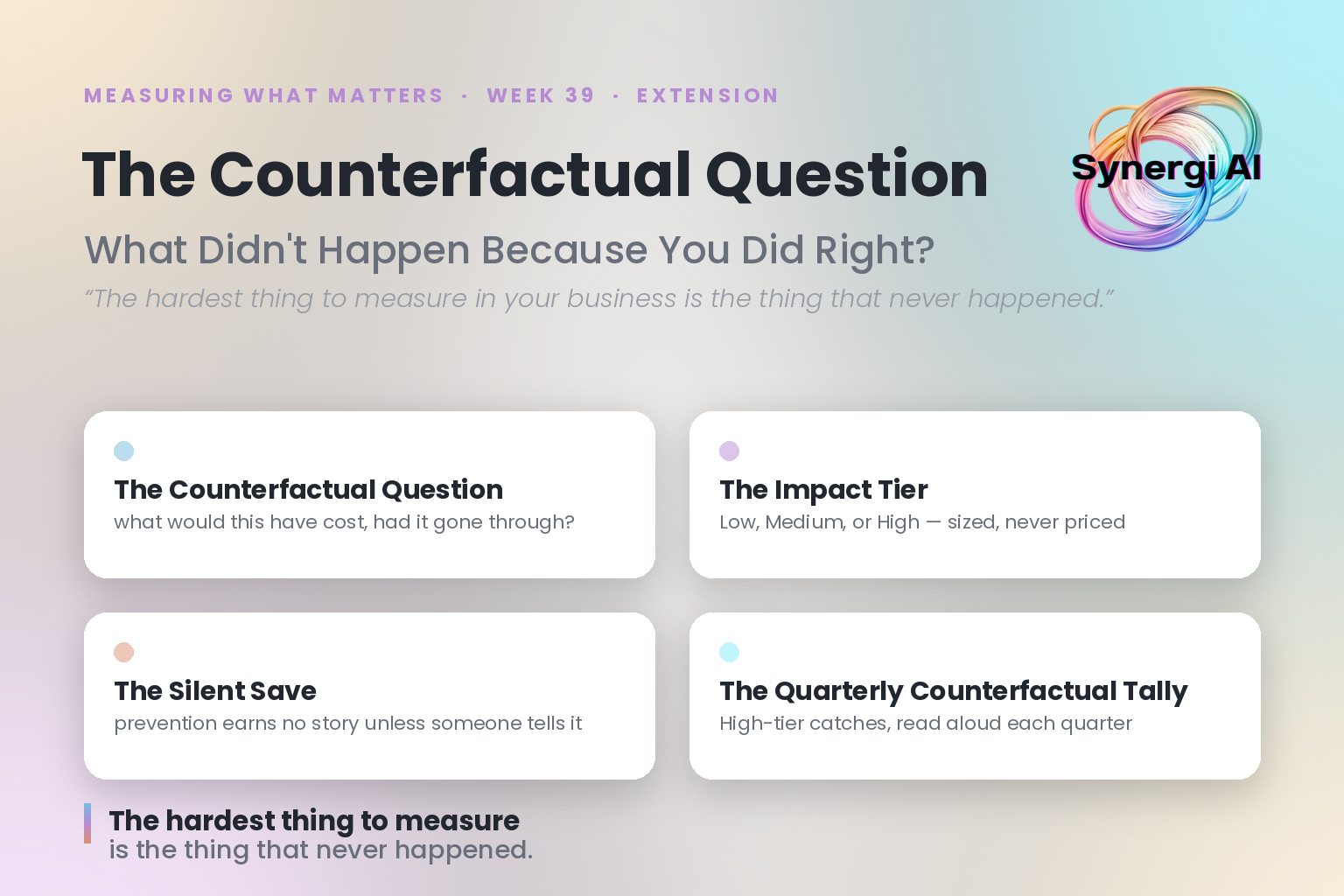
The Counterfactual Question
One question turns an invisible save into something you can actually manage: what would have happened if this had gone through, exactly as it was?
Ask it every time someone catches something — a tripped wire from the Friday check, a correction nobody would have noticed if they hadn't looked twice, an edit made out of habit rather than alarm. Most of the time the honest answer is small. Ask it anyway. The value isn't in any single answer. It's in training your organization to notice that "nothing happened" is an outcome, not a non-event.
When the answer isn't small, size it — don't price it. The Impact Tier sorts a catch into one of three buckets:
- Low — an inconvenience. Fixed in minutes, no relationship at stake.
- Medium — a real cost. Rework, an apology, a day of trust spent earning it back.
- High — irreversible had it gone through. Safety, legal exposure, a relationship that doesn't survive the mistake.
Three tiers, not a dollar figure. The temptation, once you start asking the counterfactual question, is to want a number — what did that catch save us, precisely? Resist it. A confident dollar figure invites a fight about precision instead of a conversation about what almost happened. The front-desk lead's Tuesday catch is a High — not because anyone can price a medication error, but because it was irreversible and touched trust that doesn't come back once spent. That's enough to know.
The Silent Save
Here is the part every leader underestimates. The fire that gets put out earns a story. The fire that never starts earns nothing — no thanks, no mention in the Monday meeting, often not even a memory in the person who prevented it.
The front-desk lead didn't mention her Tuesday catch to me. I found it because I ask. Not because she wanted credit and didn't get it — because it never occurred to her that a non-event was worth reporting.
That is a problem you built without meaning to. Quarterly reviews, weekly check-ins, performance conversations — all of it notices what happened. None of it notices what somebody stopped from happening. So the people best at catching things quietly conclude that catching things is invisible work, and invisible work is the first work anyone drops when they get busy.
A save is not a story if no one tells it. And a catch that gets no credit is a catch that eventually stops happening — exactly how the Silence Signal and the Zero Override begin.
The Quarterly Counterfactual Tally
This doesn't need a new system. It needs one addition to two things you already have.
- Log it where you already log near-misses. Every tripped wire from the Five-Minute Friday, and every other catch anyone mentions, gets one line in the Close Call Log — what almost happened, and the tier.
- Answer the question at the moment of the catch, while the details are sharp. Waiting for the quarterly review asks someone to reconstruct, months later, a thing that by design left no trace.
- At the quarterly Three-Line Review, pull every entry and read the High-tier ones aloud. Five minutes, after the three lines, for the counterfactual tally.
- Say thank you out loud, by name, in the room. The entire fix for the Silent Save, and the only thing that keeps the habit alive.
The tally is not a KPI, and it should never become one. The moment you start managing toward a target number of High-tier catches, you've built an incentive to either manufacture near-misses or quietly undercount them — the same trap last week warned against for the tripwires themselves. The tally exists to be read aloud once a quarter, not tracked on a dashboard.
Common Mistakes
- Pricing it instead of sizing it. A confident dollar figure on a prevented disaster is usually a guess wearing a number's clothes.
- Letting the tally become a scorecard for the software. The AI system didn't make the save. The person who looked twice did. Credit the person.
- Skipping the entry because "nothing happened." That's precisely the kind of entry this log exists to hold.
- Turning the read-aloud into a blame session. A High-tier entry isn't a near-failure to investigate. It's a save to thank someone for.
Back at the Clinic
The clinic added one line to its own Friday check the week after that Tuesday: after the four tripwire questions, a fifth — did anyone catch something that would have gone out wrong? A yes earns one sentence in the Close Call Log, and a tier.
Three weeks in, the log held two Low entries and her Tuesday, tagged High. The office manager read it aloud at the next staff meeting — no names needed, everyone already knew whose catch it was — and thanked her for it. She told me afterward it was the first time in four years anyone had thanked her for something that, as far as the rest of the building was concerned, had never happened at all.
Earlier in This Series
- The Hidden Cost of Misalignment — Foundation #5: the cost of drift lives in absence. This article extends that claim to the value side of the ledger.
- The Close Call Log — the instrument every tripped wire and quiet catch now runs through.
- Building Your First Values-Driven AI Agent — the named owner who runs the Friday check and now asks the fifth question.
- The Triple Bottom Line of AI — the three lines and the quarterly review the counterfactual tally closes out.
- Leading Indicators — last week's four tripwires and the Five-Minute Friday this week extends.
Where This Leads
The Integrity Metrics arc taught you to see your integrity. The Strategic Integrity arc taught you to price it. The Ecosystem Intelligence arc taught you to keep it in rooms you are not standing in. Two weeks ago you built three lines to count. Last week, four tripwires to hear a line moving before the ledger records it.
This week is about the line that never had to move at all — the crisis that doesn't appear on any page you own, because somebody heard it coming and said something.
Next in the series, and the last stop in this arc, we put all three pieces on a single page: the lines, the tripwires, and now the counterfactual tally, built into one Integrity Scorecard you can keep on your desk.
For now: pull your Close Call Log. Ask the question of everything in it. Say thank you out loud for the ones that mattered.
Make today your masterpiece. And count what didn't happen.