Picture a firm that did the work.
They mapped their AI systems. They wrote down their non-negotiables. And after one badly handled client message, they built the rule: any incoming note containing bereavement, medical hardship, or a legal threat stops outbound automation and routes to the account owner within four hours.
The rule worked. It fired eleven times in six weeks.
Every one of those alerts landed in a shared operations inbox that no single person was responsible for reading.
Nothing malfunctioned. The guardrail performed exactly as designed. It simply reported to nobody.
That is the gap this week is about. The Aligned Ecosystem gave the ecosystem a shared constitution. Context Is Everything specified what must travel across a handoff. Both of those produce rules.
Neither one answers the question sitting underneath them.
Who owns the rules? Who watches them? And who is allowed to change them?
Rules Do Not Maintain Themselves
Most leaders think of governance as a decision they make once. Write the policy. Configure the guardrail. Move on.
But a rule is not a monument. It is a living claim about how your company behaves, and it decays in three ordinary ways.
The owner leaves. The operations manager who built the escalation logic takes a new job. Her rules keep running. Her judgment does not. Six months later nobody in the building can explain why the threshold is set where it is, so nobody feels entitled to defend it.
The rule gets tuned. An alert fires too often. Someone reasonable widens the trigger to reduce noise. Someone else mutes the channel during a busy quarter. No one intended to weaken a value. Each adjustment was defensible on its own day.
The ground moves. Your vendor updates a model. A new tool joins the stack. A workflow gets rerouted around a bottleneck. The rule still exists, still passes its own tests, and no longer touches the decision it was written to protect.
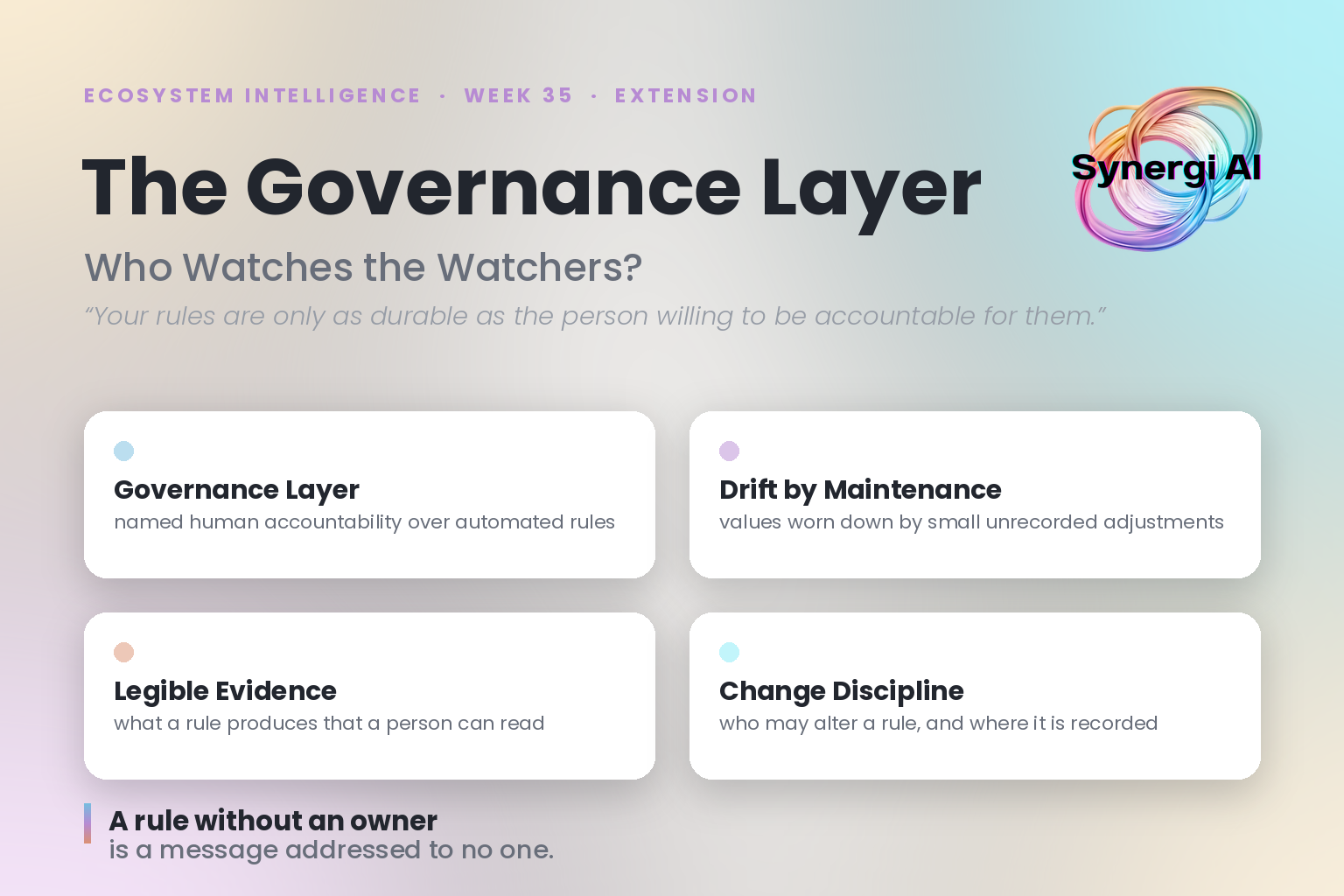
I call this Drift by Maintenance. Values rarely get overridden by a dramatic decision. They get worn down by a sequence of small, reasonable adjustments that nobody recorded and nobody reviewed.
The governance layer is not a document that prevents this. It is a standing answer to one question:
When this rule stops being true, who finds out?
The Governance Ledger
Small and midsize companies cannot build a governance department. You do not have a risk committee, a compliance officer, or an internal audit function. You have a handful of people who are already busy.
So governance has to be small enough to be real. For every consequential rule your AI ecosystem enforces, answer four questions.
1. Whose name is on this rule?
One name. Not a committee, not a department, not "operations."
An owner is a specific person who would be uncomfortable if the rule failed and who has the authority to fix it without asking permission. Shared ownership sounds inclusive and behaves like abandonment. The shared inbox in the opening scenario was owned by four people, which is another way of saying it was owned by none of them.
If you cannot name the owner in five seconds, the rule is unowned.
2. What does this rule produce that a person can actually read?
Call it legible evidence.
A guardrail that only changes a state inside software cannot be governed, because there is nothing for a human to inspect. Oversight requires an artifact: a short weekly count of how often the rule fired, a list of the exceptions it created, the cases it escalated and what happened next.
A log nobody can read is storage, not accountability. The test is simple. Could the owner, in ten minutes, tell you whether the rule did its job last month?
3. When does a human actually look?
Most SMB governance fails on cadence, not on intent. Everyone agrees the rule matters. Nobody scheduled the moment of looking.
Set two things. A rhythm — monthly is enough for most rules. And a trigger for an off-cycle review: the rule fired far more or far less than expected, a client complained, a model or vendor changed, or someone requested an exception.
Silence is the signal people misread most often. A guardrail that has not fired in four months is either protecting you perfectly or has quietly stopped working. Only a person can tell the difference.
4. Who may change it, and where is the change recorded?
A rule that anyone can silence is not a guardrail. It is a preference.
Name who may change the rule, what evidence justifies a change, and where the change gets written down. The record matters more than the approval. In a company of forty people, a formal approval workflow will be routed around by Thursday. A visible record will not.
This is also where the old question earns its keep. The watcher cannot be the watched. The person who benefits from an exception should not be the only person who can grant it quietly. You will not achieve clean separation of duties at your size — so substitute visibility for separation. Let the exception be granted quickly, and let it land somewhere a second person sees it.
Build the One-Page Ledger
Forty-five minutes. One page. No new software.
- List your five most consequential automated rules. Not all of them — the five where a failure would embarrass you in front of a client, an employee, or a regulator.
- Write one human name beside each. First names are fine. Blanks are the point of the exercise.
- Write what that person can read. If the answer is "nothing," you have found your first real gap, and it is usually cheaper to fix than you expect.
- Set the rhythm and the trigger. A date on a calendar beats a good intention every time.
- Write the change rule. Who may adjust it, and where the adjustment is recorded.
Then send the page to the five owners.
If someone is surprised to see their name, you have learned something more valuable than the ledger itself. That surprise is the exact distance between the governance you believe you have and the governance you actually have.
Earlier in this Arc
- The Aligned Ecosystem: When All Your AI Agents Share Values named Handoff Drift and the Shared Constitution.
- Context Is Everything: How Values Flow Through Multi-Agent Systems defined the five-part Context Contract that a handoff must carry.
- Why Misaligned AI Creates Organizational Drift established that the alignment layer belongs to the CEO, not the vendor.
- The Veto Power: When Humans Must Override the Algorithm defined the human authority a governance layer has to keep alive.
Governance Is a Name, Not a Document
We tend to imagine governance as weight — binders, committees, quarterly reviews, the machinery of a company much larger than ours.
It is lighter than that, and harder.
Governance is the moment a specific person says: that rule is mine, I read what it produces, I know when I last looked, and I know who is allowed to change it. Everything else is packaging.
The firm in the opening scenario did not need a compliance function. It needed one name on one inbox.
Next in this arc, we build a values-driven agent from scratch — and the ledger comes with it, because an agent without an owner is just an unattended decision that happens faster.
Your rules are only as durable as the person willing to be accountable for them.
Make today your masterpiece. And put your name on the rules you expect your systems to keep.