I sat across from the founder of a services firm last year — fifteen employees, solid margins, seven years in business — and asked a question I thought was routine.
"What does integrity cost you?"
He looked at me like I'd asked the wrong question. "Integrity doesn't cost us anything," he said. "We just do the right thing."
I've heard versions of that answer from dozens of leaders. And I've learned to hear what it actually means: integrity has become so invisible in their operation that they've stopped measuring what it protects. They see the revenue. They see the growth. What they don't see — can't see, without the right instruments — is the erosion that's already underway in the spaces where integrity used to operate but no longer does.
That's the hidden cost. Not the price of doing the right thing. The price of no longer knowing whether you are.
The Misalignment Tax
Every business that operates AI at scale is paying a tax it can't see on its balance sheet. I call it the misalignment tax — the accumulating cost of decisions that are technically correct but morally unanchored. Each one is small. Each one is defensible. And each one moves the company a fraction further from the values it claims to hold.
The misalignment tax doesn't appear as a line item. It appears as:
- A customer who used to refer you and quietly stopped.
- A team member who used to push back on borderline decisions and no longer does.
- A policy that was once a bright line and is now "more of a guideline."
- A quarterly review where no one can point to a decision that cost the company something because values required it.
These are not failures. They're absences. And absences are the hardest things to see in an operation designed to report on what happened — not what didn't.
Why Integrity Is Invisible
Here's the structural problem. Most business measurement systems are built to capture positive events: revenue earned, deals closed, customers acquired, tickets resolved. They are optimized for signal — things that happen.
Integrity operates in the negative space. It is most visible when it prevents something from happening. The deal you didn't close because the customer wasn't a fit. The feature you didn't ship because it would compromise a promise. The shortcut you didn't take because the team knew it wouldn't survive scrutiny.
None of these show up in your dashboard. None of them generate a report. And over time, the absence of measurement creates an absence of awareness — and then an absence of practice.
This is how integrity erodes. Not through a dramatic failure. Through the slow disappearance of the practices that kept it alive — because no one was watching them, because no one had a way to watch them, because the instruments were never built.
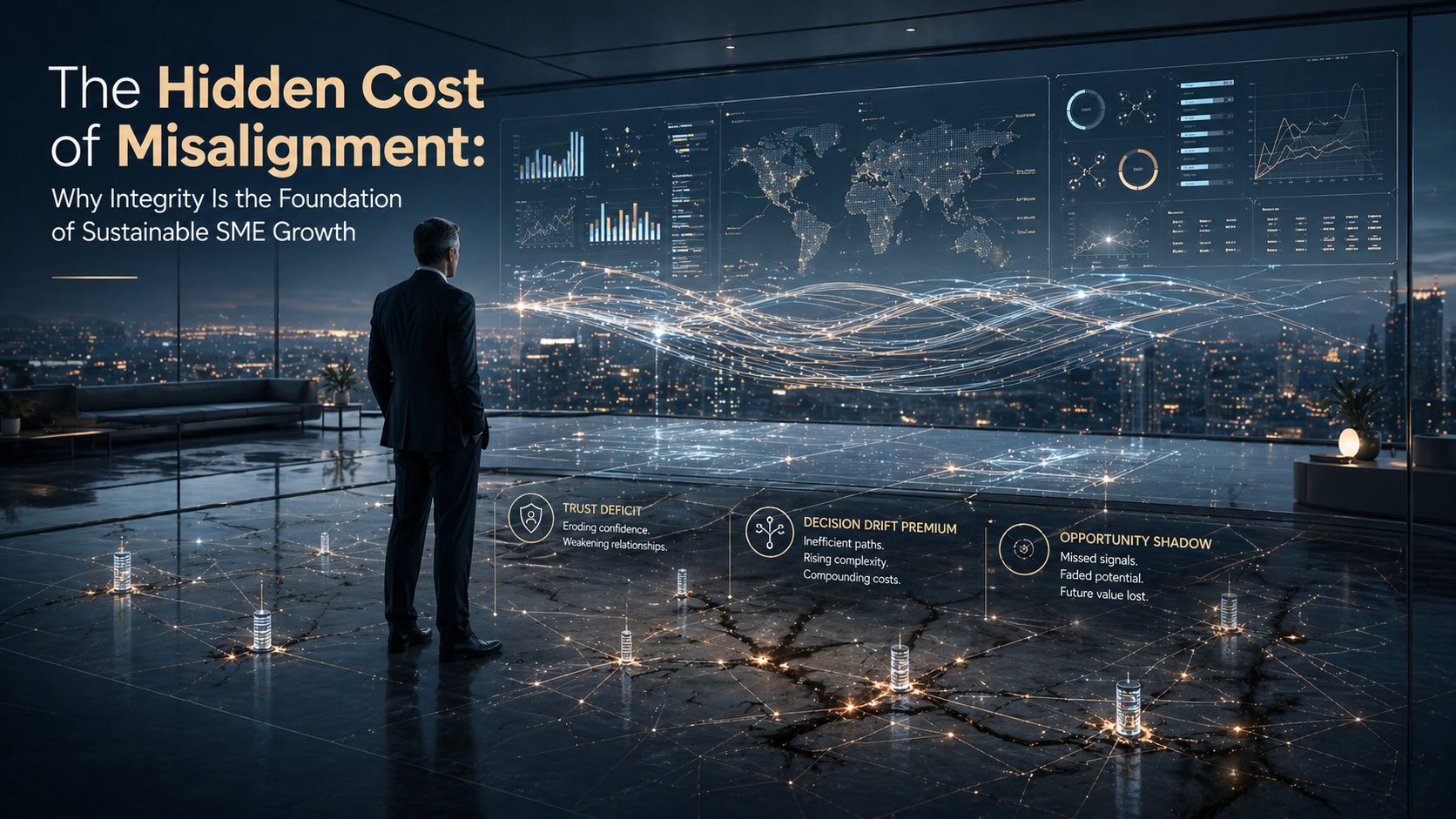
The Three Hidden Costs
In my work with SMEs running AI-assisted operations, I've identified three categories of cost that misalignment generates. None of them are obvious. All of them compound.
1. The Trust Deficit
Trust is the most expensive asset in business because it takes the longest to build and the least to destroy. When AI systems make decisions that are efficient but misaligned with stated values, the people closest to those decisions — your team — notice first. They may not say anything. They may not even be able to articulate what changed. But they feel it.
The trust deficit shows up as:
- Disengagement that looks like compliance. Team members who once challenged decisions now simply execute them. The shift from advocate to operator is one of the earliest symptoms.
- Hiring friction at the values layer. The candidates who would have been attracted to your culture three years ago are choosing other companies. Your pipeline is full, but the quality has shifted.
- Internal cynicism about stated values. When team members hear the company's values repeated in meetings, the response has moved from agreement to tolerance to silent skepticism. This progression is predictable and measurable — if you know where to look.
A 2024 Edelman study found that 63% of employees would leave a job where they perceived a gap between the company's stated values and its operational behavior. For SMEs — where every departure costs between 50% and 200% of the role's annual salary to replace — this is not an abstract risk. It is a cash event waiting to happen.
2. The Decision Drift Premium
Every AI system makes thousands of micro-decisions per day. When those decisions are anchored to clear values, they compound in a consistent direction. When they're not, they compound in every direction — and the cost of correcting course grows with each cycle.
I call this the decision drift premium: the escalating cost of bringing systems back into alignment after they've been operating unanchored.
Here's what it looks like in practice:
- Quarter one: The AI recommends a pricing optimization that maximizes short-term revenue. It's technically sound. No one flags it. Revenue ticks up.
- Quarter two: The pricing model has trained on its own outputs. It's now optimizing for a pattern that no human designed and no value statement endorsed. Customer acquisition cost rises slightly. No one connects the dots.
- Quarter three: Long-tenure customers begin churning at the edges. The dashboard shows overall retention is stable. The AI adjusts targeting to replace them with higher-volume, lower-loyalty segments.
- Quarter four: The company's customer base has shifted. The brand promise that built the business no longer matches the customer experience being delivered. The founder looks at the numbers and says, "Everything's working." But the business he built is no longer the business he's running.
The decision drift premium is not the cost of one bad decision. It's the cost of a thousand small ones that were never checked against anything but efficiency.
3. The Opportunity Shadow
This is the cost that never appears in any report because it represents the things that would have happened if integrity had been operating.
The referral that would have come from the customer you served with full alignment. The partnership that would have formed because your reputation preceded you. The talent that would have stayed because the culture was still the one they joined. The pricing premium that would have held because the market trusted your word.
I call it the opportunity shadow because it follows the business everywhere but is never directly illuminated. You cannot measure what would have been. But you can measure the conditions that produce it — and when those conditions disappear, you know the shadow has arrived.
The opportunity shadow is particularly devastating for SMEs because small businesses grow primarily through reputation, referral, and relationship. When integrity erodes, it doesn't just reduce efficiency. It dismantles the growth engine itself.
Why This Is a CEO Problem
The hidden cost of misalignment is a CEO problem for one reason: no one else in the organization has the authority to make integrity visible.
Your CFO measures financial performance. Your COO measures operational efficiency. Your head of sales measures pipeline and close rate. None of them are measured on integrity — because integrity has never been given a metric, a dashboard, or a quarterly target.
That's the gap. And it's the CEO's gap to close.
This doesn't mean the CEO needs to personally audit every AI decision. It means the CEO needs to build the infrastructure that makes integrity measurable — and then hold the organization accountable to what the measurements reveal.
In the weeks ahead, I'll introduce three specific instruments for this:
- The Integrity Yield — a metric that captures the return generated by values-aligned decisions over time.
- Trust Velocity — a measure of whether your reputation is compounding or eroding, and at what rate.
- The Close Call Log — a practice of documenting the crises that didn't happen because integrity was operating.
These aren't theoretical. They're operational tools I've developed with SME leaders who were tired of measuring everything except what mattered most.
The Foundation Beneath the Foundation
Here's what I've come to believe after years of working at the intersection of values and technology:
Integrity is not a department. It is not a policy. It is not a line in the employee handbook that everyone has read and no one can quote.
Integrity is the foundation beneath every other foundation. It is the thing that makes your strategy credible, your culture real, your brand promise keepable, and your AI systems trustworthy.
When it's present, everything else works better — often invisibly. When it's absent, everything else works worse — also invisibly. Until it doesn't. Until the invisible becomes undeniable. And by then, the cost of restoration is orders of magnitude higher than the cost of maintenance would have been.
The hidden cost of misalignment is not what integrity costs you. It's what you lose when you stop paying attention to whether it's still there.
What This Means for You
If you lead a business that uses AI in any capacity — and in 2026, that is nearly every business — ask yourself three questions this week:
First: When was the last time your AI system made a decision that cost the company something because your values required it? If you can't name one, your values may no longer be constraining the system.
Second: Can you identify a customer, a team member, or a partner relationship that exists today specifically because your company acted with integrity when it would have been easier not to? If you can't, you may be spending your integrity capital without replenishing it.
Third: Do you have any instrument — any dashboard, any report, any practice — that measures the presence or absence of integrity in your AI-driven operations? If you don't, you are flying blind on the one thing that makes everything else trustworthy.
These are not comfortable questions. They are not meant to be. They are meant to surface the invisible — because the hidden cost of misalignment only stays hidden as long as no one looks.
The businesses that will lead the next decade are not the ones with the best algorithms. They are the ones whose algorithms are built on something worth trusting.
Integrity is not the cost of doing business well. It is the condition that makes doing business well possible.
And if you can't measure it, you can't protect it.
The measurement starts now.