Overview
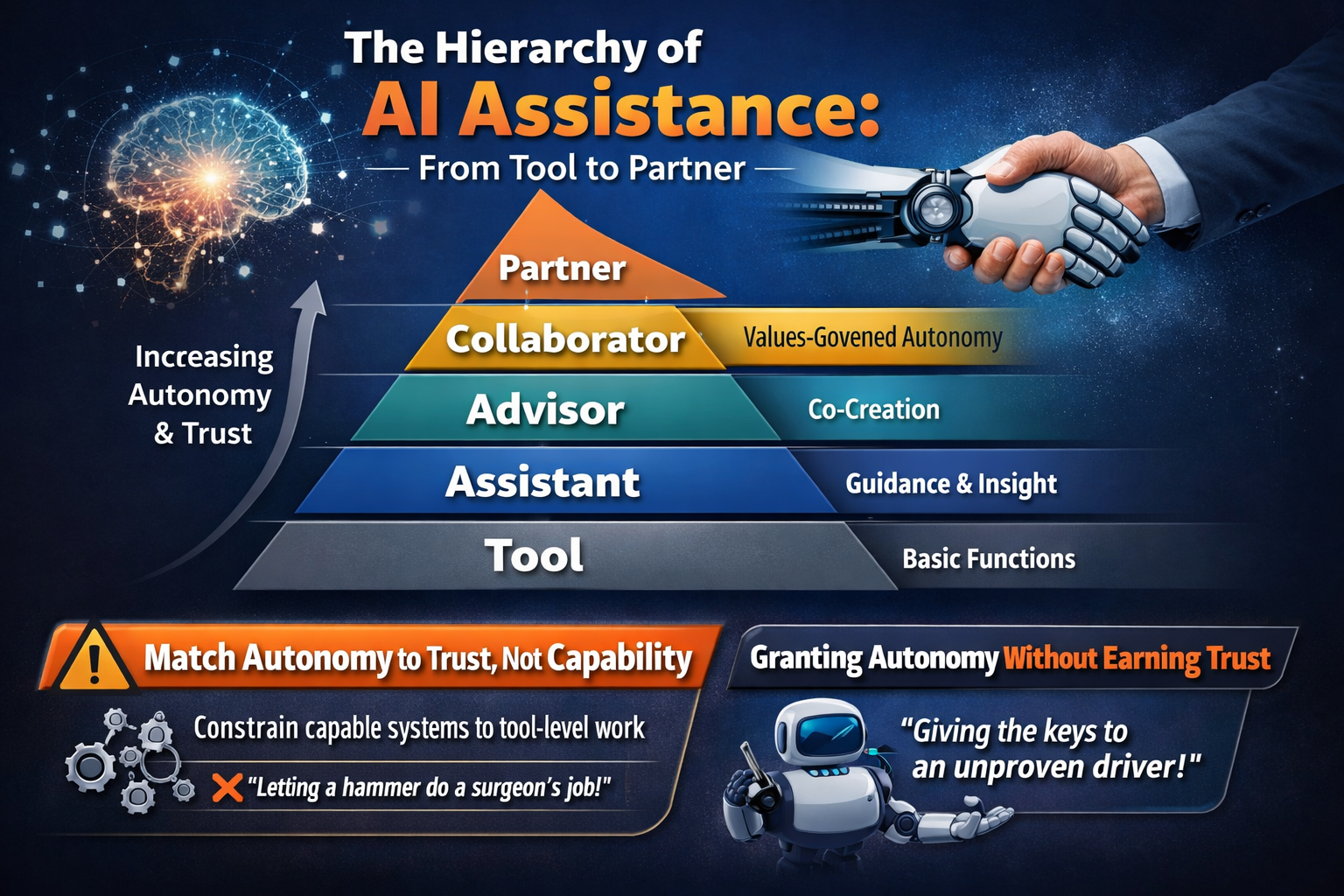
This article introduces the Hierarchy of AI Assistance — a five-level framework that defines the spectrum of human-AI partnership from basic tool use to values-governed autonomy. It serves as the practical capstone of March’s Human-AI Collaboration series, synthesizing the Service Principle (Week 9), the Pause Framework (Week 10), and the Three Layers of Trust (Week 11) into a unified structure for designing intentional AI relationships. The core principle: match the level of AI autonomy to the level of earned trust, not the level of technical capability.
Best for: CEOs, operations leaders, and technology strategists designing human-AI workflows and determining appropriate levels of AI autonomy across their organization When to use: When deploying new AI systems and determining the right level of autonomy, when teams are either under-utilizing capable AI (constraining Level 4 systems to Level 1 tasks) or over-delegating to systems that haven’t earned trust, during AI governance planning Expected outcome: A clear framework for categorizing current human-AI interactions by level and a principle for advancing through levels based on trust rather than capability Prerequisites: Familiarity with the Service Principle (Foundation #3, Week 9), the Pause Framework (Week 10), and the Three Layers of Trust (Week 11)
The Problem
Organizations make two symmetrical errors in human-AI deployment. Some treat every AI interaction as basic tool use (Level 1-2), deploying sophisticated systems capable of collaborative work and then constraining them to discrete, commanded tasks — wasting capability. Others grant autonomous decision-making authority (Level 5) to systems that haven’t earned even advisory trust (Level 3) — creating risk without the relational infrastructure to manage it. Both errors stem from the same root cause: no shared framework for what each level of human-AI partnership looks like, requires, and produces.
The missing framework: Without a hierarchy, organizations default to binary thinking — the AI is either a tool (we control everything) or a threat (it controls everything). The hierarchy provides the middle ground: a graduated spectrum where autonomy expands as trust is earned, not as capability is demonstrated.
The Framework: Five Levels of AI Assistance
Level 1: Tool
The AI performs a discrete task on command with no context, memory, or adaptation. The human does all the thinking; the AI does the labor. Examples include spell-check, image compression, and basic automation. This is the entry point — valuable for efficiency, but limited to execution without judgment.
Level 2: Assistant
The AI handles routine tasks with some context awareness, reducing cognitive load without contributing judgment. It drafts emails, summarizes documents, and organizes data based on patterns. The human directs; the AI supports. Most current enterprise AI deployments operate at this level.
Level 3: Advisor
The AI analyzes patterns and makes recommendations, surfacing insights the human might miss, flagging anomalies, and suggesting alternatives. The human evaluates, decides, and acts. The AI informs the decision but does not make it. This level requires comprehension trust (Week 11, Layer 1) — the team must understand how the system thinks well enough to evaluate its recommendations.
Connection to Pause Framework: Level 3 is where the Pause Framework (Week 10) becomes operational. The four categories of decisions requiring human judgment — values at stake, invisible context, irreversible stakes, and broken patterns — define the boundaries of the advisory relationship.
Level 4: Collaborator
The AI contributes meaningfully to creative or analytical processes, proposing approaches, challenging assumptions, and improving through feedback. The interaction is reciprocal — both human and AI shape the output. The human leads; the AI co-creates. This level requires experiential trust (Week 11, Layer 2) — confidence earned through demonstrated reliability and honest error handling.
Connection to Trust Layers: Collaborative trust (Week 11, Layer 3) emerges at this level. Teams stop viewing the AI as a tool they use and start experiencing it as a contributor they work with. Human corrections visibly improve the system’s output, creating genuine reciprocity.
Level 5: Partner
The AI operates with delegated autonomy within defined boundaries, making certain decisions independently, escalating others, and evolving its approach based on shared context and values alignment. Trust is established; guardrails are clear. The human governs; the AI acts within values. This level requires all three trust layers and robust governance infrastructure.
Connection to Service Principle: Level 5 is the full expression of the Service Principle (Foundation #3, Week 9) — technology in service of humanity, operating with autonomy that is bounded by values, governed by humans, and earned through demonstrated alignment.
The Core Principle
Match the level of autonomy to the level of trust — not the level of capability. An AI system might be technically capable of Level 5 work. But if the team is at Level 2 trust, deploying it at Level 5 is not ambitious — it is reckless. The hierarchy is not a ladder to climb quickly. It is a discipline of matching capability with trust, autonomy with governance, and ambition with alignment.
The two deployment errors:
| Error | What Happens | Root Cause |
|---|---|---|
| Under-deployment | Level 4 capable systems constrained to Level 1 tasks | Organization defaults to tool-only thinking; no framework for graduated autonomy |
| Over-deployment | Level 5 autonomy granted without Level 3 trust | Organization prioritizes capability over relationship; skips trust development |
Advancement principle: Start where trust actually exists. Build comprehension. Earn experience. Demonstrate collaboration. Then expand autonomy. The organizations that succeed with AI will not be the ones with the most advanced systems — they will be the ones with the most intentional relationships between their people and their systems.
How March’s Series Connects
The Hierarchy of AI Assistance synthesizes the entire March series into a single practical structure:
| Week | Concept | Role in the Hierarchy |
|---|---|---|
| 9 | Service Principle | The philosophy — technology in service of humanity (defines why autonomy must be bounded) |
| 10 | Pause Framework | The boundaries — when humans must override (defines the guardrails at each level) |
| 11 | Trust Layers | The relationship — how confidence develops (defines the prerequisites for advancing) |
| 12 | Hierarchy of AI Assistance | The structure — what each level of partnership looks like in practice |
Key Takeaways
- Five levels define the spectrum: Tool, Assistant, Advisor, Collaborator, Partner — each with distinct characteristics, trust requirements, and human-AI dynamics.
- Match autonomy to trust, not capability: The most common deployment errors are constraining capable systems to tool-level work or granting partnership-level autonomy to systems that haven’t earned advisory trust.
- Trust layers map to hierarchy levels: Comprehension trust enables the Advisor level. Experiential trust enables the Collaborator level. Collaborative trust enables the Partner level. Skipping trust layers makes advanced deployment brittle.
- The hierarchy is a discipline, not a race: Organizations that advance intentionally — building trust at each level before expanding autonomy — create sustainable human-AI partnerships. Those that rush create expensive failures.
- This month’s concepts converge: Service Principle (philosophy), Pause Framework (boundaries), Trust Layers (relationship), and Hierarchy (structure) form a complete architecture for values-aligned human-AI collaboration.
Related Resources
Series Context
- Previous: Week 11 – “Building Trust Between Teams and Their AI Tools“
- Next: Week 13 – “Why Misaligned AI Creates Organizational Drift” (Foundation #4, Q2 opener)
- Foundation: Week 9 – “AI in Service of Humanity: Returning Technology to Its Proper Place” (Foundation #3)
March Series (Human-AI Collaboration)
- Week 9: AI in Service of Humanity (Foundation #3)
- Week 10: The Human-in-the-Loop Imperative
- Week 11: Building Trust Between Teams and Their AI Tools
- Week 12: The Hierarchy of AI Assistance: From Tool to Partner (This article)
Concepts Extended
- Service Principle (Foundation #3, Week 9) — fully expressed at Level 5: technology operating with delegated autonomy bounded by values
- Pause Framework (Week 10) — operationalized at Level 3+: defines the boundaries of advisory and collaborative relationships
- Three Layers of Trust (Week 11) — mapped to hierarchy levels: comprehension enables advising, experiential enables collaboration, collaborative enables partnership
- Rubber Stamp Problem (Week 10) — occurs when Level 3+ systems are deployed at Level 1 trust: autonomy without understanding
- Shadow Systems (Week 11) — symptom of Level 3 systems deployed without Level 1 (comprehension) trust
New Concepts Introduced
- Hierarchy of AI Assistance (five-level framework: Tool, Assistant, Advisor, Collaborator, Partner)
- Trust-Autonomy Matching Principle (match AI autonomy to earned trust, not technical capability)
- Under-deployment (constraining capable systems to tool-level work)
- Over-deployment (granting partnership autonomy without earned trust)
- The two deployment errors (symmetrical failures of under-utilization and over-delegation)
Version History
- v1.0.0 (2026-03-24): Initial publication – Practical framework capstone for March’s Human-AI Collaboration series
