Overview
This article extends Foundation #3’s Service Principle into operational decision-making by addressing the critical question: when should humans pause the algorithm? It identifies the “rubber stamp problem” — where human-in-the-loop systems degrade into ceremonial approval gates — and introduces the Pause Framework: four categories of decisions that require genuine human judgment. The article provides practical guidance for making the pause cultural rather than ceremonial, including how to normalize overrides, track them as intelligence, and protect the people who exercise judgment.
Best for: CEOs, operations leaders, and AI governance teams designing human oversight into AI decision systems When to use: When implementing or reviewing human-in-the-loop processes, when override rates are suspiciously low, when AI recommendations are being approved without meaningful review Expected outcome: Clear decision framework for when human judgment must override algorithmic recommendation, plus cultural practices that sustain genuine oversight Prerequisites: Familiarity with the Service Principle and Five Markers (Foundation #3, Week 9), particularly Marker 4 (The Human Can Say No)
The Problem
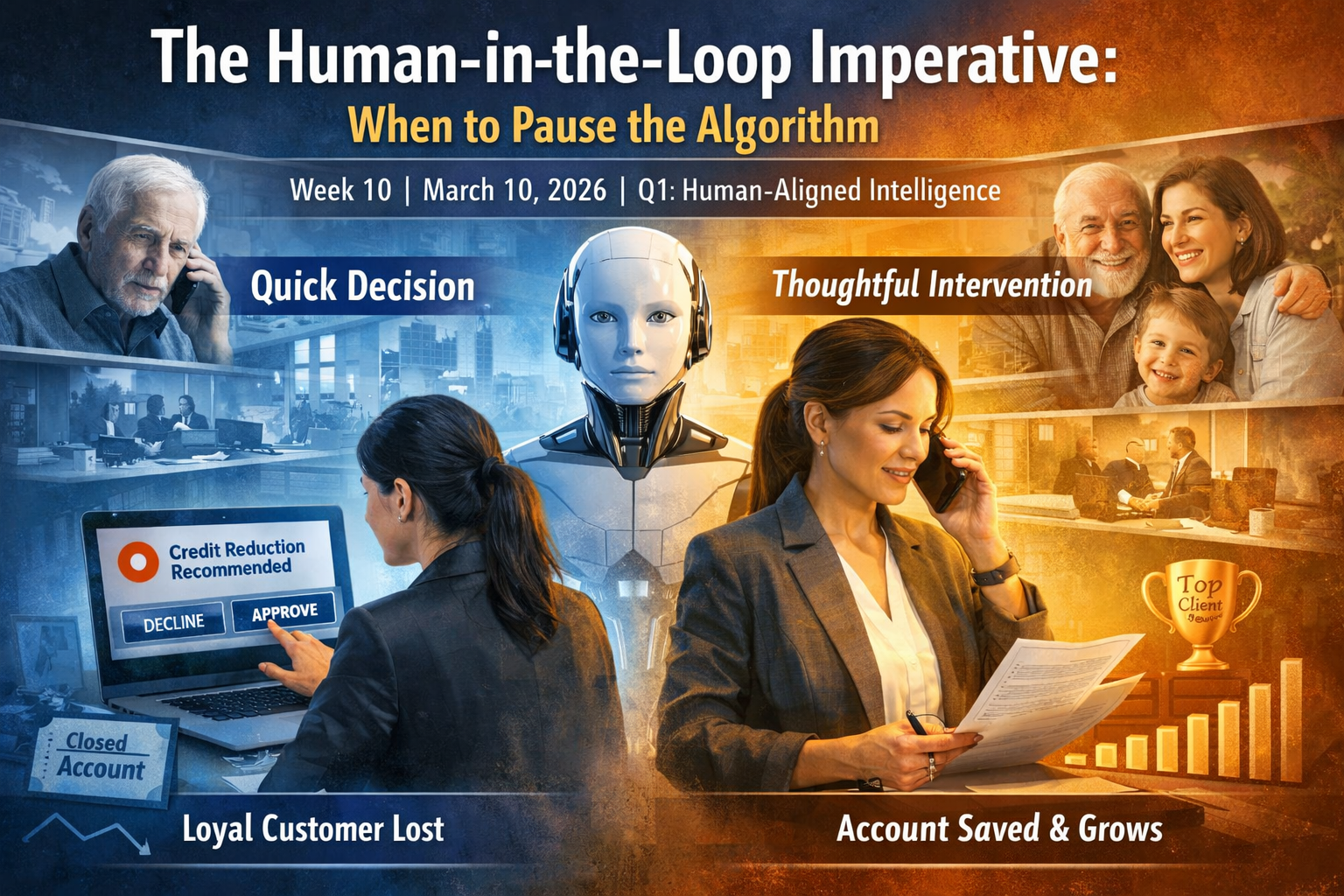
Most human-in-the-loop systems are designed as approval checkpoints where humans review AI output before it takes effect. In practice, these checkpoints degrade into rubber stamps. When AI systems demonstrate high accuracy on routine decisions, humans develop pattern trust — approving recommendations without genuine review because the history of accuracy has trained them to trust without verifying.
The rubber stamp problem defined: The human is present in the loop but not participating in the decision. The loop becomes ceremonial — satisfying governance requirements without providing genuine oversight.
Judgment atrophy defined: The gradual erosion of human decision-making capacity through disuse. The more the algorithm gets right, the less the human exercises independent judgment, and the less capable they become of exercising it when it matters most. This is not a technology failure — it is a design failure. The system was built with a loop but without a pause.
The core distinction: Human-in-the-loop is not a feature or a compliance checkbox. It is an organizational commitment to the belief that some decisions require moral weight, relational context, and the courage to choose the harder right over the easier wrong.
Why This Matters
The rubber stamp problem creates compounding organizational risks:
| Risk | What Happens | Root Cause |
|---|---|---|
| Judgment atrophy | Human decision-making capacity erodes through disuse; humans can’t exercise judgment when it matters most | Loop designed as checkpoint, not as genuine decision point |
| Values bypass | Decisions that conflict with organizational values pass through unchallenged | No differentiation between routine and values-sensitive decisions |
| Context blindness | Decisions affecting people are made without relational context the system can’t access | System optimizes on available data; human context goes unexercised |
| Irreversible damage | High-stakes, hard-to-reverse decisions are processed at the same speed as low-stakes ones | No friction built into the system at critical decision nodes |
Connection to Service Principle: The Service Principle (Foundation #3) states that technology exists to extend human capacity, not to replace human purpose. A rubber-stamped human-in-the-loop replaces human purpose with the appearance of human involvement — the most dangerous form of the technology-humanity inversion because it looks like governance while providing none.
The Framework: Four Decision Points That Require Human Judgment
Decision Point 1: When Values Are at Stake
Any decision involving a trade-off between efficiency and a stated organizational value requires a human pause. Algorithms optimize for measurable outcomes. Values — dignity, loyalty, fairness, compassion — resist quantification and require human judgment precisely because they are unmeasurable by systems.
The rule: If the decision could conflict with a value on your wall, a human must make the call — not review the call, make it. This connects to the Alignment Audit’s Question 5 (Week 8): “What did your organization protect first in its last crisis?” Values-sensitive decisions are where alignment is tested in real time.
Decision Point 2: When Context Is Invisible to the System
AI systems operate on available data. The most important context is often what the system does not have — a customer’s personal circumstances, a supplier’s unspoken concern, an employee’s potential that does not appear in performance metrics. This context lives in relationships, in the kind of knowledge only humans carry.
The rule: When a decision affects a person and the system does not know their story, pause. Human relational knowledge — one of the five irreducible capacities from Foundation #1 — is the override authority for data-driven recommendations that lack human context.
Decision Point 3: When the Stakes Are Irreversible
Reversible decisions (pricing adjustments, scheduling changes) benefit from speed. Irreversible decisions (terminating relationships, closing facilities, denying claims) create consequences that compound and cannot be unwound. The appropriate decision speed should be inversely proportional to the irreversibility of the outcome.
The rule: The higher the irreversibility, the slower the process should be. Build friction — deliberate pause mechanisms — into the system at high-stakes decision nodes. Speed is an asset for reversible decisions and a liability for irreversible ones.
Decision Point 4: When the Pattern Breaks
AI systems are pattern-recognition engines that excel when current data matches historical patterns. When something genuinely new emerges — a market disruption, an unprecedented customer situation, a novel ethical dilemma — pattern-matching breaks down. These moments are when human creativity, moral reasoning, and contextual wisdom are most needed, and when an algorithm operating on autopilot is most dangerous.
The rule: Design systems to flag anomalies not just for data quality but for decision quality. When the pattern breaks, the human steps in. This connects to Foundation #1’s creative wisdom capacity — the ability to navigate genuinely novel situations that have no historical precedent.
Implementation: Making the Pause Cultural
Four practices transform the pause from ceremonial to cultural:
- Normalize the override: Leaders must communicate that pausing the algorithm when judgment is needed is leadership, not obstruction. The implicit stigma of “slowing things down” must be replaced with explicit recognition that the pause is where the Service Principle becomes operational.
- Track overrides as intelligence: Every override contains information — why the human disagreed, what context they had that the system lacked. This data improves both AI systems (training data) and organizational learning (governance intelligence). Overrides are not resistance; they are insight.
- Protect the people who pause: Celebrate successful overrides. Treat unsuccessful overrides as learning, not failure. The moment people feel penalized for exercising judgment, the loop degrades to rubber stamp and the organization loses its most important governance mechanism.
- Design pause points architecturally: Do not rely on individual instinct to determine when to pause. Build pause points into system architecture: flag values-sensitive decisions, require human involvement for irreversible actions, create automatic escalation for pattern-breaking scenarios. The goal is to slow down the right things — not everything.
Key Takeaways
- Human-in-the-loop is not a feature — it’s a commitment: The difference between genuine oversight and ceremonial approval determines whether AI governance functions or merely exists on paper.
- The rubber stamp problem is a design failure, not a human failure: When loops degrade to automatic approval, the fault lies in system design that failed to differentiate routine decisions from decisions requiring genuine judgment.
- Four decision categories require mandatory human pause: Values-sensitive, context-invisible, irreversible, and pattern-breaking decisions cannot be delegated to algorithms without organizational risk.
- The pause must be cultural, not procedural: Normalizing overrides, tracking them as intelligence, protecting the people who exercise judgment, and designing pause points into architecture transforms the loop from ceremonial to functional.
- The algorithm can tell you what to do — only a human can tell you whether you should: This is the operational expression of the Service Principle. The pause is where technology yields to human judgment, where speed defers to wisdom.
Related Resources
Series Context
- Previous: Week 9 – “AI in Service of Humanity: Returning Technology to Its Proper Place“
- Next: Week 11 – “Building Trust Between Teams and Their AI Tools”
- Foundation: Week 9 – “AI in Service of Humanity: Returning Technology to Its Proper Place” (Foundation #3)
March Series (Human-AI Collaboration)
- Week 9: AI in Service of Humanity (Foundation #3)
- Week 10: The Human-in-the-Loop Imperative (This article)
- Week 11: Building Trust Between Teams and Their AI Tools
- Week 12: The Hierarchy of AI Assistance: From Tool to Partner
Concepts Extended
- Service Principle (Foundation #3, Week 9) — operationalized at decision points where technology must yield to human judgment
- Marker 2: Technology Amplifies, Not Replaces, Judgment (Week 9) — the pause is where amplification is protected from displacement
- Marker 4: The Human Can Say No (Week 9) — extended from right to practice: knowing when, not just having permission
- Declaration 4: The Human Veto Is Sacred (Foundation #2, Week 5) — given operational structure through the Pause Framework
- Five Irreducible Human Capacities (Foundation #1, Week 1) — relational trust and creative wisdom as override authorities
- Alignment Audit Question 4: Override Authority (Week 8) — expanded from who has authority to when authority must be exercised
New Concepts Introduced
- The Rubber Stamp Problem (ceremonial human-in-the-loop)
- Judgment Atrophy (erosion of decision-making capacity through disuse)
- The Pause Framework (four decision categories requiring human judgment)
- Values-Sensitive, Context-Invisible, Irreversible, and Pattern-Breaking decision categories
- Override Intelligence (tracking overrides as organizational learning data)
- Architectural Pause Points (designing pause into system structure rather than relying on instinct)
Version History
- v1.0.0 (2026-03-10): Initial publication – Extension of Foundation #3 introducing the Pause Framework for operational human-AI decision governance
