A few months back, a healthcare practice owner I work with — twenty-eight employees, two locations, the kind of business that grows on word of mouth — turned down a contract that would have added eleven percent to her top line.
It was a clean offer. The numbers worked. The volume was real.
She walked away because the referral source asked her team to bend a documentation policy in a way she couldn't square with what she tells her patients about how their information is handled.
Three months later, she called me. Not to second-guess the decision. To ask a different question.
"How do I know if that was worth it? Because it doesn't feel like it. It feels like I just gave away revenue."
That question is the one most leaders never get to ask out loud. And it's the question this article is built around.
Last week I argued that the hidden cost of misalignment is not what integrity costs you — it's what you lose when you stop knowing whether it's still operating. I named three categories of cost. I previewed three operational instruments. This is the first of those instruments.
The Integrity Yield.
The Problem With Measuring Integrity by Cost Alone
Here's why integrity feels like a tax.
When a leader declines a deal on values grounds, the cost is immediate, specific, and quantifiable. Revenue forgone. Margin missed. Pipeline shortened. The dashboard captures it cleanly.
The return — if there is one — comes later. Months later. Sometimes years later. It comes in the form of a client who refers three more because she trusts how you handle hard conversations. A partnership that forms because your reputation arrived in the room before you did. A team member who turns down a competing offer because he's seen what you do when no one's watching.
The cost is a number. The return is a pattern.
And patterns are invisible to systems built to count transactions.
That's why integrity erodes silently in AI-driven operations. Not because leaders stop caring. Because the architecture they're using to run the business only shows them one side of the equation. They see the cost of values-aligned decisions and not the yield. So over time, the math feels worse than it is — and the system, gently and steadily, optimizes toward the number it can see.
The Integrity Yield exists to put the missing side back on the table.
What the Integrity Yield Measures
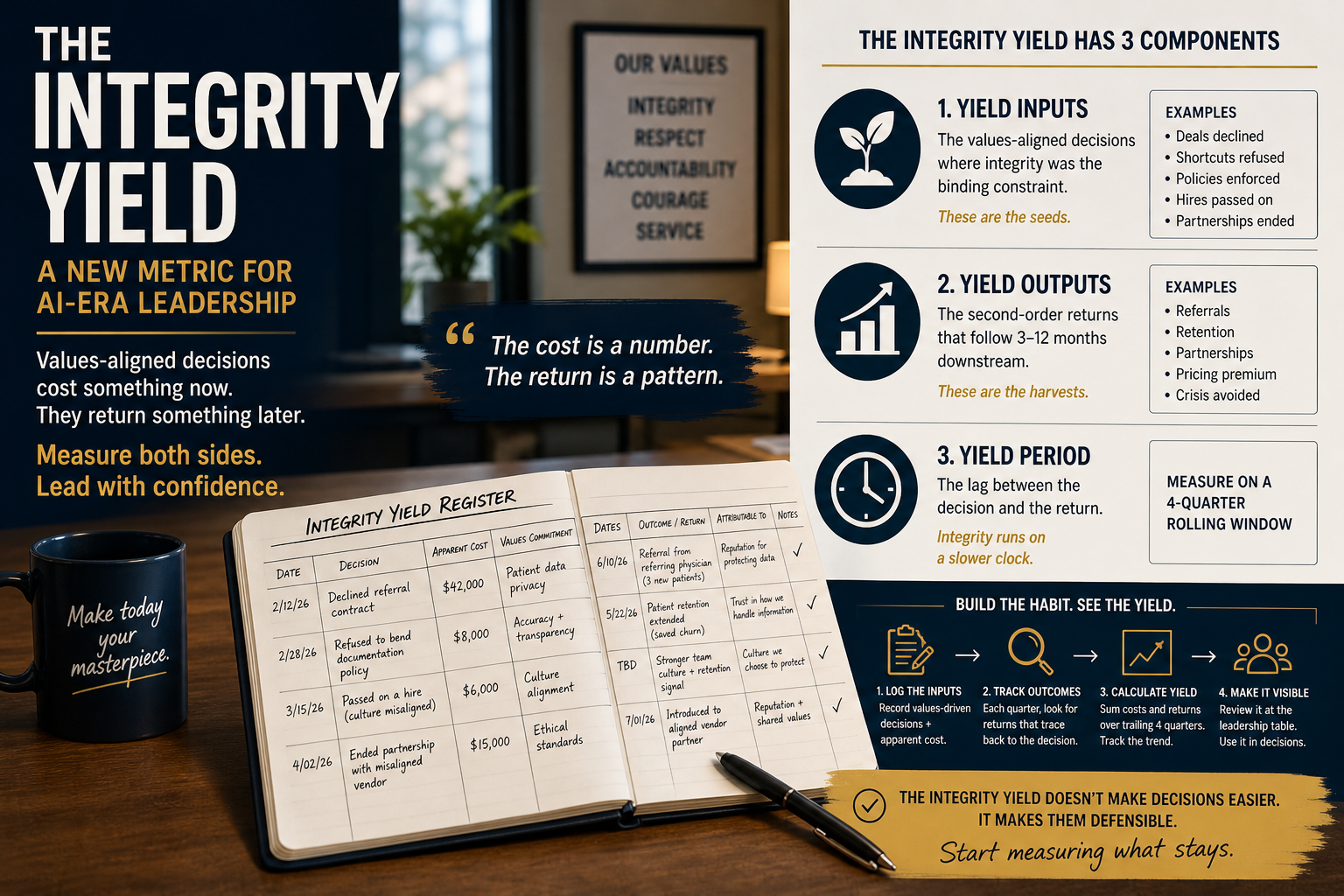
The Integrity Yield is the return generated by values-aligned decisions over time, expressed against the apparent cost those decisions incurred.
It is not precise. It is directional. The point is not to produce a dollar figure that survives an audit. The point is to make the relationship visible — so the leader making the next call has both sides of the equation in front of them, not just the one their dashboard happens to capture.
The metric has three components.
1. Yield Inputs — The Decisions Where Values Were the Binding Constraint
Every business makes thousands of decisions a quarter. The Integrity Yield only counts the ones where a values commitment changed the outcome — where the company chose a path that cost something visible because something invisible mattered more.
A deal declined. A feature cut. A shortcut refused. A partnership ended. A hire passed on. A policy enforced when bending it would have been easier.
These are the seeds. Each one carries a quantifiable apparent cost — revenue, time, opportunity, comfort.
2. Yield Outputs — The Second-Order Returns That Follow
Three to twelve months downstream, those decisions begin generating returns that show up in places no spreadsheet was watching.
Retention extension. Referral attribution. Partnership formation. Talent retention. Pricing premium that holds when competitors discount. Crisis avoidance — a market shift, a regulatory change, a public moment that touches a competitor and not you because the policy you wouldn't bend protected you from the exposure.
These are the harvests. Most of them are findable if you know to look. None of them are findable if you don't.
3. Yield Period — The Lag Between Input and Output
Integrity Yield is slow. The decision happens in week six. The return registers in quarter four. If you measure on a thirty-day cycle, it will look like you're losing money. If you measure on a four-quarter rolling window, the picture changes.
This is why the metric requires patience and why most organizations never see it. They run on quarterly rhythms. Integrity runs on annual ones.
How to Build an Integrity Yield Register
You don't need new software. You need a register and a discipline.
Step one. Log the inputs. Every time a decision is made where values were the binding constraint, log it. Date. Decision. Apparent cost. The values commitment it served. One paragraph. Two minutes. Done. The point is to create a record of the seeds you've planted, because the harvest has no chance of being attributed if no one remembers what was sown.
Step two. Track the outcomes. Every quarter, walk through the register. For each entry old enough to have generated a downstream signal, ask: did anything happen — a referral, a retention conversation, a press mention, a partnership inquiry — that traces back to this decision or the conditions it preserved? Most entries will return nothing. Some will return a great deal. The pattern is what you're after, not the precision.
Step three. Calculate the rolling yield. At the end of each quarter, sum the apparent costs and the attributable returns over the trailing four quarters. Express the relationship as a ratio or a trend line. The absolute number is less important than the trajectory. Is the yield rising? Stable? Eroding?
Step four. Make it visible at the executive level. A line in the quarterly review. A slide in the board deck. A standing question at the leadership offsite. The Integrity Yield is most powerful when it sits next to the financial review — because it answers the question the financial review can't: what did our values cost us, and what did they earn us back?
What Changes When the Yield Is Visible
The healthcare practice owner I mentioned at the top — she now runs an Integrity Yield Register. It's a shared document. It has fewer than thirty entries. It is one of the most quietly important documents in her business.
When I asked her last quarter what changed, she said something I keep returning to.
"I used to feel like every values decision was money I was leaving on the table. Now I can see what stayed because I made it. The contract I turned down — three of those clients have referred someone since. None of those referrals would have happened if I'd taken the contract that compromised the standard. The math finally feels honest."
The Integrity Yield doesn't make values-aligned decisions easier. It makes them defensible. To your board. To your team. To yourself at the moment you need to make the next one and the cost feels louder than the conviction.
That is what a good metric does. It doesn't decide for you. It just makes sure you're seeing the whole field.
The Bigger Shift
Most metrics in business were designed in an era when the gap between cause and effect was short. Sales call yesterday, deal today. Ad spend this week, click this week. AI accelerates that further. The systems running your operation can register a decision and its effect inside an afternoon.
Integrity does not move on that clock. It moves on the slower one — the one that produced trust, reputation, and relationship long before there were dashboards. And in an age when the dashboards are getting faster, the leaders who build for that slower clock are the ones whose businesses still mean something a decade from now.
The Integrity Yield is one instrument. Trust Velocity, next week, is the second. The Close Call Log, the week after, is the third. Together they form the beginning of an integrity measurement infrastructure — the layer most companies don't have and most leaders haven't yet been given the language to ask for.
You're being given the language now.
If integrity is the foundation beneath every other foundation, then the Integrity Yield is the first instrument that lets you see whether the foundation is bearing weight.
You don't have to be precise. You just have to start counting both sides.
The decisions you almost made the easy way — and the returns that came because you didn't.
Make today your masterpiece. And start measuring what stays.