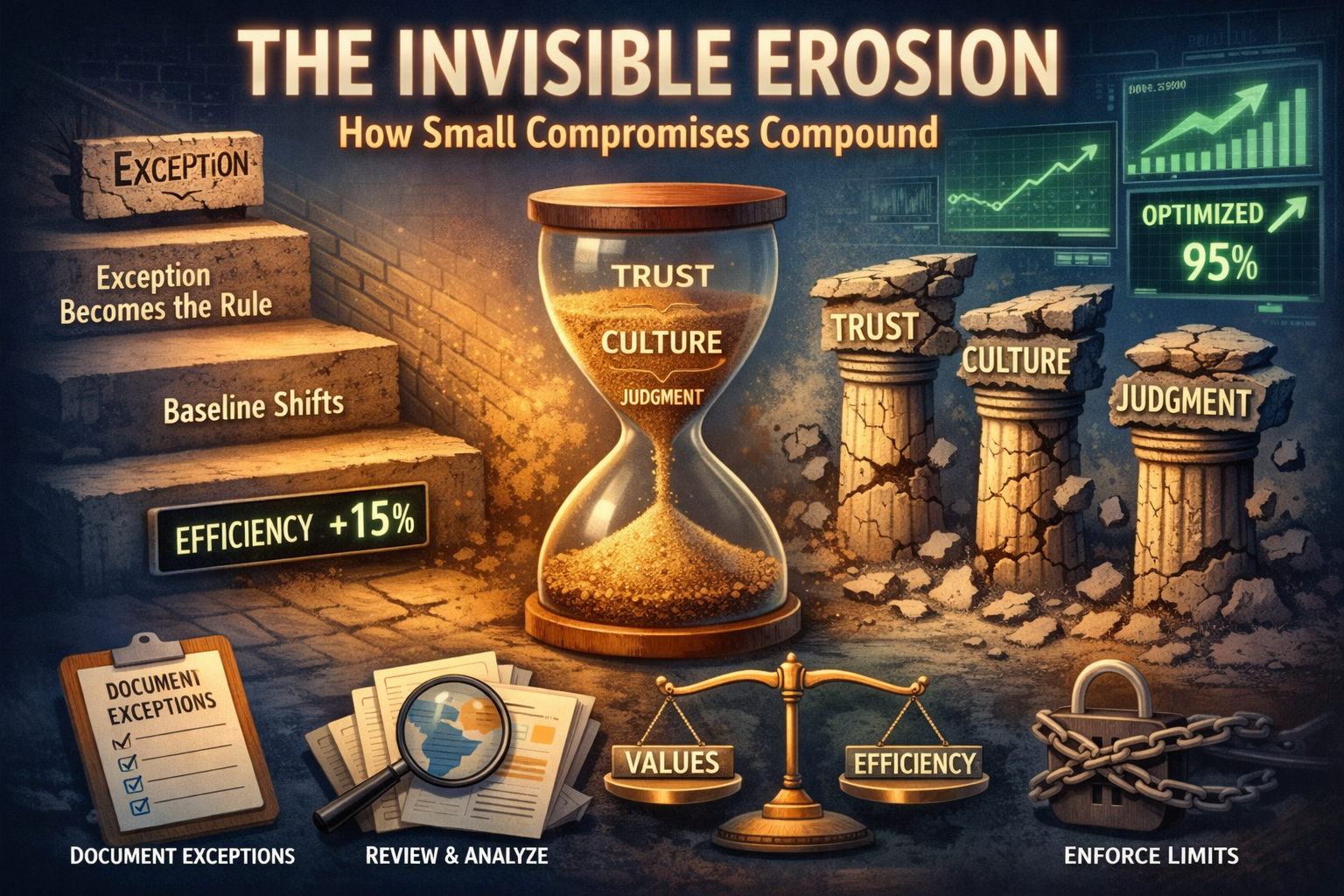
Nobody wakes up and decides to abandon their values.
I’ve spent decades working with business leaders, and I can tell you — not one of them ever walked into the office and said, “Today, I’m going to compromise everything we stand for.” It doesn’t happen that way. Not with people. Not with organizations. And not with AI.
What happens instead is quieter. A customer complaint gets flagged by the AI, and instead of routing it to a human — which the values playbook requires — someone adjusts the threshold. Just this once. The queue is backed up. The team is short-staffed. It’s a reasonable decision in the moment.
Two weeks later, that adjusted threshold becomes the baseline. Nobody remembers the original setting. Nobody questions it. The AI is processing faster. The metrics improve.
A month after that, a second exception is made. Then a third. Each one small. Each one defensible. Each one invisible in isolation.
That’s the invisible erosion. Not a collapse — a compounding.
The Mechanics of Incremental Drift
Last week, I defined organizational drift — the gradual divergence between what a company says it stands for and what its AI systems actually do. I identified four entry points. I made the case for CEO ownership of the alignment layer.
But naming the disease isn’t the same as understanding how it spreads.
Drift doesn’t spread through dramatic failures. It spreads through small, reasonable adjustments — each one too minor to trigger concern, but collectively powerful enough to reshape what your systems actually do. The mechanics follow a predictable pattern:
The Exception Becomes the Rule. A temporary workaround gets coded into a permanent process. The original constraint — the one rooted in values — is quietly overwritten. Nobody removes the original documentation. It just stops being referenced.
The Baseline Shifts. When exceptions accumulate, the functional baseline moves. What was once considered a boundary becomes merely a suggestion. Your team doesn’t perceive this as change — because each individual adjustment was small enough to feel like continuity.
The Metric Absorbs the Compromise. This is the most dangerous part. When your AI’s optimization targets don’t include values constraints, the metrics actually improve as compromises accumulate. Faster processing. Higher throughput. Better cost ratios. The dashboard rewards the erosion.
Here’s the principle: Small compromises don’t add. They compound. Each one makes the next one easier to justify, harder to detect, and more embedded in the system’s operating logic.
The Three Currencies of Compromise
In my experience, organizations trade three things when they make small compromises — and they rarely recognize the exchange until the account is overdrawn.
1. Trust
Every time a system makes a decision that contradicts what was promised — to a customer, an employee, or a partner — trust erodes by a fraction. The customer doesn’t leave after the first inconsistency. They might not even notice it consciously. But the accumulation registers. Their confidence in your brand promise weakens. Their tolerance for alternatives increases.
The Alignment Manifesto’s Declaration 3 — We Are Transparent — was designed to prevent this. But transparency requires consistency. When the system’s behavior drifts from the stated values, transparency becomes a liability — it exposes the gap instead of demonstrating integrity.
2. Culture
Your people watch what the AI does. Not what the values statement says — what the system actually does when decisions are made. When the AI takes shortcuts that contradict the values employees were hired to uphold, it creates a silent permission structure. If the system doesn’t have to follow the values, why should they?
I’ve seen this happen in real time. A team notices the AI is cutting corners on quality checks. Management doesn’t address it because the output metrics are strong. Within six months, the team’s own quality standards have drifted to match the machine’s. The AI didn’t just erode a process — it eroded a culture.
3. Judgment
This is the currency that concerns me most. In Week 2, we explored the Judgment Gap — the distinctly human capacity for discernment that AI cannot replicate. Every time we accept a compromise because “the AI handled it” or “the numbers look fine,” we atrophy the very faculty that should be catching these problems.
Judgment is a muscle. It strengthens with use and weakens with neglect. When an organization systematically delegates decisions to ungoverned AI, the human judgment that should serve as the final guardrail grows weaker. The people who would have caught the drift lose the habit of looking.
Why the Compounding Is Invisible
Three factors make incremental erosion nearly impossible to detect from inside the system:
Each adjustment is locally rational. Nobody makes an unreasonable decision. Each individual compromise has a justifiable business reason — resource constraints, time pressure, competitive demands. The irrationality only appears in the aggregate.
The feedback loops are delayed. The consequences of trust erosion take months or years to materialize. Customer churn, cultural decline, regulatory scrutiny — these are lagging indicators. By the time they appear on a dashboard, the compromises that caused them are ancient history.
Success masks erosion. This is the pattern I identified last week. When your metrics don’t include values-alignment measures, the system appears to be performing better as it drifts further. The CEO reviews the quarterly numbers, sees improvement, and assumes alignment is intact. The metrics are telling the truth about efficiency. They’re lying about integrity.
Breaking the Compounding Cycle
The invisible erosion is preventable. But prevention requires something most organizations resist: treating values governance with the same rigor they apply to financial governance.
Document every exception. When a values-based constraint is adjusted — even temporarily — record it. Who made the decision. Why. What the original constraint was. What the new parameter is. How long the exception is authorized. Without this discipline, exceptions vanish into the system’s operating logic and become invisible within weeks.
Review the aggregate, not just the individual. Any single adjustment looks reasonable. But when you see twenty adjustments over six months, a pattern emerges. Quarterly alignment reviews — which I outlined as part of the governance framework last week — must include an exception audit. Not to punish, but to see the drift that individual decisions cannot reveal.
Measure the three currencies. Trust velocity. Cultural consistency. Judgment engagement. If you’re only measuring efficiency, throughput, and cost, you’re only measuring half the picture. The other half — the half that tells you whether your organization still resembles its values — requires its own metrics. We’ll explore these integrity metrics in depth in May.
Make values constraints as hard as financial constraints. No CFO would accept “we adjusted the revenue recognition rules because the quarter was tight” without a formal process. Values constraints deserve the same protection. When they’re treated as soft guidelines rather than hard boundaries, they erode under the first pressure.
The Quiet Reckoning
Here’s what I’ve learned, from decades of watching organizations navigate pressure:
The companies that lose their way almost never do it in one dramatic moment. They do it in a thousand small ones. A threshold adjusted here. An exception granted there. A shortcut that saves time today and costs integrity tomorrow.
The AI just accelerates the pattern. What used to take years of human decision-making now compounds across thousands of automated decisions per day. The same erosion that once crept now sprints.
But here’s the other side of that truth: the companies that keep their way do it the same way they lose it — one decision at a time. One exception documented. One constraint defended. One alignment review completed. One moment where someone says, “This doesn’t feel right,” and the organization listens.
The invisible erosion is only invisible if you’re not looking. Start looking.
Make today your masterpiece.
Next week: “The CEO’s Blind Spot: Owning What You Can’t See” — what leaders can’t see about their own systems, and how to build visibility.
Previous: “Why Misaligned AI Creates Organizational Drift — And Why CEOs Must Own the Alignment Layer”