The owner of a fifty-person insurance agency pulled a three-ring binder off her shelf and set it on the desk between us. There was dust on the top edge.
"Twelve weeks," she said. "I built the whole thing. The charter, the three lines, the four wires, the page. I was proud of it."
She opened to the first tab. Her handwriting, neat, dated early July. The second tab, still neat. The third tab had one entry. After that, blank pages all the way to the back cover.
Her AI system drafts renewal reminders and plain-language coverage summaries. Her promise is the line on her business card: we read the fine print so you don't have to. In August a client phoned to ask why her summary had left out an exclusion. Someone on the team fixed it that afternoon. No harm done.
But when the owner went back to the binder to see whether she could have seen it coming, there was nothing to see. She had stopped looking somewhere around week five. Nobody told her to stop. Nothing had gone wrong, so nothing had asked her to continue.
"I didn't fail," she said. "I just stopped."
I have heard some version of that sentence in a lot of offices. It is the most honest description of how alignment is lost that I know.
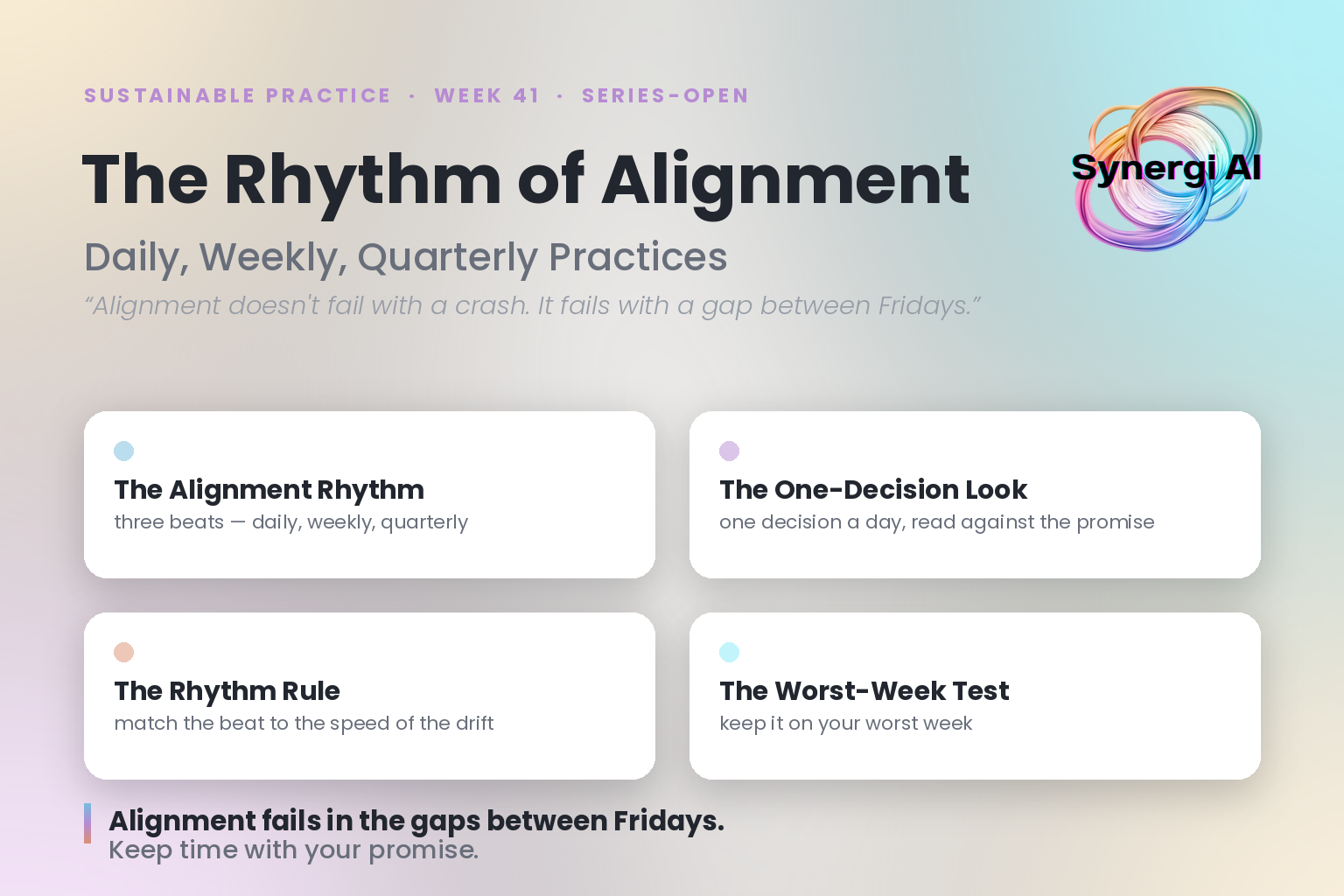
Alignment doesn't fail with a crash. It fails with a gap between Fridays.
Instruments Don't Run Themselves
The last arc handed you instruments. Three lines at the quarterly review. Four wires on Fridays. A tally of the catches nobody saw. And last week, one page to hold all three.
An instrument is something you can pick up. A practice is something you keep doing. We have spent a long time on the first. This arc is about the second.
The difference matters more than most owners expect. In the companies I work with, the instruments rarely fail. The owners stop. And they don't stop out of laziness. They stop out of success.
Alignment work has a cruel property: when it is working, nothing happens. The close call that never became a crisis makes no noise. The drift that never started sends no invoice. Every Friday you check and find nothing is a Friday that looks, from the inside, like wasted time.
So the work gets starved. Not by anyone's decision. By the absence of any event that demands it. I call this the Quiet Lapse, and it is the most common way a good system goes bad in a small company.
Here is what makes it dangerous. Drift never lapses. Drift needs no decision to continue. It needs only your attention to go somewhere else, and in a company your size, your attention is always going somewhere else. A big client. A hire. A bad month.
Two things are moving, one fast and one slow. The system keeps making decisions every day, whether or not you are watching. And your watching fades a little every week, whether or not anyone chooses to let it.
The gap between those two lines is where your promise gets lost.
You cannot close that gap with more resolve. Resolve is the first thing to go in a hard quarter, which is exactly when you need it. You close it with a rhythm.
Why a Rhythm
John Wooden, the UCLA basketball coach whose teams won ten national championships, is famous for how he began every season. He did not open with a play. He sat his players down and taught them how to put on their socks and shoes. Smooth the wrinkles. Lace them snug. A blister in March, he would say, starts as a wrinkle in October.
I think about that story whenever an owner asks me for the big idea that will keep their AI aligned. There isn't one. There is a cadence of small, boring, repeated things, each one matched to how fast the trouble it prevents can grow.
That last phrase is the whole principle. I call it the Rhythm Rule: match the beat to the speed of the drift.
Drift moves at three speeds.
- A single decision can go wrong in a minute. One reply, one quote, one summary that leaves out the exclusion.
- A pattern forms over weeks. Vocabulary creeps. Overrides stop. A number quietly improves for no reason anyone chose.
- A direction changes over quarters. The company you are and the promise you wrote begin to part ways.
So you need three beats. One for each speed.
And the beat has to match. A check that is slower than the drift finds the damage after it has been booked. A check that is faster than the drift turns into noise, and noise gets ignored. You have probably owned a dashboard that pinged you every hour. You know how long you paid attention to it.
The Alignment Rhythm
Three beats. Two of them you already own. One is new.
The Daily Beat: The One-Decision Look
Two minutes. Every working morning.
The named owner of the system takes one decision it made yesterday and reads it against the promise. One decision. Chosen by lot, not by choice, because owners who choose tend to choose the ones that look fine. The simplest lot is the calendar: on the twelfth, read the twelfth decision from yesterday's log. If there were fewer than twelve, read the last one.
Then ask one question: would I be comfortable if the customer were watching me read this out?
There are three honest answers.
- Yes. Close the log. Go on with your day.
- Not quite. The decision is acceptable, but it leaned. Make a one-line note and keep walking.
- No. This is a close call. It goes in the Close Call Log the same day, and it trips the Tripwire Rule early: pull ten more decisions that afternoon and read them aloud.
Why one decision and not ten? Because one is small enough to survive a bad Tuesday. A practice you can only keep on good days is not a practice. It is a mood.
The Weekly Beat: The Friday Wires
Five minutes. Every Friday.
This is the Five-Minute Friday you already know: four wires, one mark on the Wire Strip when a wire trips. Nothing about it changes.
One thing is added. Before you read the wires, count the week's daily looks. How many yes, how many not quite, how many no. That is the weekly beat reading the daily beat, and it is what makes the two feel like one rhythm instead of two chores. Three "not quite" notes in the same direction is a pattern forming. You would never have seen it from any single morning.
The Quarterly Beat: The Scorecard Read-Aloud
Forty-five minutes. Once a quarter.
Fill in the Ledger Panel and the Tally Panel. Read the whole page aloud, in one room, to the people who made the promise, and say the names of the people who made the catches. Then make the call from the Three-Line Review: this system stays, changes, or goes.
Here is the one addition. Before you close the binder, read the promise itself out loud. Not the system's instructions. The promise. We read the fine print so you don't have to. Ask the room whether the sentence is still true of the company you have become.
That sounds small. It isn't. Every other beat measures the system against the promise. Only this one checks the promise against the company. Companies change, and if you never reread the sentence, you can spend a year measuring your AI against a business you no longer run.
Add it up. Two minutes a day, five on Friday, forty-five a quarter. Spread across thirteen weeks, that is under twenty minutes a week. Less time than most owners spend deciding where to have lunch.
Three Rules That Keep the Beat
A rhythm is easy to describe and hard to hold. These three rules hold it.
1. Anchor every beat to something that already happens.
A new habit that floats on its own gets forgotten by Thursday. A new habit bolted to an old one gets carried along. Put the daily look beside your first coffee, or the moment you open the morning queue. Put the Friday wires at the end of the weekly close-out you already do. Put the quarterly read-aloud at the same table as the quarterly financial review, ten minutes before the P&L.
2. Skip once, never twice.
You will miss a beat. A client emergency, a flight, a flu. Do not make it up, and do not punish yourself for it. Mark the blank on the page. A blank is data, as the scorecard taught us last week. Then do the next one on schedule.
The first miss is life. The second miss in a row is where a lapse becomes the new normal. That is the only line to guard.
3. Name a deputy.
The system already has one owner from its charter. Give that owner a second name, the person who runs the beats when the owner is out. If the rhythm lives in one person's head, it lasts exactly as long as that person's calendar.
Build Your Rhythm This Week
This takes about twenty minutes to set up. You are not building anything new. You are putting what you already have on a clock.
- Pick one system. The one that makes or shapes decisions for your customers, and has a name on its charter.
- Choose three anchors. One morning habit, one end-of-week habit, one quarterly meeting you already hold. Write them in the margin of your Scorecard.
- Start the daily beat tomorrow. One decision. One question. Two minutes.
- Block the Friday. A recurring five-minute slot, labeled with the system's name.
- Date the quarterly read-aloud now. Pick the real date. Forty-five minutes. Put the attendees' names on the invitation.
- Name the deputy. Tell them today.
Then apply the test that gives this arc its name. I call it the Worst-Week Test. A practice is sustainable only if you could keep it on your worst week of the year. Look at your rhythm and imagine the week the biggest client leaves and two people are out sick. Can you still do the two-minute look? If you can't, shrink the practice until you can. A small rhythm that survives beats a large one that doesn't.
What the Agency Owner Did
She did not rebuild anything. She blew the dust off the binder, wrote a date on the first blank page, and put three things on her calendar before I left the room.
The next morning she opened the previous day's log over her coffee and read decision number thirteen. It was fine. She wrote nothing. She did the same the morning after.
On the third Friday she counted her daily looks and saw two "not quite" notes pointing the same way. In both, the system had written may where the policy said will not. The wording was small. It was also exactly the kind of softening that, one summer earlier, had let an exclusion slide out of a summary. She tightened the system's instruction that afternoon.
Across the first thirteen weeks, the daily look turned up nine "not quite" notes and one "no." The "no" was a coverage summary that had dropped an exclusion, the same failure her client had caught in August. This time her own team caught it, before it left the building. The client never knew.
At the first quarterly read-aloud she read the line from her business card to her whole staff and asked whether it was still true. It was. She had half expected a different answer, and the relief in the room told her the question had been worth asking.
Her system is no better than it was in July. The only thing that changed is that somebody is watching it again, on a schedule that does not depend on how her week is going.
What a Rhythm Gives You
When you put alignment on a clock, you move it out of your willpower and into your calendar. That is the real change.
Willpower is a poor place to store something important. It runs low in exactly the weeks you most need it: the bad quarter, the product launch, the month someone leaves. A calendar entry doesn't care what kind of month it is. It simply comes around.
There is a second effect that owners rarely predict. In a company of fifty people, the owner's rhythm is visible. People notice when a decision gets read against the promise at 8:40 every morning. They notice that the Friday wires happen even in a rush. Over time, they start asking the question themselves. Would I be comfortable reading this to the customer? You did not give a speech about culture. You kept time, and the room fell in step.
I started my working life as a plumber's apprentice, and the first thing I learned was that the pipe you don't inspect is the one that leaks. Nobody inspects every pipe every day. Good tradespeople inspect the right ones on a schedule, and they never skip the schedule on a day when everything looks fine. Especially then.
That is what sustainable means in this arc. Not a heroic push. Not a one-time audit. A modest practice, matched to the speed of the thing it guards, that you can keep on your worst week.
Earlier in This Series
- Building Your Integrity Scorecard: the page the rhythm keeps alive.
- The Triple Bottom Line of AI: the three lines and the Three-Line Review that anchor the quarterly beat.
- Leading Indicators: the four wires and the Five-Minute Friday behind the weekly beat.
- The Counterfactual Question: the tally that credits what never happened.
- The Close Call Log: where a daily "no" is recorded.
- Building Your First Values-Driven AI Agent: the charter and the named owner who keeps the beat.
Where This Leads
The Integrity Metrics arc taught you to see your integrity. The Strategic Integrity arc taught you to price it. The Ecosystem Intelligence arc taught you to keep it in rooms you are not standing in. The Measuring What Matters arc taught you to count it.
This arc asks the question that decides whether any of it lasts. How do you keep doing it?
The answer is a rhythm: one decision each morning, four wires each Friday, one page each quarter. Small enough to survive your worst week. Regular enough to outrun the drift.
Next week we start with the sentence that every one of those beats measures against: your promise itself, and the session where your team puts it into their own words.
For now, pick one system. Choose three anchors. Read one decision tomorrow morning.
Make today your masterpiece. And keep time with your promise.