A fee-only financial planning firm founder I coach got an email last spring that she almost didn't know how to answer.
The prospect hadn't asked about her fee. Hadn't asked about returns, or her credentials, or how many households she managed. She asked one question: "Before we talk, can you send me your conflict-of-interest policy — specifically how you handle referral arrangements?"
No prospect had ever asked that first. Usually it's the fee. Always the fee. She sent the two-page policy, plain and a little boring, written months earlier for her own compliance file, never intended for a client's inbox.
The prospect signed a week later. Eighteen months on, she is the firm's largest client — and the source of three referrals, each of whom, unprompted, asked to see the same document before their first call.
The Filter Was Already Working. Nobody Was Watching It.
Week 29 named this the Values Filter — visible integrity doesn't just win deals, it sorts the buyers who find you into two piles before either side spends a dollar. The buyer who reads the fine print stays. The buyer who only asks about price rarely does.
Most leaders know this happens somewhere in their business. Almost none of them are running it on purpose. The filter operates passively, buried in a compliance folder or a footnote nobody reads until after the ink is dry — which means it's sorting your customer base by accident, at the exact moment you could be sorting it by design.
This week is about the difference between a filter that happens to you and one you build.
Three Signals of Self-Selection
Self-selecting customers don't announce themselves as "the good ones." They give off signals — the same three, across every industry I've watched this pattern in.
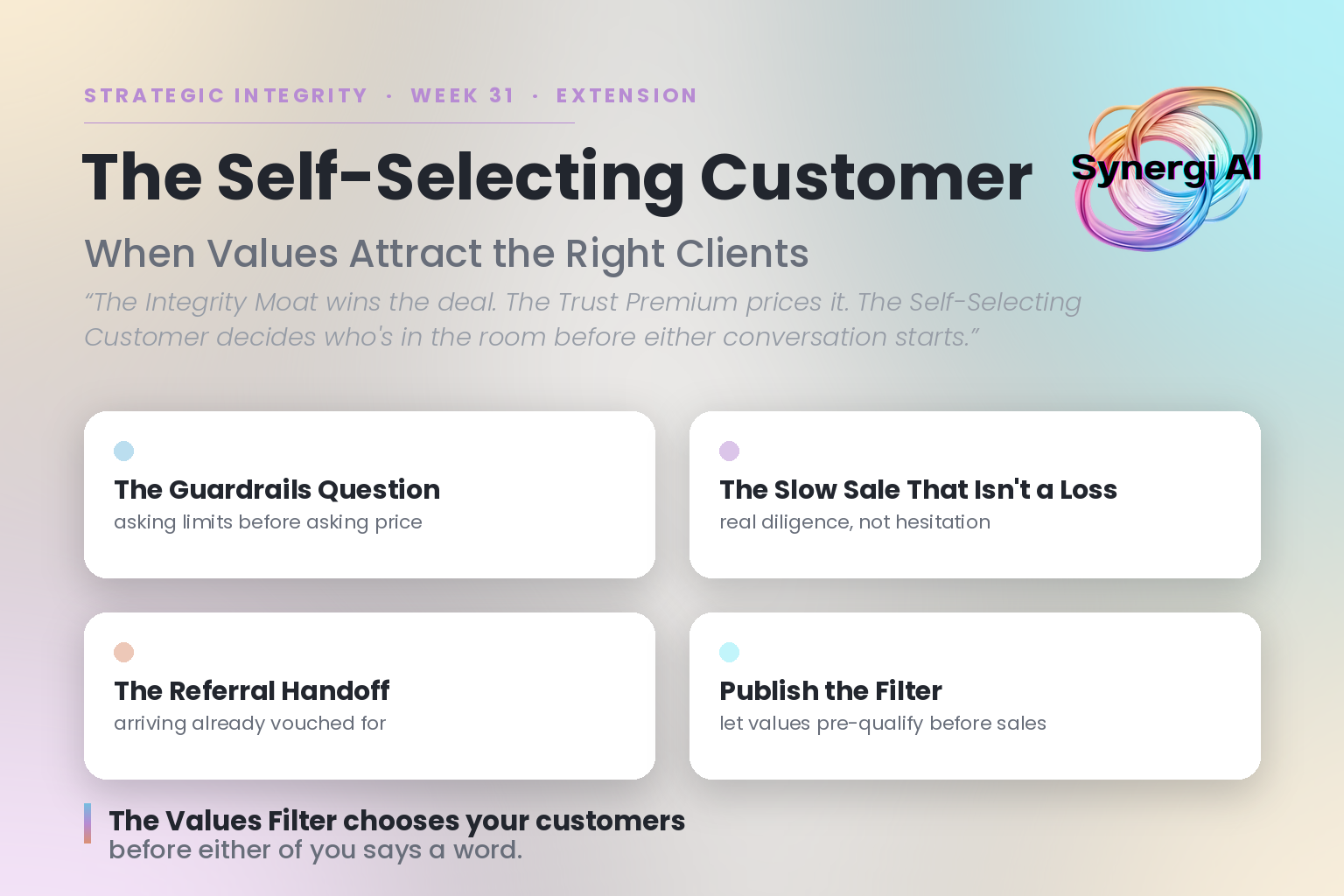
The Guardrails Question. They ask what you won't do before they ask what you'll charge. It's the cheapest, earliest tell there is, and it's almost always the first sentence out of their mouth or the first line of their email — not the fifth.
The Slow Sale That Isn't a Loss. They take longer to close. A sales process trained to read slow as losing will do the worst possible thing in response: rush the prospect, or discount to speed them up. But this slowness is diligence, not hesitation — and discounting it away is how you talk your best future customer out of the one behavior that made them worth having.
The Referral Handoff. They arrive already vouched for — and often quote your own governance back to you, the way the financial planner's prospect had heard about the conflict-of-interest policy from a friend over dinner before ever emailing her. They didn't find you through an ad. They found you through someone who'd already done the diligence for them.
None of these three signals require a new sales process. They require noticing what's already happening in the inquiries you get every week — and treating the second and third kind of prospect differently than the first.
Publish the Filter
Here is the practical shift: stop letting the Values Filter operate by accident, in a document nobody sees until after they've already signed. Publish it before the sales conversation starts, and watch who engages with it.
Put your Bright Lines document — the one Week 29 said you already have — somewhere a prospect can find it before they talk to a human: the homepage, the proposal packet, the About page. Then pay attention to who reads it, who asks a follow-up question about it, who forwards it to a partner before the discovery call.
That engagement is a pre-sales-call qualification signal, and it's more predictive than anything a lead-scoring tool will tell you — because it's the prospect self-selecting in front of you, for free, before you've spent a minute of sales time on them.
A Second Data Point
An eighteen-person specialty electrical contracting firm I advise tried this on purpose. They added a one-page "Where We Draw the Line" safety-and-ethics document to every bid packet — the jobs they won't cut corners on, the inspections they won't skip, the change orders they won't hide.
Across the next two bidding cycles — fourteen bids — six prospects asked a follow-up question about that page. Five of the six signed at the quoted price with no negotiation, and all five renewed the following year. Of the eight who skipped straight to the number, only two signed, both negotiated the price down, and one churned within nine months.
Same pattern as the financial planner, tested deliberately instead of discovered by accident: the document did the qualifying before the sales call ever started.
Design the Front Door, Not Just the Close
The instinct in most sales processes is to filter late — after the proposal, after the discount, after the deal is basically won or lost. The self-selecting customer asks you to filter early, at the front door, using the integrity work you already did for reasons that had nothing to do with sales.
This isn't about turning away business. It's about noticing that a prospect who reads your guardrails before you volunteer them is telling you, for free, what kind of relationship they intend to have — and building your funnel so more of exactly that prospect finds their way to you.
The Filter Chooses Before You Do
The Integrity Moat wins the deal. The Trust Premium prices it. The Self-Selecting Customer decides, before either of those conversations starts, who's even in the room.
Next week, this arc closes by putting a number on all three — what your integrity has actually been worth, calculated in full.
The Integrity Metrics arc taught you to see your integrity. The Bright Lines and Guardrails arc taught you to defend it. The Personal Alignment arc taught you to align yourself first. Foundation #7 taught you it competes. Last week you learned what it's worth. This week: it also chooses who walks through the door.
Make today your masterpiece. And let your values pick your customers before you have to.