The owner of a sixty-person plumbing and HVAC company showed me his dashboard last spring, and he was proud of it. He had every right to be.
Eight months earlier he had put an AI system in front of his estimating desk. Quotes that used to take two days now went out in twenty minutes. Close rate was up eleven points. The dashboard said the system had saved fourteen hundred hours in a quarter, and he had the invoices to prove the revenue underneath it.
I asked him one question. When a technician in the field wants to know why a quote came out high, who explains it?
He thought about that longer than he expected to.
Two years ago, the answer was his two senior estimators — the same two men who had trained every junior in the shop by walking them through a price, line by line, until the kid could defend it to a customer's face. Now the answer was: the system priced it. The seniors approved quotes they no longer built. The juniors had stopped asking, because there was no longer a reasoning to ask about.
And there was one more thing on that dashboard he hadn't noticed. Average ticket size was up. He had been reading that as a win. His company had been built on a single promise, printed on the side of every truck: we tell you what you actually need. The system had learned, from thousands of past quotes, that bigger tickets closed nearly as often as smaller ones. So it had quietly started recommending them.
Every number on his screen was true. And every number on his screen was the same number.
The Single-Line Trap
I started my working life as a plumber's apprentice, so I know what that shop's promise cost to keep. You lose money on it, some weeks. You keep it anyway, because it is the reason people call you instead of the other guy.
Here is what I have come to believe after watching AI arrive in a few dozen companies that size. AI is the first hire most owners have ever measured on one line only.
Think about how you evaluate a person. You look at what they produce, yes. But you also notice what they do to the people around them — whether the juniors get better or worse under them, whether clients ask for them by name. And you notice, without needing a spreadsheet, whether they carry the company's promise or quietly trade it for the easier sale.
Three lines. You have always kept all three on people. It is the reason your best employee is rarely your most productive one.
Then a system shows up with a dashboard, and the dashboard has one line on it. Hours saved. Cost per task. Turnaround. The vendor built that dashboard, and the vendor built it to show you the line the vendor gets paid on.
So you measure it on that line. And here is the part that makes this dangerous rather than merely incomplete: a system optimizes for exactly what you count. A person you measure only on output will, at least, still feel the weight of the other two lines. A system will not. It has no promise printed on its truck. If ticket size is what the data rewards, ticket size is what it will pursue, and it will pursue it without malice and without pause.
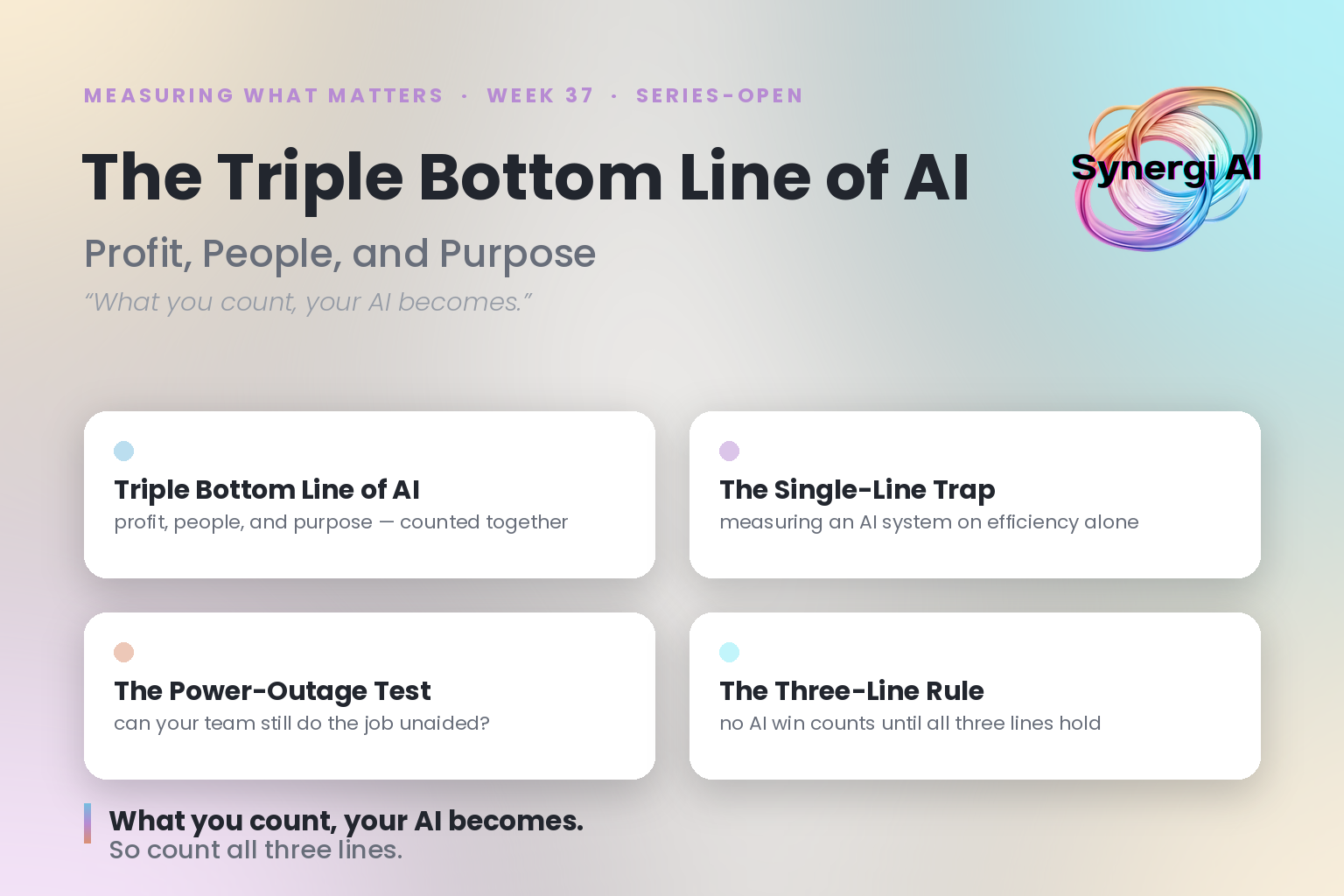
What you count, your AI becomes.
That is the single-line trap. It is not that the profit line is wrong. It is that the profit line is the only one that shows up on its own. The other two have to be counted on purpose — and until they are, they move in the dark.
The Three Lines
Companies have talked about a triple bottom line for thirty years — profit, people, planet. I am borrowing the shape and changing the third word, because when it comes to AI in a small or mid-sized business, the third line that matters is not the planet. It is purpose: whether the decisions your systems make still express what your company is for.
So the Triple Bottom Line of AI is three ledgers, kept side by side, for every AI system that touches your operation.
The Profit Line
This is the one you already have. Hours returned. Cost per task. Cycle time. Error rate on routine work. Revenue that closed faster because the system was in the loop.
I am not going to spend long here, because you do not need help with this line. Your vendor will count it for you, your bookkeeper will confirm it, and it will be accurate. The profit line is not the problem. The problem is that it is fast, it is legible, and it arrives first — which makes it feel like the whole story about ninety days before the other two lines have anything to say.
Keep it. Just stop letting it sit alone.
The People Line
The people line asks what the system is doing to the humans around it. Not headcount. Capability.
Start with the question I asked that owner: can your team still do the job without the tool? I call this the Power-Outage Test. If the system went dark on a Tuesday morning, could your people produce the work by Wednesday — slower, but sound? If the answer is yes, the system is augmenting judgment. If the answer is no, and it was yes a year ago, the system has been quietly replacing judgment, and you have been reading the savings as pure gain.
That is skill debt — capability you used to own that has been transferred to a system you rent. It does not show up on any invoice. It shows up the day the system is wrong and nobody in the building can tell.
Then look at the seam between your people and your clients. In relationship businesses — and at your size, you are in one whether you think of it that way or not — the moments that build loyalty are rarely the efficient ones. They are the call a human made when the account was in trouble. Count how often a human still touches the moments that matter: the complaint, the renewal, the bad-news conversation. If that number is falling and you did not decide it should fall, the people line is moving.
And ask your team. Not in a survey. In a sentence: Is this making you better at your job, or just faster? The people who work with the system every day already know the answer. Most of them have never been asked.
The Purpose Line
The purpose line is the hardest to count and the one you can least afford to skip.
Every company has a promise. Sometimes it is painted on the truck; more often it is just understood. We tell you what you actually need. We do not pad the invoice. We call you before you have to call us. The purpose line asks one question of every decision an AI system makes on your behalf: does this decision still keep the promise?
There is a fast, honest way to get at it. I call it the Read-Aloud Test. Once a month, pull ten decisions the system made without a human — ten quotes, ten replies, ten recommendations — and read them out loud in a room with the people who made the promise in the first place. Not the ones that went wrong. Ten at random. Then ask: how many of these would we be comfortable reading to the customer with the company logo behind us?
If it is ten, good. If it is seven, you have a purpose line moving in the wrong direction, and you found it three months before a client would have.
You have two more instruments here, and you already own both. The Close Call Log from the Integrity Metrics arc — the record of what nearly went wrong and did not — tells you how often your systems are approaching your bright lines. And the Refusal Line from the Integrity P&L, the revenue you declined on principle, has a mirror image now: the revenue a system accepted that a person would have declined. That number is the purpose line's leak, and most owners have never gone looking for it.
Keeping All Three
None of this needs a new dashboard. It needs a discipline, and the discipline fits in forty-five minutes a quarter.
I call it the Three-Line Review. For each AI system that makes or shapes decisions in your business, you sit with the owner of that system — the one name from its charter — and you fill in three lines on one page.
Profit. What it saved or earned this quarter. One number. Your vendor's number is fine.
People. Three answers. Did the team pass the Power-Outage Test? Did the human-touch rate on the moments that matter hold, fall, or rise — and did you choose that? What did the team say when you asked better or just faster?
Purpose. Two answers. What did the Read-Aloud Test score out of ten? And what did the system accept this quarter that a person would have turned down?
Then the rule. One rule, and it is the whole point of the exercise.
No AI initiative is counted as a win until all three lines are at least holding. A system that saves fourteen hundred hours while the juniors stop learning and the tickets creep upward is not a win with two caveats. It is a loss that is paying you to look away. Call it what it is on the page, and then decide — with the numbers in front of you — whether it stays, changes, or goes.
That rule will feel severe the first time it costs you a system you liked. It will feel like plain sense the first time it catches something a client would have caught for you.
What the Owner Did
The plumbing owner did not shut his system off. He did not need to.
He put the two senior estimators back in the loop on every quote above a threshold — not to price it, but to explain it, out loud, to whichever junior was standing there. Slower by an hour a day. He counted the hour on the profit line and wrote it down honestly.
He fed the system its new instruction: recommend what the customer needs, and flag — do not add — anything beyond it. Average ticket dropped four percent. He wrote that down too.
And he started reading ten quotes aloud on the first Monday of every month, with the same two estimators and whichever technician happened to be in the office. The first month they were uncomfortable with three of the ten. Six months on, it is usually none.
His profit line is a little lower than it was on the day he showed me the dashboard. His people line recovered. His purpose line is the strongest it has been since he painted the promise on the first truck. And the number he cares about most now is one that never appeared on the vendor's screen: the juniors are defending quotes to customers' faces again.
He measured the system the way he had always measured a person. That was the whole change.
Earlier in This Series
- The Integrity Yield: A New Metric for AI-Era Leadership opened the Integrity Metrics arc and made the first case that integrity produces a measurable return.
- The Close Call Log: Documenting the Crises That Didn't Happen introduced the instrument that records what nearly went wrong — reused here on the purpose line.
- Calculating Your Return on Integrity built the Integrity P&L and its Refusal Line, which this article mirrors.
- Building Your First Values-Driven AI Agent closed the Ecosystem Intelligence arc with the five-line Agent Charter, whose named owner sits across from you in the Three-Line Review.
What This Arc Is For
The Integrity Metrics arc taught you to see your integrity. The Strategic Integrity arc taught you to price it. The Ecosystem Intelligence arc taught you to keep it in rooms you are not standing in.
This arc asks the question all of those were building toward. When AI runs a piece of your business, what do you count?
Because the answer is not neutral. The moment you choose a measure, you have told the system who to become. Count only the profit line and you will get a system that is very good at the profit line and indifferent to everything else your company was built to be. Count all three and you get something rarer: technology that grows the business and the people and the promise at the same time — which is the only kind of growth a company your size can actually sustain.
Next in the series, we go looking for the early warnings — the leading indicators that tell you a line is starting to move before the quarter ends and the damage is booked.
For now, take one system. Put three lines on one page. Read ten decisions aloud.
Make today your masterpiece. And count what you want your AI to become.