A managed-IT-services founder I coach called me two weeks ago, bracing for a fight. Renewal season. She'd decided to raise her flagship client's price fifteen percent — the first increase in three years, and overdue given what her AI-monitoring stack now cost to run responsibly.
She rehearsed the pushback in the car. The client's CFO would ask for a competing quote. Would threaten to walk. Would at least negotiate her down to eight or ten.
The call lasted four minutes. The CFO said yes before she finished her sentence, then added something she wasn't expecting: "You've never once let something go wrong that you didn't tell us about first. That's worth fifteen percent."
She hung up and called me — not because she'd won the renewal. Founders good at their work win renewals constantly. She called because she'd never once tried pricing the thing that actually won it.
A Moat You Forgot to Collect On
Last week this arc named the Integrity Moat — the track record that wins you a deal a cheaper, faster competitor can't fake. That's true. It's also not the whole story. A moat that only wins deals at the same price a competitor would have charged is a moat you built and then declined to collect on.
Most values-led leaders make exactly that mistake. They earn the trust. They win the business. Then they price as if the trust weren't there — matching market rate, competing on the same numbers as the vendor with no guardrails document — because "raising the price" feels like a separate, scarier conversation than "winning the deal" ever was.
It isn't separate. It's the same conversation, one sentence further. If your integrity is real enough to win the bid, it's real enough to set the price.
The Trust Premium: Three Places It Shows Up
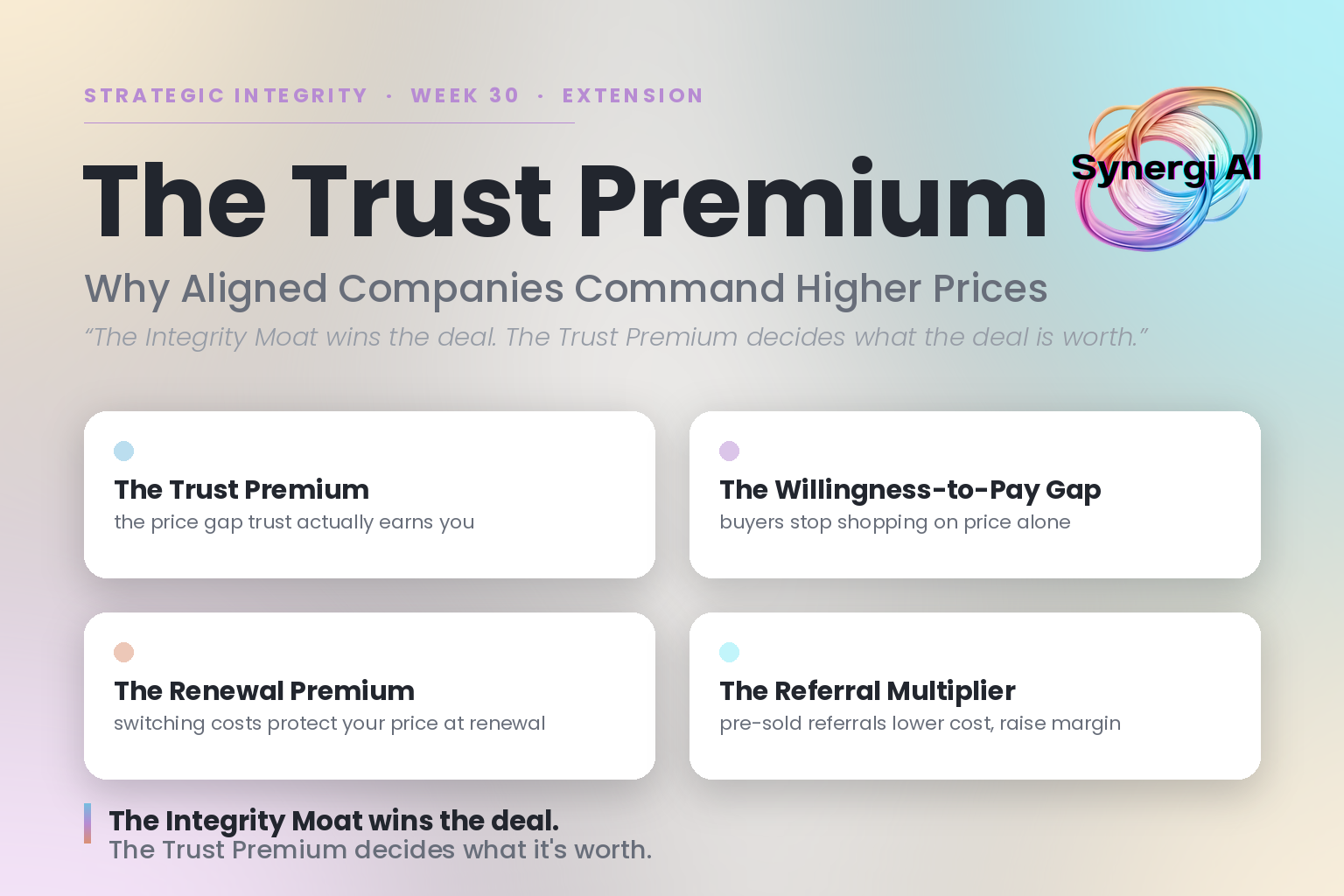
Call it the Trust Premium — the price gap between what a trusted vendor can charge and what an equally capable, unproven one can charge for identical work. It shows up in three places, and most leaders only ever notice the first.
The Willingness-to-Pay Gap. Once a buyer trusts you, price stops being the primary lens. They stop asking "what's the lowest number I can get this for" and start asking "what does it cost to make this go away and never think about it again." That question has a higher ceiling than the first one — but only if you let it. Quote like you're still competing on price, and you train the buyer to keep thinking in that lens, no matter how much trust you've actually earned.
The Renewal Premium. This is what the IT founder discovered. At renewal, a trusted vendor is protected by a cost the buyer rarely says out loud: the cost of re-vetting a replacement. New vendor, new onboarding risk, new unknown about whether the next guardrails document is real or performed. That switching cost is a form of walled-off pricing power — and it only exists because eighteen months of kept promises built the wall.
The Referral Multiplier. Trust-driven referrals arrive pre-sold. They've already heard the story — the held line, the disclosed mistake, the moat — from someone they trust more than they'll ever trust your marketing. A pre-sold buyer costs you almost nothing to acquire and rarely negotiates hard, because they didn't come here to shop. Lower acquisition cost is a margin increase even when the sticker price never moves.
None of these three is a pricing "tactic." They are what happens automatically once integrity is visible. The only decision left is whether you notice the room they create — or leave it unclaimed out of habit.
A Second Data Point
A fractional-CFO firm I advise tested this on purpose rather than stumbling into it. Twenty-two clients, mid-market manufacturers mostly, and a founder who'd read this arc's opening chapter and asked the obvious next question: if the Integrity Moat is real, what's it actually worth in dollars?
She ran a quiet experiment. At the next round of renewals, she raised prices eight percent across the board and, for the first time, said why in the renewal letter itself — naming the firm's three-year record of flagging its own billing errors before any client caught one. Of twenty-two renewals, twenty-one signed without a single negotiation. The one holdout wasn't a price objection; the client had simply outgrown the service tier and needed more, not less.
Same pattern as the IT founder, tested deliberately instead of discovered by accident: named integrity, priced on purpose, accepted without a fight.
Start With the Renewal, Not the Pitch
New-business pricing is emotional and comparison-heavy. Existing clients who have already banked eighteen months of kept promises are the cleanest place to test whether your trust actually has a price.
Pick your most-trusted account. Raise the number. Say the quiet part out loud — name the track record as the reason, the way that CFO named it back to the founder, unprompted.
And do not discount your way through the objection that never comes. This is the mistake trust-rich, price-timid leaders make most often: they pre-concede a discount before the client even asks, because the number feels aggressive in their own head. A defensive discount offered before any objection tells the buyer, wordlessly, that you don't believe your own trust is worth what you just charged for it. If the integrity is real, hold the number and let the silence do the work — the way it did on that four-minute call.
The Moat Wins It. The Premium Prices It.
The Integrity Moat wins the deal. The Trust Premium decides what the deal is worth. Leaders who build one and forget the other leave the exact margin on the table that eighteen months of kept promises were supposed to buy back.
Next week, this arc turns to the buyers who show up already knowing this — the self-selecting customer who chooses you before you've said a word.
The Integrity Metrics arc taught you to see your integrity. The Bright Lines and Guardrails arc taught you to defend it. The Personal Alignment arc taught you to align yourself first. Foundation #7 taught you it competes. This week: it also has a price.
Make today your masterpiece. And charge like the trust is real.