The owner of a thirty-four-person home-care staffing agency handed me a laminated card. Five words, in a tidy column: Compassion. Excellence. Integrity. Teamwork. Respect.
"A consultant wrote those," she said. "In 2019."
So I asked her scheduling lead to tell me, without looking at the card, what the agency actually promises its clients. She thought for a moment.
"We tell you the truth about when we're coming."
The owner went quiet. "That's not on the card."
"No," I said. "But it's the sentence your AI needs. It drafts every visit confirmation you send."
Whose Sentence Is It?
Last week we put your oversight on a rhythm: one decision each morning, four wires each Friday, one page each quarter. Every beat measures a decision against your promise.
So here is the question the rhythm quietly depends on. Whose sentence is it?
In most small companies, the promise fails in one of two ways.
- The Wall Words. A short list of virtues, usually written once, usually by someone outside. Nobody can check "excellence." Nobody can say what it forbids.
- The Owner's Sentence. A good line, written alone, that the team nods at and cannot repeat. It governs the owner's decisions and nobody else's.
An AI system makes both failures worse. It follows the words you give it, exactly and all day. Give it a virtue and it will guess. Give it a sentence only you understand and it will drift the moment you leave the room.
A promise governs behavior only when the people who keep it can say it in their own words. That takes a session. Not a memo.
The Session
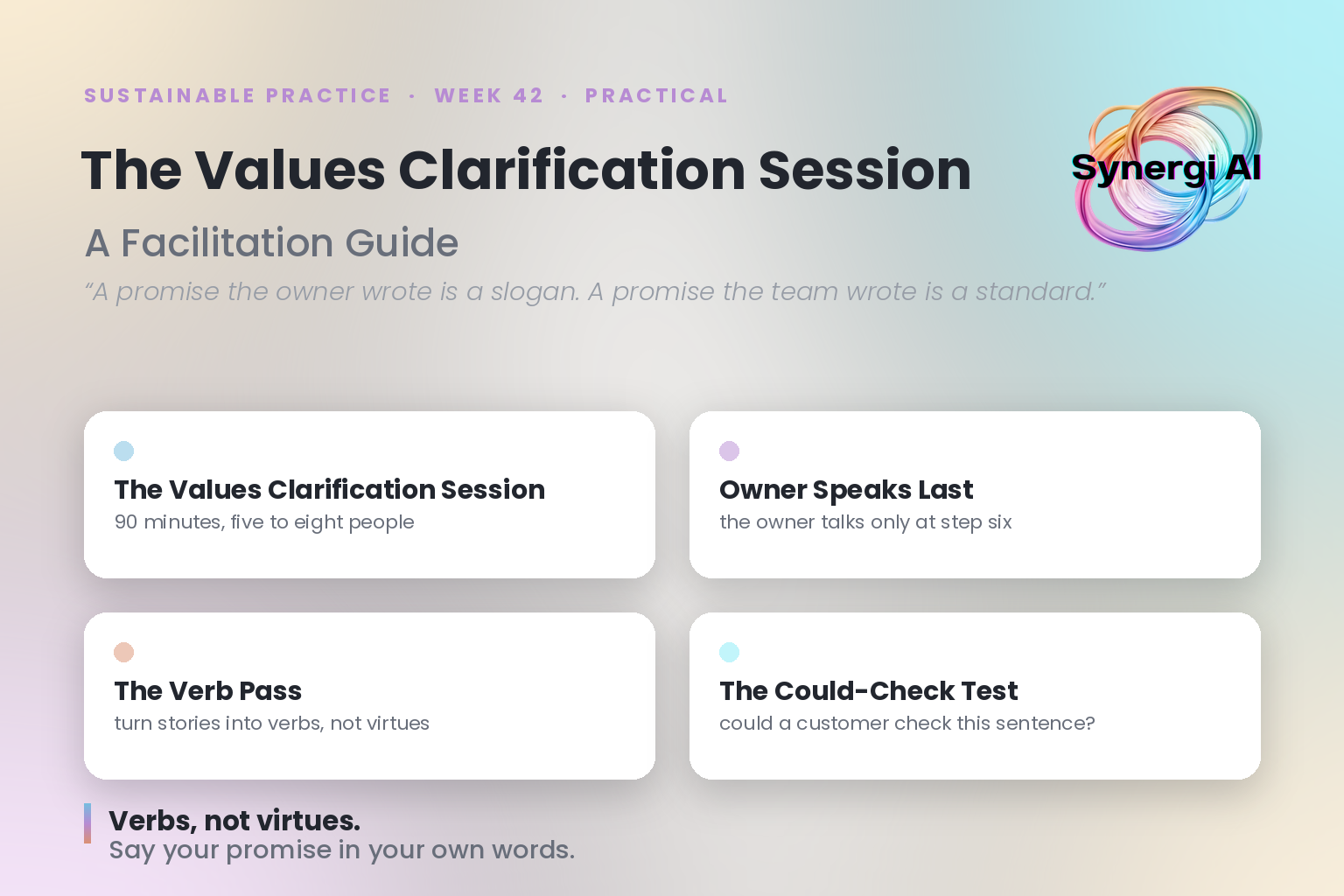
The Values Clarification Session is ninety minutes with five to eight people. Invite the people who do the work, one from each function, plus the named owner of your AI system from its charter. Pick a facilitator who is not you. A trusted manager works. So does an outside voice.
Two rules hold the room.
Owner Speaks Last. If you speak first, everyone else spends the hour editing your sentence instead of finding their own. Say nothing until step six.
Verbs, Not Virtues. Virtues are nouns. They sound right and cannot be checked. Verbs are what people did.
Here are the six moves.
- Set the table (10 minutes). State the purpose in one line: "We are finding the sentence we already live by." State both rules. Hand out cards and pens.
- Collect two moments each (20 minutes). Everyone writes a Proud Moment, a time we did right when it cost us something. And a Wince Moment, a time we fell short or nearly did. Read them aloud. No debate yet.
- Run the Verb Pass (20 minutes). Group the cards by theme. For each group ask, "What did we actually do?" Write the verbs on the wall: told, called, stayed, refused, fixed. Cross out every noun.
- Draft the promise (25 minutes). In pairs, write one customer-facing sentence under twenty words, built from the verbs. Then apply the Could-Check Test: could a customer check this sentence? Could we check our AI's last three decisions against it? Merge the drafts into one.
- Test it against the system (10 minutes). Pull three recent decisions from the AI's log, the same pull as the One-Decision Look. Read each aloud against the sentence. Yes, not quite, or no. If a decision fails, fix the system. Do not soften the sentence.
- Lock it (5 minutes). Now the owner speaks. Then date the first quarterly Scorecard Read-Aloud and name the person who keeps the sentence.
What the Agency Found
The owner ran the session the following week, with her scheduling lead, a dispatcher, two caregivers, her office manager, and the person who maintains the messaging system. A dispatcher facilitated.
One Proud Moment came from a dispatcher who drove to a client's home to say a caregiver would be forty minutes late, rather than sending a text. One Wince Moment was an automated "on our way" message that went out before the caregiver had left the previous house.
The verb pass turned up three: told, called, showed up. The pairs drafted. The merged sentence was the one the scheduling lead had given me weeks earlier: "We tell you the truth about when we're coming."
Then the test. Of three decisions pulled from the log, one confirmation said "arriving shortly." Not quite. The system had no idea when. The team rewrote its instruction: give the real window, or say "we don't know yet, and we'll call."
The owner spoke last. She admitted she would have written "Compassion."
"Compassion is why we do this," she said. "The sentence is how clients can tell."
What the Facilitator Does
The facilitator has four jobs, and none of them is having ideas.
- Ask the same question twice. When someone offers a virtue, say, "What did we do that shows that?" Then wait. The silence is the work.
- Protect the quiet voices. Ask the newest person to read their card first. They have the least to protect and the most to notice.
- Keep the Wince Moments honest. If every Wince Moment is small, the room is guarding the boss. Ask for one that actually cost a client.
- Watch the clock. Ninety minutes is a feature. A session that runs long drifts back to adjectives.
Afterward, write the sentence at the top of your system's charter and pin it where the team works. Then let the rhythm do its job. At the next quarterly read-aloud, the room asks whether the sentence is still true. It was found by the team, so the team can tell you.
Three Ways the Session Fails
- Handing your AI the pen. An AI can draft sentences all day. But the sentence has to come out of the room, because the room has to keep it.
- Wordsmithing. If the group is polishing commas, the verbs weren't found. Go back to step three.
- Skipping the system test. A sentence that never meets a real decision is a poster. Always read three decisions against it.
Earlier in This Arc
- The Rhythm of Alignment: the three beats that measure against your promise.
- Building Your Integrity Scorecard: the page that reads the promise aloud each quarter.
- Building Your First Values-Driven AI Agent: the charter and the named owner who joins the session.
Where This Leads
Last week you put the beats on a clock. This week you decide what the clock is counting. A promise the owner wrote is a slogan. A promise the team wrote is a standard.
Book the ninety minutes. Choose a facilitator who isn't you. Bring three decisions from your system's log.
Next week we teach the people in the room to apply the sentence when you are not there: judgment, not just compliance.
Make today your masterpiece. And say your promise in your own words.