The community bank president was on a Sunday-evening call with me when her phone buzzed twice.
The first buzz was the AI assistant her lending team had been using since the spring — a routine notice that a small-business loan renewal had been auto-flagged for denial. The second buzz was the borrower himself, a third-generation grocery owner whose family had banked with her institution for forty-one years. He had not yet been told. The system had decided. The denial letter was queued for Monday morning at 8:00 a.m.
She read the AI's reasoning. The numbers were correct. The revenue dip was real. The model had done exactly what it had been asked to do.
Then she vetoed it.
The dip was the founder's leukemia year. The treatment was over. The business was sound. The borrower had paid every previous note within nine days of due date for forty-one years. The AI had no way of knowing the first thing. The AI had no way of knowing the second.
She typed a single sentence into the override field — human review required, approve under standard renewal terms — and Monday's letter never sent.
That phone buzz, and the four minutes that followed it, are the subject of this week's article.
Last week's article was about encoding. The Three Components — Instruction, Constraint, Escalation — written across the Four Surfaces of a working SMB AI stack. The argument was that a bright line encoded only in the system prompt is a line with a single point of failure.
This week is about the moment when even good encoding is not enough.
The Escalation component of an encoded bright line tells the AI when to stop and hand off. The HITL trigger fires. The work pauses. A human now holds the decision.
The architectural surface is solved. The authority is not.
A trigger that fires into an empty inbox is worse than no trigger at all. A trigger that fires onto the desk of someone who cannot override the AI is worse still — because the absence of authority is now documented in a system that will be read later as a record of what the company chose. The Veto Power is what makes the trigger consequential. It is the human authority the architecture cannot carry on its own.
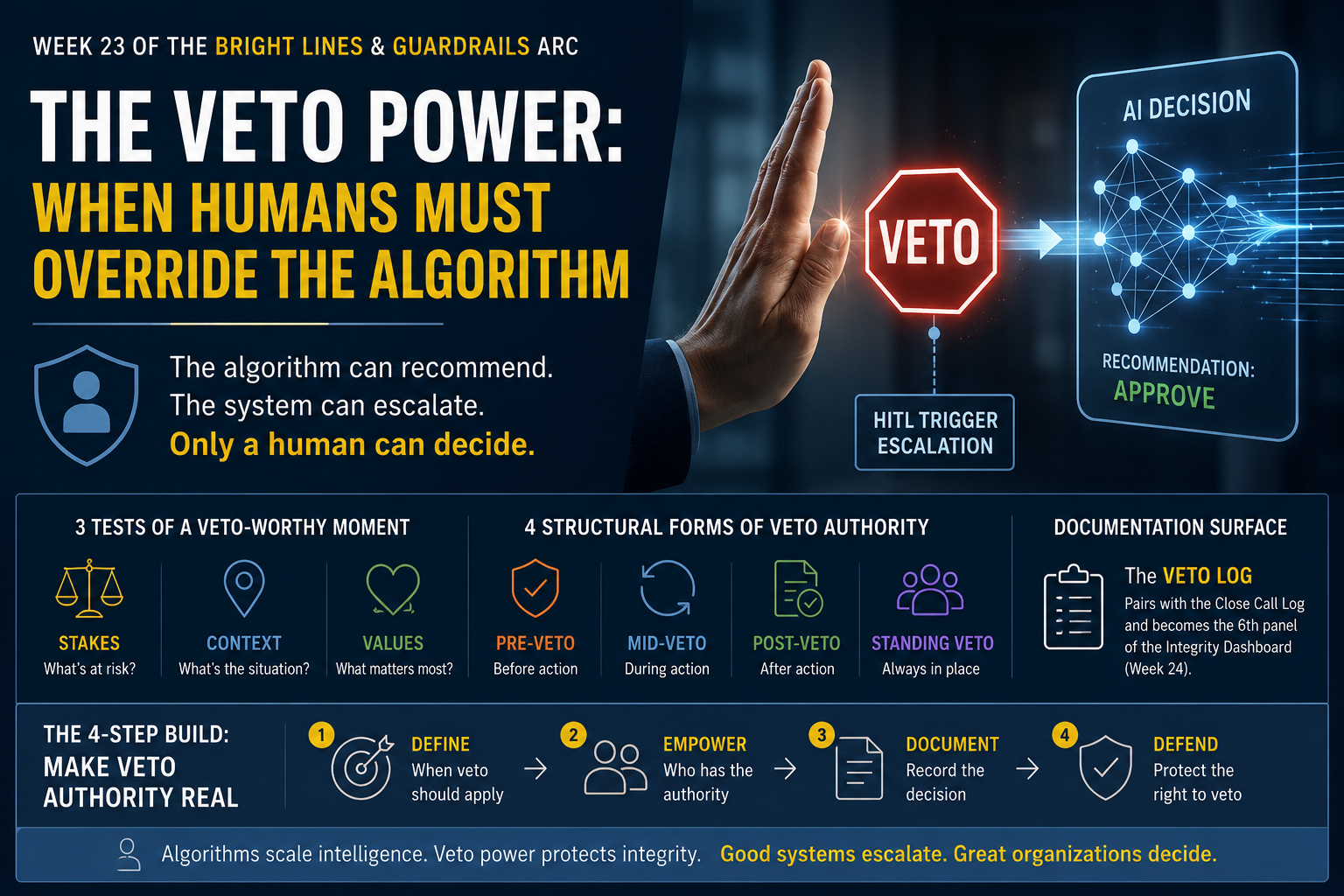
The Three Tests of a Veto-Worthy Moment
Not every escalation is a veto. Most are routine handoffs — the AI did its job, the conversation is now ready for a human. Vetoes are different. A veto is the moment a person formally reverses what the system was about to do.
Three tests, taken together, mark the moments where veto authority is the right instrument.
The stakes test. Would the outcome be defensibly bad if the AI acted alone? Vetoes are reserved for decisions that carry weight — financial, reputational, regulatory, relational. Low-stakes overrides are noise; they teach the organization that veto authority is casual, and casual authority erodes. The stakes test is what keeps the veto rare enough to be respected.
The context test. Does the human have information the AI does not have? The bank president did. The grocery family's leukemia year was not in any data field the model could read. Veto power exists precisely because the model's inputs are always a subset of the situation, and the difference between the subset and the situation is sometimes the entire decision.
The values test. Is this a decision the company has said cannot be made by software alone? Some decisions are not assigned to the algorithm in the first place — not because the AI is wrong, but because the company has decided that this kind of decision belongs to a person. The values test is the structural one. It is the bright line acting as a standing prohibition.
A real veto passes all three tests. A decision that passes only one is usually a coaching moment for the encoding — the system can be improved so the override is not needed next time.
The Four Forms of Veto Power
Once the moment is identified, the form of the veto matters. There are four.
The Pre-Veto. The human reviews before the AI acts. Highest friction. Reserved for the smallest number of decisions — the ones the company has decided will never be delegated to software at all. Pre-vetoes do not require triggers; they require workflows that route the decision to a person before the AI is allowed to surface a recommendation.
The Mid-Veto. The HITL trigger fires, work pauses, a named human decides. This is the form Week 22 was building toward. The encoding is doing its job. The escalation reaches the right desk. The veto is the human action that resolves the paused state. Most vetoes in a well-designed SMB AI stack are mid-vetoes.
The Post-Veto. The AI acted. The human reviews the action afterward and reverses it. Repair work follows — the customer is contacted, the record is corrected, the company makes the situation whole. Post-vetoes are the most costly form because the bad outcome already occurred. They are also the most important form to make easy, because the AI is now acting at a speed that guarantees some decisions will reach the customer before any human sees them.
The Standing Veto. The bright line itself, functioning as a structural veto. The company has said, in advance, that this kind of decision will not be made by software at any time, for any reason. The standing veto is the cheapest form because it operates at the encoding layer — it never reaches a moment of override because the AI was never authorized to act in the first place. Most companies discover, in retrospect, that they wanted more of their veto authority structured as standing vetoes.
Vetoes are not interchangeable. The form has to match the decision.
How to Build Veto Authority Into the Architecture
The four-step build mirrors the May arc's instrument template and the June arc's prior weeks. Reverse the order and the authority leaks.
Step one. Define. Name the decisions where human veto is required. Sort them by form — pre-veto, mid-veto, post-veto, standing veto. The list will be shorter than expected. Most decisions do not require veto authority; the ones that do, do.
Step two. Empower. For each decision in the list, name the person who holds the veto and the standing under which they hold it. Veto authority is not a title; it is an authorization. Without a named person and a named standing, the trigger fires into ambiguity.
Step three. Document. Every exercised veto is recorded — the moment, the override, the rationale, the outcome. The Veto Log is to human authority what the Close Call Log is to organizational integrity. Both are documentation of what did not happen.
Step four. Defend. Quarterly review against the Close Call Log and the Veto Log together. Standing vetoes that get exercised often are candidates for encoding upgrades. Mid-vetoes that get exercised on the same kind of decision repeatedly are signal that the encoding is incomplete. Post-vetoes are the highest-priority review item — every one is evidence that the architecture had a gap the company is now paying to repair.
That sequence — Define, Empower, Document, Defend — is what converts veto power from an instinct into an institution.
What the Bank President's Veto Did
The grocery owner came in the next morning, not knowing how close he had come to a denial letter. The renewal was approved on standard terms. The relationship continued. The Sunday-evening four minutes never appeared in any customer-facing record.
It appeared in one internal record — the Veto Log. Loan renewal denial reversed, customer-context not in model inputs, founder health event resolved, standing relationship 41 years. One row. One sentence. One signal to the encoding team that the model's revenue-dip threshold was firing on cases the bank did not want it to fire on.
The next month, the AI flagged a similar case. The bank president reviewed it the same way and approved. The month after that, the encoding was revised. The threshold was no longer the single trigger; it was now paired with a relationship-tenure check and a recent-context flag. The mid-veto count dropped.
That is what the Veto Power does inside a working architecture. It does not just resolve the immediate decision. It feeds the encoding upgrade that means the same decision will not require a veto next time.
The line was the same line the bank had always held — we lend to people, not to data points — and now it lived in four places: the president's authority, the override field, the Veto Log, and the encoding-review queue.
What Comes Next
Bright Lines name the decisions. Ethics as Code encodes them. The Veto Power preserves what no encoding can carry on its behalf. The three pieces work together.
Next week the June arc closes with Building Your Integrity Dashboard: A Step-by-Step Guide — the practical instrument that holds the architectural defense layer in one frame. The Veto Log becomes one of its six panels. The dashboard is where six months of work becomes one review.
For this week:
Pick one decision in your operation where the AI is currently acting on its own. Ask the three tests against it — stakes, context, values. If it passes any one, name the form of veto that fits and the person who holds it. Then add a row to the Veto Log the first time the authority is exercised.
The May arc taught you to see your integrity. The June arc is teaching you to defend it.
Make today your masterpiece. And start preserving the authority that cannot be encoded.