The counter clerk at a forty-one-person equipment-rental company had been on the job three weeks. On a Friday afternoon, a contractor's generator quit in the middle of a pour.
The contractor was furious. The company's AI drafted a reply in seconds. It quoted the policy: no refunds after twenty-four hours. The clerk read it, checked it against the handbook, and sent it.
Every box was checked. The contractor never rented from them again.
"She did everything right," the owner told me.
"She did everything you taught her," I said.
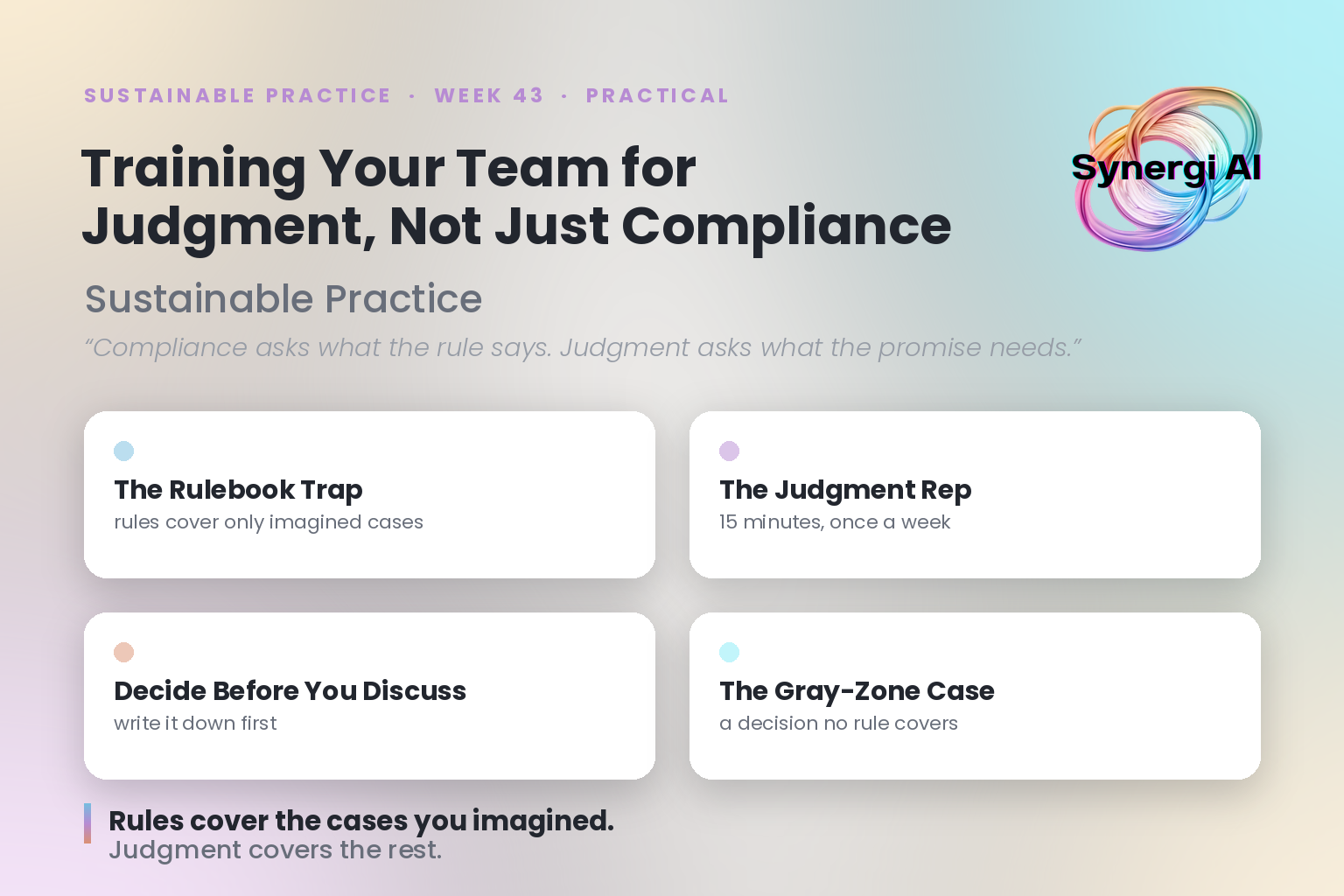
The Rulebook Trap
Last week your team found its own promise in its own words. That sentence is the start. The harder question is what happens in the moment between the sentence and the decision.
Most small companies answer it with rules. Rules are fast to write and easy to test. But they are written for the cases you imagined, and customers bring the rest.
I called the result organizational drift: the slow gap between what a company says and what its systems do. Compliance-only training widens that gap quietly. People follow yesterday's rules into today's situations.
Two failures show up again and again.
- The Rulebook Trap. Training teaches the rule and stops. People follow it when it fits. When it doesn't, they freeze, or they hide. The clerk wasn't careless. She was obedient.
- The Rubber Stamp. The AI's draft sounds sure of itself, so people approve it. Checking feels like arguing with the system, and nobody wants to be the person who slowed things down. Fluent is not the same as right.
An AI system makes both worse. It applies the rule exactly, instantly, and with total confidence, to every customer.
Compliance asks what the rule says. Judgment asks what the promise needs. Your team has to practice the second question exactly where the first one runs out.
This is not a case against rules. Keep your bright lines, the few things that must never bend, and train them hard. But a bright line is a fence, not a map. Inside it, your people make hundreds of calls a week that no rule covers, and your AI is now drafting many of them.
The Judgment Rep
Judgment is a muscle, so train it with reps, not a course. A course teaches the rule once. A rep builds the habit.
A Judgment Rep is fifteen minutes, once a week, right after your Friday wires from the Alignment Rhythm. Two ideas hold it together.
The Gray-Zone Case. A real decision where no rule fit, or two rules disagreed. Pull one from your Close Call Log or from the week's One-Decision Look. Strip the names.
Decide Before You Discuss. Everyone writes their decision on a card before anyone speaks. The newest person reads first. Otherwise the room waits to hear the senior voice, and deference quietly replaces judgment.
Here are the five steps.
- Pick the case (2 minutes). One Gray-Zone Case. Say what the AI drafted and what the person did.
- Read the promise (1 minute). Read your team's sentence aloud, word for word.
- Write before you speak (3 minutes). Each person writes what they would have done, and which verb in the sentence they leaned on.
- Compare (6 minutes). Newest voice first. Look at the verbs people reached for, not at who was right.
- Close the gap (3 minutes). If the case will come back, add one line to the charter of the AI system, the kind you wrote in your first values-driven agent. If it won't, file it. Never add more than one line.
Fifteen minutes is a feature. Anything longer becomes a meeting, and meetings get skipped. Weekly is the point too. A skill unused for a month fades. A clerk who has run ten reps has made ten hard calls with a net under her.
One more piece is permission. In The Veto Power, we named when a human must override the algorithm. A rep is where people practice doing it, with no blame attached. Say it out loud: anyone may stop an AI draft that doesn't fit the promise.
What the Rental Company Did
The owner had already run a clarification session. Her team's sentence was: "If our equipment stops your job, we get you running again."
The next Friday she ran the first rep on the generator case. The clerk read the sentence aloud. Then everyone wrote a card. Four of five wrote some version of "swap the unit and call." One would have refunded on the spot. Nobody wrote "quote the policy."
"I thought the policy was the safe answer," the clerk said.
"It was safe for you," the owner said. "It wasn't safe for the customer."
They added one line to the charter: when a failure stops a customer's job, offer a swap and a call before quoting any policy. The AI's draft changed that afternoon.
Notice what did not change. Nobody got a longer handbook. The clerk got a question she could ask herself at the counter: which verb is this moment asking for?
Three weeks later the clerk stopped a draft that quoted a late fee to a customer whose truck had arrived a day late. Nobody told her to. The sentence had told her.
Three Ways the Rep Fails
- Turning it into a trial. If the rep hunts for who was wrong, people stop bringing real cases. Look at the verbs, not the verdicts.
- A new rule every week. One line, only for a case that will return. Otherwise the rulebook grows back.
- Skipping the newest voice. If the senior person speaks first, you are training agreement.
The Takeaway
Training for compliance makes people safe. Training for judgment makes them trustworthy. The first protects you from the cases you imagined. The second protects your customers from the ones you didn't.
Your AI will keep applying the rule you gave it, all day, with total confidence. Someone in the room has to be practiced at asking whether the rule still serves the promise. Make that everyone.
Try It This Week
- Find one Gray-Zone Case from the last two weeks: a draft your team followed but felt uneasy about.
- Book fifteen minutes after your Friday wires.
- Read your team's sentence first.
- Ask the newest person to read their card first.
Earlier in This Arc
- The Rhythm of Alignment: the three beats the rep plugs into.
- The Values Clarification Session: the ninety minutes that produce the sentence the rep reads aloud.
Where This Leads
Last week your team found the sentence. This week you teach them to use it when you are not in the room. Compliance asks what the rule says. Judgment asks what the promise needs.
Next week the Sustainable Practice arc closes with the annual audit: one checklist for everything you have built.
Make today your masterpiece. And teach your people to carry the promise without you.