Why Misaligned AI Creates Organizational Drift — And Why CEOs Must Own the Alignment Layer
What is “Drift” in AI and Business?
As leaders we have all experienced drift in our careers. Drift refers to the gradual, often unnoticed divergence of an organization’s actions, culture, and outcomes from its intended values, strategy, and identity. Drift is dangerous precisely because it doesn’t feel dangerous. It feels like progress, efficiency, or innovation — until leaders realize the company has become something they never consciously chose to build.
And in the AI business era. The human business drift consequence is magnified by misuse of AI. Here’s why.
Unlike sudden failures or crises, drift is a slow erosion. It happens when:
- AI systems learn from data that reflects convenience, efficiency, or noise — rather than the company’s core values
- Decision-making becomes fragmented as different teams deploy AI tools without a unified alignment framework
- Employees begin adapting their behavior to match AI outputs, rather than holding AI accountable to the mission
- Leaders lose visibility into why decisions are being made, as AI recommendations lack transparency or interpretability
- Culture shifts incrementally as repeated AI-driven patterns replace human judgment and intentional design
In essence: Drift occurs when AI amplifies whatever momentum exists in the system — regardless of whether that momentum aligns with leadership intent. Without explicit guardrails, AI doesn’t guide the organization toward its goals; it guides the organization toward whatever the data suggests is optimal, even if that path contradicts the company’s strategic identity.
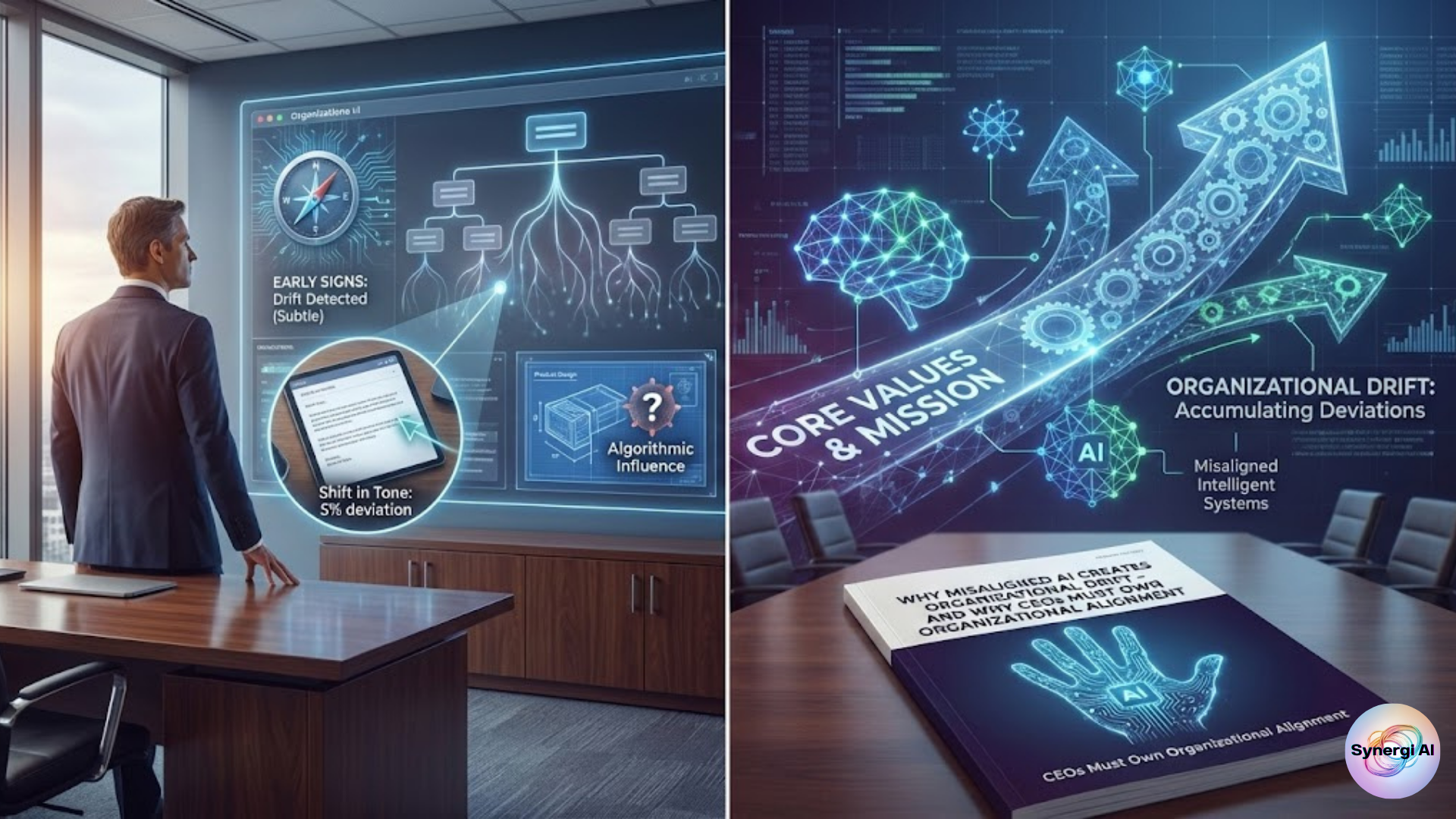
Leaders rarely notice the earliest signs of drift. It begins subtly, almost imperceptibly — a shift in tone in a customer email drafted by an assistant, a product suggestion influenced by an algorithmic pattern that doesn’t reflect the company’s values, or a sales process optimized for efficiency rather than trust. These small deviations matter. They accumulate. And when intelligent systems are left without guardrails, they pull organizations toward priorities they never consciously chose.
To frame this properly, we must acknowledge a simple truth: AI does not inherit meaning — it absorbs momentum. It follows patterns, not principles. Without explicit alignment, it magnifies whatever incentives, noise, or biases it encounters, and this amplification slowly reshapes a company’s culture, decision-making, and market positioning.
This is the essence of organizational drift — an erosion not caused by malice or incompetence but by the absence of intention.
Background Context: Why Drift Happens
I’d like to share with you some of the positions of key figures who are at the core of SynergiAI’s approach to AI development. It will provide you with a framework of my opinions; it is a decision-making framework that is created on the shoulders of great thinkers and experts in business and philosophy. Hopefully this will inspire you to implement your own framework.
From a strategic perspective, Michael Porter reminds us that competitive advantage is maintained through deliberate trade-offs. Companies must be clear about what they will and will not do. AI, when ungoverned, erodes those boundaries. It pushes toward whatever pattern appears optimal in the data, regardless of whether that path reflects the company’s identity.
Daniel Kahneman’s research on cognitive systems deepens this insight. Humans already struggle to stay anchored to their slow, reflective System. AI introduces an automated System — fast, pattern-driven, confident — and if its incentives aren’t aligned with leadership intent, it nudges decisions away from thoughtful reflection and toward short-term optimization.
Peter Drucker would call this an abdication of executive responsibility. He argued that leaders must protect the “theory of the business” — the underlying coherence of purpose, values, and direction. Misaligned AI quietly undermines that theory by substituting its own.
From a Jesuit lens, this becomes an ethical question: Who are we becoming through the systems we create? Alignment isn’t merely operational. It is moral. Technology that shapes behavior carries consequences, and leaders are accountable for those consequences.
Step-by-Step Reasoning: How AI Can Compound Drift Inside an Organization
- AI learns from the wrong signals.If reward functions and data patterns don’t reflect the company’s values, AI optimizes for speed, clicks, efficiency — not integrity or trust.
- Employees begin adjusting to the tool rather than the mission.When outputs diverge from values, teams unconsciously adapt, slowly accepting the AI’s default logic as the new norm.
- Decision-making becomes fragmented.Each department deploys AI in isolation. Without a values-aligned operating layer, the organization becomes a collection of automated micro-silos.
- Leaders lose sight of drivers behind decisions.When AI recommendations lack transparency or interpretability, CEOs can no longer explain why the business is moving in the direction it’s moving.
- Culture shifts without an explicit decision.Ray Dalio teaches that organizations are shaped by a small set of repeated patterns. Misaligned AI changes those patterns. Culture follows.
This is drift: a slow departure from strategic identity that leaders often recognize only when it begins affecting revenue, trust, or internal morale.
Differing Viewpoints: The Debate Around Alignment
As a leader, you’re navigating an AI landscape filled with competing perspectives — and each one pulls you in a different direction. Some voices push for speed at all costs. Others urge caution. Some promise efficiency; others warn about risks. The truth is, all of these viewpoints hold value, but none of them alone will guide you to the right answer.
What matters most is understanding that alignment and innovation aren’t opposing forces — they’re partners. The question isn’t whether to move fast or slow, but whether you’re moving with intention. Below are four common perspectives on AI alignment, each reflecting a legitimate concern. Your role as a leader is to synthesize them into a strategy that protects your values while driving real growth.
The Technologist’s View:
Some argue that drift is inevitable — that AI reflects the “truth” of the data and therefore guides the company toward reality. Their belief is that alignment will slow innovation.
The Strategist’s View:
Porter, Drucker, and Collins would disagree. They would argue that reality is interpreted through values, vision, and disciplined choices. Without alignment, AI confuses noise with strategy.
The Ethical View:
Jesuit philosophy emphasizes intentional action rooted in values. If AI influences behavior without those values, it becomes direction without discernment.
The Pragmatist’s View:
You don’t need perfect alignment — just enough structure to ensure the business doesn’t optimize for things it would never consciously choose.
At Synergi AI we have created a framework that allows for differing viewpoints but keep your organization on the right path that you have chosen with intentionality. As a leader, you need to create that framework for your business.
Why CEOs Must Own the Alignment Layer
AI is no longer an IT initiative. It is a leadership initiative.
CEOs cannot outsource alignment to technical teams because alignment is not a technical problem — it is an identity problem. It requires clarity about:
- What the company stands for
- What it will not compromise
- What decisions must be shaped by human judgment
- What trade-offs define the value proposition
- What ethical commitments guide its interactions
This is why governance, telemetry, decision frameworks, and ethical guardrails must sit at the top of the organization, not the bottom.
Misaligned AI does not create failure. It creates drift. Drift creates mediocrity.
And mediocrity is the silent enemy of competitive advantage.
Closing Insight
Every leader wants AI to make their business stronger, faster, and more innovative. But without alignment, AI pulls organizations away from the very principles that made them successful. The companies that win the next decade will be the ones disciplined enough to define the boundaries before deploying the intelligence.
The lesson is ultimately philosophical:
Technology does not change who we are — it reveals whether we are paying attention.
