Overview
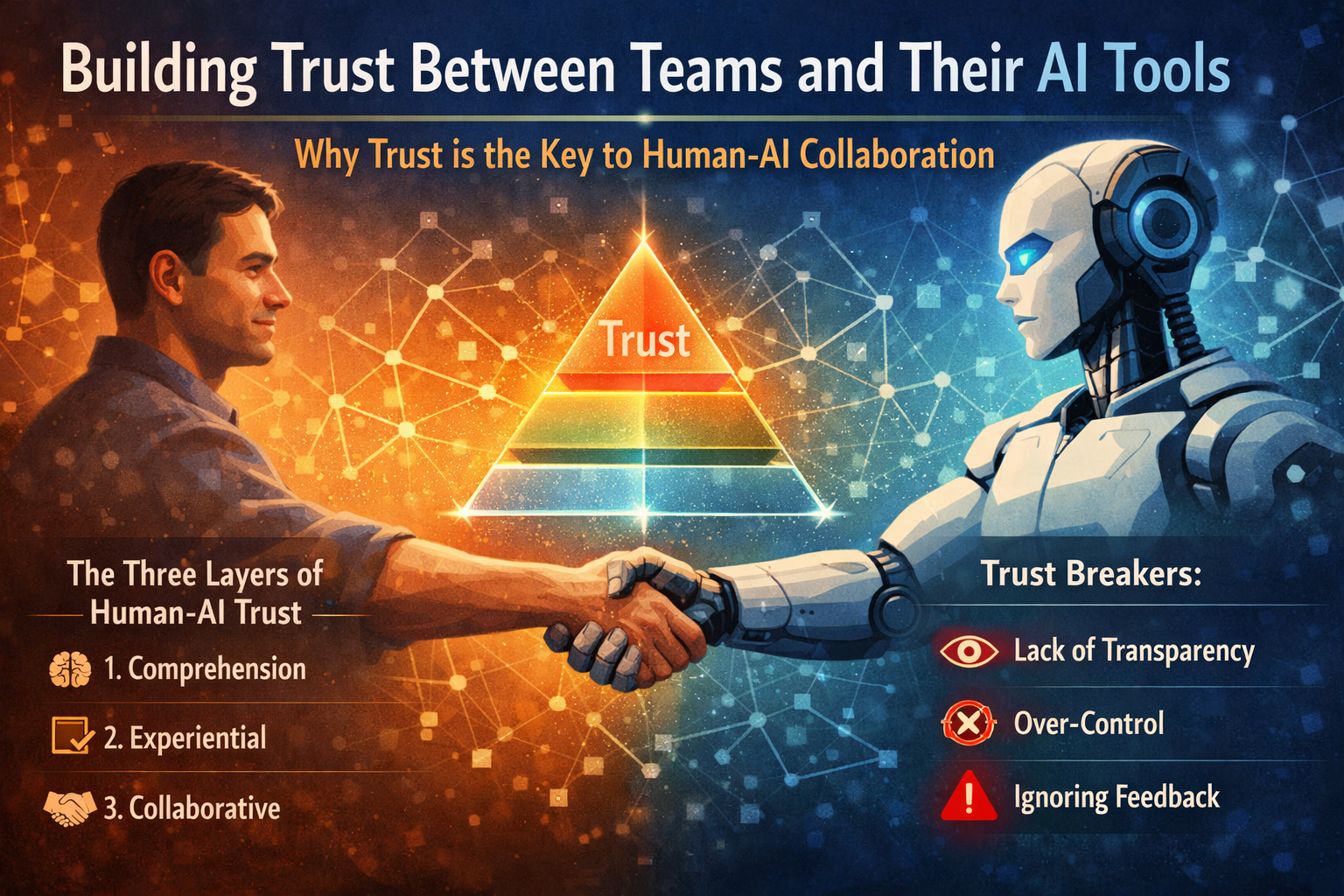
This article explores why trust — not accuracy — is the primary bottleneck in human-AI collaboration. It introduces the Three Layers of Human-AI Trust (comprehension, experiential, and collaborative) as a developmental model for how teams come to rely on AI tools, and identifies three organizational behaviors that destroy trust faster than any technical failure. Building on the Pause Framework (Week 10) and the Service Principle (Foundation #3, Week 9), this article reframes trust as organizational infrastructure rather than a soft skill — the invisible layer that determines whether capable AI systems get used, gamed, or ignored.
Best for: CEOs, operations leaders, and team managers overseeing AI tool adoption and human-AI workflow integration When to use: During AI rollout planning, when adoption rates are low despite high system accuracy, when teams build shadow systems alongside official AI tools, when override rates are suspiciously low or high Expected outcome: A developmental roadmap for building trust between teams and AI systems, with clear indicators of trust health and specific behaviors to avoid Prerequisites: Familiarity with the Service Principle (Foundation #3, Week 9) and the Pause Framework (Week 10)
The Problem
Organizations invest heavily in AI system capability — accuracy, speed, analytical power — but underinvest in the human trust required for adoption. The result is capable systems that teams ignore, work around, or comply with ceremonially without genuine reliance. A system that is ninety-seven percent accurate but distrusted by its users produces less organizational value than a less capable system that teams actively engage with, question, and integrate into their judgment.
The core distinction: Technical trust asks “Is the system accurate?” Human trust asks “Do I understand it enough to stake my judgment on it?” These are fundamentally different questions. Accuracy is a system property. Trust is a relationship property — and relationships develop through understanding, experience, and psychological safety, not data sheets.
Connection to the Pause Framework: The Pause Framework (Week 10) established when humans must exercise judgment over algorithmic recommendation. But the pause only functions if people trust themselves enough to exercise it and trust the system enough to know when not to. Trust is the enabling condition for the entire human-in-the-loop architecture.
Why This Matters
Low human-AI trust creates three organizational failure modes:
| Failure Mode | What It Looks Like | Root Cause |
|---|---|---|
| Over-trust (rubber stamping) | Teams approve AI recommendations without genuine review, leading to the ceremonial loop described in Week 10 | Comprehension layer skipped — people don’t understand the system well enough to question it |
| Under-trust (shadow systems) | Teams build parallel manual processes alongside AI tools, duplicating effort and ignoring system output | Experiential layer absent — system hasn’t earned confidence through demonstrated reliability in recognizable contexts |
| Compliance without commitment | Teams use the AI tool as required but don’t integrate its output into genuine decision-making | Collaborative layer never reached — teams view the system as imposed rather than partnered |
The organizational cost: All three failure modes waste the investment in AI capability. The system works, but the organization doesn’t benefit proportionally because the human-AI relationship is underdeveloped. Trust is the infrastructure that converts AI capability into organizational value.
The Framework: Three Layers of Human-AI Trust
Layer 1: Comprehension Trust
The question: “Do I understand what this system does and why?”
Comprehension trust is the foundation layer. Before people trust a tool, they need to understand it at a purpose level — not what it can do, but why it works the way it does, what it considers, and what it ignores. Most AI rollouts skip this layer entirely, demonstrating output without revealing logic.
Why it matters: People who don’t understand a system cannot exercise judgment about when to trust it and when to question it. Without comprehension trust, teams either over-trust (rubber stamp) or under-trust (shadow systems). Both responses represent a failure of understanding, not a failure of capability.
How to build it: Explain the system’s reasoning in human terms — not the math, but the logic. “The system recommended this because it weighted these three factors and deprioritized these two.” When teams understand the why, they can engage with the what. This connects directly to Marker 3 from Foundation #3 (The System Explains Itself).
Layer 2: Experiential Trust
The question: “Has this system earned my confidence through demonstrated reliability in contexts I recognize?”
Experiential trust develops through repeated interaction — using the system, seeing it perform well, and critically, seeing it handled well when it performs poorly. This layer cannot be shortcut. Organizations that expect teams to trust AI after a demo and a training session are attempting to skip experience, and trust that skips experience is brittle.
The trust-destroying moment: The most damaging event is not when the AI gets something wrong. It is when the AI gets something wrong and the error is explained away, minimized, or blamed on the user. When teams learn that the system is defended rather than governed, their trust collapses — not just in the tool, but in the organization’s commitment to honest collaboration.
How to build it: Create safe spaces for teams to test AI recommendations against their own judgment without consequence. Celebrate when someone catches the system getting it wrong. Make error acknowledgment part of the culture. Trust grows fastest when questioning the system is welcomed rather than punished. This directly extends the override culture from the Pause Framework (Week 10).
Layer 3: Collaborative Trust
The question: “Do I believe this system and I work better together than either of us works alone?”
Collaborative trust is the highest and rarest layer. It emerges when teams stop viewing AI as a tool they use and start experiencing it as a partner they work with — not because the AI has intentions, but because the interaction pattern becomes genuinely reciprocal. The human brings context, judgment, and relational awareness. The AI brings speed, pattern recognition, and analytical breadth. Each contributes what they do best.
Connection to Service Principle: This is where the Service Principle (Foundation #3) comes to life operationally. Technology extending human capacity. Not one replacing the other, but both contributing their distinctive strengths.
How to build it: Design workflows where human and AI contributions are both visible and valued. Show teams how their input improves the system’s output. Create feedback loops where AI recommendations evolve based on human corrections — and make that evolution visible. When people see their judgment shaping the system, they stop viewing it as a black box and start viewing it as a collaborator.
The Trust Killers
Three organizational behaviors destroy human-AI trust faster than any technical failure:
| Behavior | What It Communicates | Trust Impact |
|---|---|---|
| Deploying without explaining | “Use this tool; don’t ask how it works” | Prevents comprehension trust from forming; creates compliance without understanding |
| Defending the system instead of governing it | “The technology matters more than your judgment” | Destroys experiential trust; teaches teams that errors will be rationalized, not addressed |
| Punishing the pause | “Questioning the AI is resistance, not leadership” | Prevents collaborative trust; trains the most thoughtful people to stop thinking |
The common message: All three behaviors communicate that the system matters more than human judgment. Once teams receive that message, trust doesn’t stall — it reverses.
Key Takeaways
- Trust, not accuracy, is the adoption bottleneck: A system can be highly accurate and still distrusted. Trust is a relationship property, not a system property, and it develops through understanding, experience, and psychological safety.
- Trust develops in three layers: Comprehension (understanding what the system does and why), experiential (seeing it perform and fail honestly), and collaborative (experiencing genuine reciprocity). Skipping a layer makes trust brittle.
- Three behaviors destroy trust faster than technical failure: Deploying without explaining, defending instead of governing, and punishing the pause. All three communicate that the system matters more than human judgment.
- Trust is infrastructure, not a soft skill: It is the invisible layer that determines whether AI capability converts into organizational value. Without it, capable systems get ignored, gamed, or ceremonially complied with.
- Override culture enables trust: The override culture from Week 10’s Pause Framework is the behavioral foundation of trust. When questioning the system is genuinely welcomed, trust develops naturally. When it is merely tolerated, trust remains superficial.
Related Resources
Series Context
- Previous: Week 10 – “The Human-in-the-Loop Imperative: When to Pause the Algorithm“
- Next: Week 12 – “The Hierarchy of AI Assistance: From Tool to Partner”
- Foundation: Week 9 – “AI in Service of Humanity: Returning Technology to Its Proper Place” (Foundation #3)
March Series (Human-AI Collaboration)
- Week 9: AI in Service of Humanity (Foundation #3)
- Week 10: The Human-in-the-Loop Imperative
- Week 11: Building Trust Between Teams and Their AI Tools (This article)
- Week 12: The Hierarchy of AI Assistance: From Tool to Partner
Concepts Extended
- Service Principle (Foundation #3, Week 9) — operationalized through collaborative trust: technology extending human capacity through genuine partnership
- Marker 3: The System Explains Itself (Week 9) — connected to comprehension trust: understanding the why, not just the what
- Marker 4: The Human Can Say No (Week 9) — trust is the enabling condition for meaningful exercise of override authority
- The Pause Framework (Week 10) — override culture as the behavioral foundation of experiential trust
- Rubber Stamp Problem (Week 10) — reframed as over-trust: a failure of the comprehension layer
- Judgment Atrophy (Week 10) — a consequence of trust that never develops past compliance
New Concepts Introduced
- Three Layers of Human-AI Trust (comprehension, experiential, collaborative)
- Comprehension Trust (understanding at purpose level, not technical level)
- Experiential Trust (confidence earned through demonstrated reliability and honest error handling)
- Collaborative Trust (reciprocal partnership where both human and AI contributions are visible and valued)
- Trust Killers (deploying without explaining, defending instead of governing, punishing the pause)
- Shadow Systems (parallel manual processes built alongside distrusted AI tools)
- Trust as Infrastructure (the invisible layer converting AI capability into organizational value)
Version History
- v1.0.0 (2026-03-17): Initial publication – Extension of Foundation #3 introducing the Three Layers of Human-AI Trust framework
