Overview
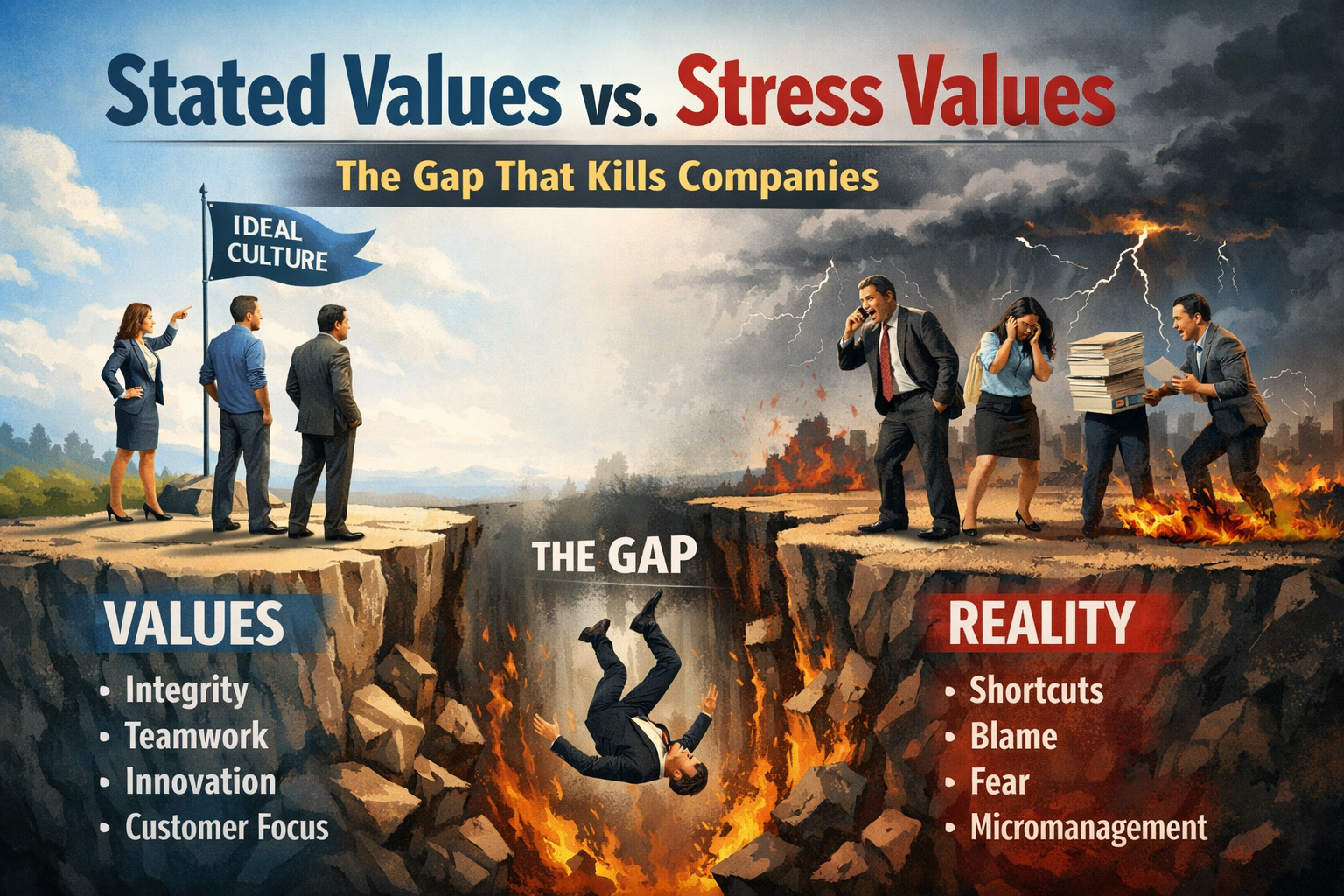
Every organization operates with two sets of values: stated values (aspirational, declared during stability) and stress values (operational, revealed under pressure through actual decisions). The gap between them erodes internal trust, betrays values-aligned customers, and — critically — corrupts AI systems that inherit organizational hypocrisy at machine speed and scale. This article introduces the Stress Audit framework and provides four practices for closing the gap before the next crisis exposes it.
Best for: CEOs, COOs, and leadership teams evaluating organizational readiness for AI implementation When to use: Before embedding values into AI systems, during governance design, after organizational crises, or when employees signal distrust of stated values Expected outcome: Honest assessment of values consistency and practical steps to close the gap between stated and stress values Prerequisites: Familiarity with AI Alignment Manifesto (Week 5) and Two Operating Systems (Week 6)
The Problem
Organizations declare values during calm, stable conditions — but reveal different values under financial pressure, competitive threat, or internal disruption. This creates a structural gap that compounds over time.
Stated Values are crafted in calm conditions. They appear on websites, in employee handbooks, in investor decks. They represent aspirational identity — who the organization wants to be.
Stress Values emerge through actual decisions under pressure. They live in what gets cut first, who gets protected, which principles get downgraded from “non-negotiable” to “guideline,” and which corners get rounded.
The critical distinction: Stated values tell the market who you want to be. Stress values tell your people who you actually are. People always know — they feel the shift even when they lack the language for it.
Why This Matters
The gap between stated and stress values creates three compounding consequences:
| Consequence | What It Looks Like | Root Cause |
|---|---|---|
| Internal Erosion | Employees develop cynicism toward stated values; best people leave first; ethical concerns go unreported | Repeated experience of values abandoned under pressure |
| Customer Betrayal | Values-aligned customers feel deceived; reputational damage exceeds ordinary churn | Customers chose the organization for its principles, not its price |
| AI Amplification | AI systems built on stated values amplify organizational hypocrisy at machine speed | Digital systems inherit corrupted analog operating system |
Scale of danger: A leader can be inconsistent in one meeting. An AI system can be inconsistent in ten thousand interactions per hour. The gap between stated and stress values corrupts the analog operating system (introduced Week 6), and the digital system inherits that corruption at scale.
The Framework: Closing the Values Gap
Practice 1: Conduct a Stress Audit
A backward-looking examination of the last three organizational crises to identify where stated and stress values diverge.
Audit questions:
| Question | What It Reveals |
|---|---|
| What did we protect first? | What the organization actually values most |
| What did we sacrifice first? | What the organization considers expendable |
| Which values survived the pressure? | The real non-negotiables |
| Did our decisions match what we say we believe? | The size of the gap |
Key principle: This is an exercise in truth, not shame. You cannot align what you will not acknowledge.
Practice 2: Define Bright Lines Under Pressure
Identify 3-5 commitments that hold regardless of financial circumstances — survival values, not aspirational values.
The test: Name the values you’d keep if revenue dropped 40%.
Key insight: “If you can’t name them under hypothetical pressure, you won’t hold them under real pressure.”
Distinction from stated values: Bright lines are tested against pressure scenarios. Stated values are articulated in comfort. The difference matters.
Practice 3: Build Stress Scenarios Into AI Governance
Most AI governance tests for normal conditions only. Stress-testing the alignment layer requires simulating pressure:
| Stress Scenario | What to Monitor |
|---|---|
| Budget cuts | Do values constraints get reduced alongside spending? |
| Consolidated override authority | Does human veto access narrow under pressure? |
| “Efficiency mode” activation | Are values constraints the first casualty of cost reduction? |
| Quarterly pressure | Does AI behavior shift toward short-term optimization? |
Key insight: “An alignment layer that holds in calm but breaks under pressure isn’t alignment. It’s decoration.”
Practice 4: Make the Gap Visible
Create mechanisms that surface the distance between stated and stress values:
- Decision journals: Leaders document reasoning behind high-pressure choices
- Values retrospectives: Post-crisis review of whether decisions matched stated values — for learning, not punishment
- Anonymous feedback channels: Employees flag when they see the gap widening
- Alignment dashboards: Track whether AI system behavior shifts during high-pressure periods
Key principle: “What you can see, you can close. What stays invisible compounds.”
Key Takeaways
- Two value sets are universal: Every organization has stated values (aspirational) and stress values (operational). The question is how large the gap between them is.
- The gap compounds: Internal erosion leads to talent loss, customer betrayal leads to reputational damage, and AI amplification scales hypocrisy at machine speed.
- AI alignment cannot exceed organizational alignment: If the human value system is inconsistent under stress, AI systems built on stated values will inherit and amplify that inconsistency.
- Consistency beats perfection: Customers and employees expect the organization to be the same on a bad day as on a good one. Consistency under pressure is the rarest and most valuable organizational trait.
- Alignment is proven under stress, not in stability: Companion truth to Week 5’s principle that alignment is a practice, not a destination.
Related Resources
Series Context
- Previous: Week 6 – “The Two Operating Systems: Analog Values, Digital Execution”
- Next: Week 8 – “The Alignment Audit: 10 Questions Every CEO Should Ask”
- Foundation: Week 5 – “AI Alignment Manifesto: A Declaration for Values-Driven Intelligence”
February Series (The Alignment Imperative)
- Week 5: AI Alignment Manifesto (Foundation #2)
- Week 6: The Two Operating Systems
- Week 7: Stated Values vs. Stress Values (This article)
- Week 8: The Alignment Audit: 10 Questions Every CEO Should Ask
Concepts Extended
- Alignment Layer (introduced Week 6) — must be stress-tested, not just designed
- Two Operating Systems (introduced Week 6) — the values gap corrupts the analog OS
- Declaration 6: Alignment Is a Practice (Week 5) — companion truth: proven under stress
- Values Before Variables (Declaration 1, Week 5) — which values survive pressure?
New Concepts Introduced
- Stated Values vs. Stress Values
- The Values Gap
- Stress Audit framework
- Bright Lines Under Pressure
- AI Governance Stress Testing
- Decision Journals
- Values Retrospectives
- Alignment Dashboards (stress-aware)
Version History
- v1.0.0 (2026-02-17): Initial publication – Extends Foundation Article #2 with Stated Values vs. Stress Values framework
