Overview
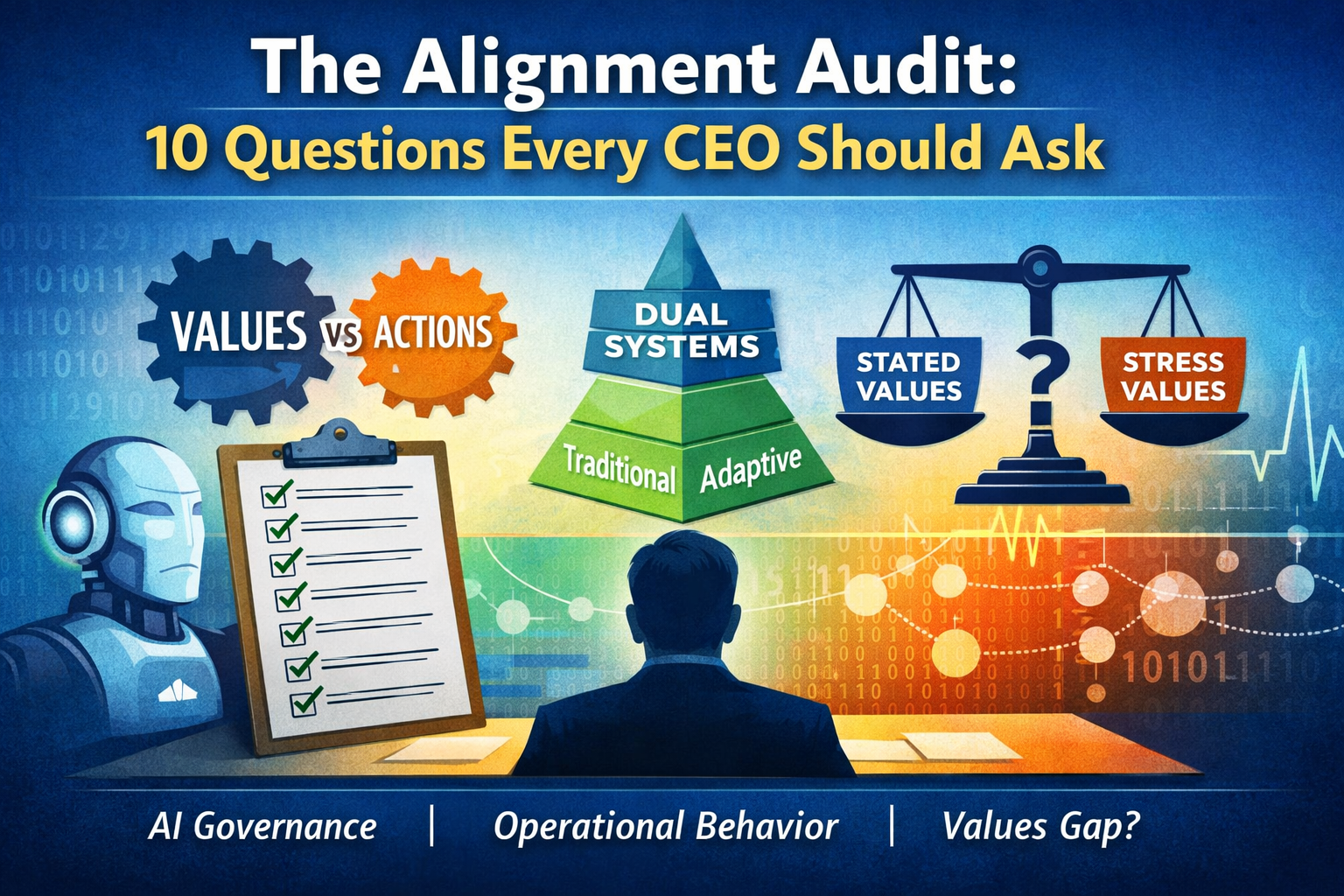
This article provides a practical, 10-question diagnostic tool that CEOs and leadership teams can use to assess their organization’s alignment health — the consistency between stated values, operational behavior, and AI system governance. The questions synthesize frameworks from the full February series: the AI Alignment Manifesto’s seven declarations (Week 5), the Two Operating Systems architecture (Week 6), and the Stated Values vs. Stress Values gap analysis (Week 7). Each question targets a specific dimension of alignment and reveals whether values are operating or merely decorating.
Best for: CEOs, COOs, and leadership teams evaluating organizational and AI alignment readiness When to use: Quarterly self-assessment, before AI implementation decisions, after organizational crises, during governance reviews Expected outcome: An honest diagnostic of alignment health across five dimensions, with clear indicators of where gaps exist Prerequisites: Familiarity with AI Alignment Manifesto (Week 5), Two Operating Systems (Week 6), and Stated Values vs. Stress Values (Week 7)
The Problem
Most organizations lack a structured way to evaluate whether their stated values are actually operating — in human decisions and AI systems alike. Leadership teams assume alignment exists because values are documented, but documentation is not implementation. Without a diagnostic tool, the gap between aspirational identity and operational reality remains invisible until a crisis exposes it.
The core challenge: Organizations need a repeatable, honest assessment mechanism that tests alignment across multiple dimensions — not just whether values exist on paper, but whether they hold under pressure, translate into AI governance, and remain consistent across business conditions.
Why This Matters
The alignment audit addresses five dimensions that compound when neglected:
| Dimension | What It Tests | Why It Matters |
|---|---|---|
| Values Clarity | Whether leadership can articulate and trace the origin of core values | Values that aren’t internalized by decision-makers cannot guide decisions |
| Alignment Architecture | Whether an explicit translation layer exists between human values and AI behavior | Without architecture, AI systems interpret values independently — creating uncontrolled drift |
| The Values Gap | Whether stated values match actual behavior under pressure | The gap between stated and stress values (introduced Week 7) corrupts both culture and AI systems |
| Stress Integrity | Whether governance holds under simulated and real pressure conditions | Alignment layers that break under stress are decoration, not governance (established Week 7) |
| Operational Consistency | Whether AI behavior and organizational review practices remain stable across business conditions | Conditional values — values that shift with financial pressure — are not values at all |
The Framework: The Alignment Audit
Dimension 1: Values Clarity (Questions 1-2)
Question 1: Can your leadership team name your core values without looking them up? Values that decision-makers cannot recite are not operating in daily decisions. They exist as documentation, not as guidance. This question tests whether values have moved from the wall to the workflow.
Question 2: Were your values developed through deliberation — or inherited through tradition? Values adopted without stress-testing at the point of adoption are unlikely to survive their first operational test. Deliberated values carry the weight of considered commitment. Inherited values carry the weight of habit — which breaks under novel pressure.
Dimension 2: Alignment Architecture (Questions 3-4)
Question 3: Does your organization have an explicit alignment layer between human values and AI behavior? The alignment layer (introduced Week 6) is the translation mechanism between the analog operating system (human values, culture, decisions) and the digital operating system (AI agents, algorithms, automation). Without an explicit layer, AI systems interpret organizational values independently, creating uncontrolled value drift.
Question 4: Who has override authority when an AI system makes a values-inconsistent decision? Override authority is the operational test of human governance over AI systems. If the answer is unclear, undefined, or limited to technical staff without values context, the organization lacks functional governance.
Dimension 3: The Values Gap (Questions 5-6)
Question 5: What did your organization protect first in its last crisis? This question applies the Stress Audit framework (introduced Week 7). The gap between what a leader wishes they had protected and what actually happened reveals the alignment gap — the structural distance between stated and stress values.
Question 6: Can you name three commitments you’d keep if revenue dropped forty percent? Bright lines under pressure (introduced Week 7) are survival values — commitments that hold regardless of financial conditions. The inability to name them under hypothetical pressure predicts the inability to hold them under real pressure.
Dimension 4: Stress Integrity (Questions 7-8)
Question 7: Have you stress-tested your AI governance under simulated pressure conditions? Most AI governance frameworks test under normal conditions only. Stress-testing the alignment layer under simulated budget cuts, consolidated authority, and efficiency mandates reveals whether governance is structural or cosmetic.
Question 8: Do your employees trust your stated values — or have they learned to discount them? Employee perception is the most accurate indicator of alignment health. When employees develop cynicism toward stated values — hearing “integrity” and thinking “until it costs something” — the values gap has become structural.
Dimension 5: Operational Consistency (Questions 9-10)
Question 9: Does your AI behave the same way during a strong quarter as it does during a weak one? Conditional AI behavior — systems that shift toward short-term optimization under financial pressure — reveals that values are not embedded in the system architecture. They are parameters subject to override.
Question 10: When was the last time you reviewed whether your organization’s actions matched its stated principles? Alignment is a practice, not a destination (Declaration 6, Week 5). Practices require regular examination. The absence of regular review is itself a diagnostic finding — it indicates alignment is assumed rather than maintained.
Key Takeaways
- Alignment is diagnosable: These ten questions provide a structured, repeatable assessment that moves alignment from abstract aspiration to measurable organizational health metric.
- Five dimensions cover the full alignment surface: Values clarity, alignment architecture, the values gap, stress integrity, and operational consistency together capture where alignment holds and where it breaks.
- The audit synthesizes the full February series: Each question traces directly to frameworks established across Weeks 5-7 — the seven declarations, the two operating systems, the alignment layer, and the stated-vs-stress values distinction.
- Honesty is the prerequisite: The audit is only useful if answered truthfully. Aspirational answers reproduce the same gap the audit is designed to expose.
- Alignment is a practice: A single audit is a starting point. Quarterly repetition reveals whether the gap is closing, holding, or widening — turning a snapshot into a trend.
Related Resources
Series Context
- Previous: Week 7 – “Stated Values vs. Stress Values: The Gap That Kills Companies“
- Next: Week 9 – “AI in Service of Humanity: Returning Technology to Its Proper Place”
- Foundation: Week 5 – “AI Alignment Manifesto: A Declaration for Values-Driven Intelligence“
February Series (The Alignment Imperative)
- Week 5: AI Alignment Manifesto (Foundation #2)
- Week 6: The Two Operating Systems
- Week 7: Stated Values vs. Stress Values
- Week 8: The Alignment Audit: 10 Questions Every CEO Should Ask (This article)
Concepts Extended
- Alignment Layer (introduced Week 6) — tested via Questions 3, 4, 7
- Two Operating Systems (introduced Week 6) — analog/digital translation via Question 3
- Stress Audit (introduced Week 7) — applied via Questions 5, 6
- Bright Lines Under Pressure (introduced Week 7) — tested via Question 6
- Stated vs. Stress Values (introduced Week 7) — diagnosed via Questions 5, 8
- Alignment as Practice (Declaration 6, Week 5) — operationalized via Question 10
New Concepts Introduced
- The Alignment Audit (10-question diagnostic framework)
- Five Dimensions of Alignment Health (values clarity, alignment architecture, values gap, stress integrity, operational consistency)
- Alignment as diagnosable organizational health metric
Version History
- v1.0.0 (2026-02-23): Initial publication – Closes February’s “The Alignment Imperative” series with practical diagnostic tool synthesizing Weeks 5-7
