
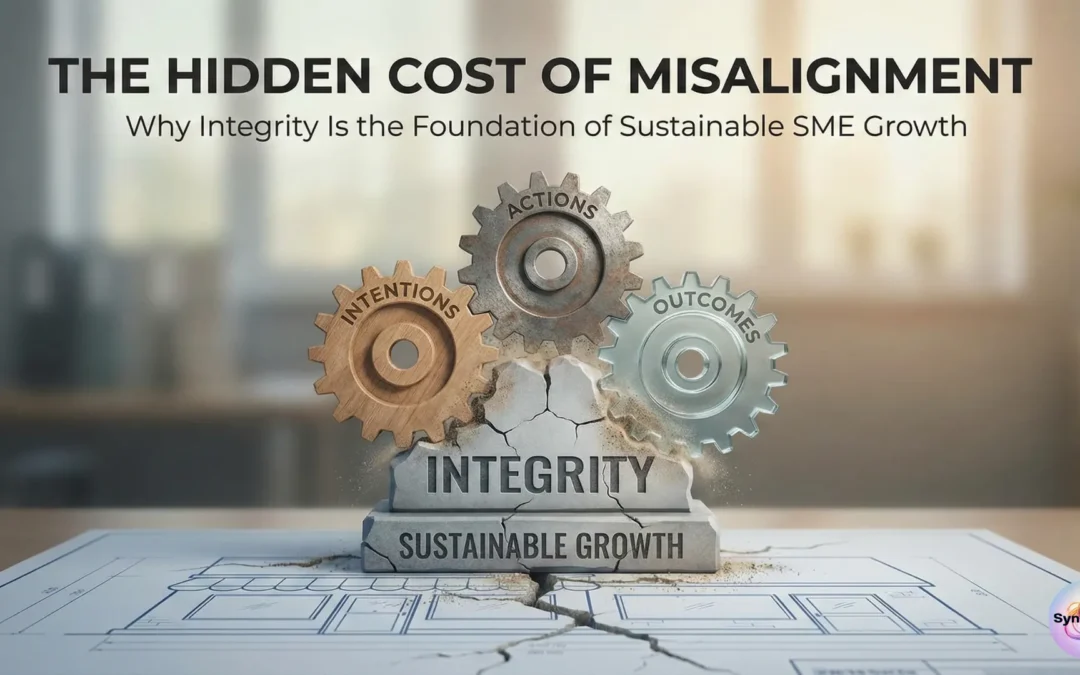
The Hidden Cost of Misalignment:
Why Integrity Is the Foundation of Sustainable SME Growth
Small and midsize businesses often believe their biggest challenges come from competition, market shifts, or technology disruption. But the most costly force working against growth is usually internal. It’s the quiet erosion caused by misalignment—when intentions, actions, and outcomes no longer match.
Peter Drucker warned leaders that “organizational confusion is the enemy of performance.” Jim Collins reinforced the idea when he observed that great companies maintain discipline in people, thought, and action. Yet many organizations drift because their stated values and their daily behaviors do not match. That gap is where trust breaks, performance drops, and culture weakens.
Integrity closes that gap.
Integrity is not a moral decoration; it is a structural advantage. It creates predictability in how decisions are made, how people behave under pressure, and how value is delivered to customers. In a world shaped by AI and accelerating change, integrity becomes more than a virtue—it becomes a growth strategy.
Where Misalignment Comes From
Daniel Kahneman’s work on cognitive biases reminds us that humans default to shortcuts when under stress. When values are unclear, shortcuts become inconsistent. That inconsistency multiplies across teams, leading to higher turnover, uneven customer experience, and wasted resources.
Based on this perspective, growth strategies often fail not because leaders lack ambition, but because their organizations have quietly drifted off course. The gap between what a company says it values and how it actually operates rarely announces itself with fanfare. Instead, it accumulates through a thousand small compromises—a process shortcut here, a priority shift there, a value statement that looks impressive on the wall but disappears under pressure. These fractures don’t originate from negligence or bad intent. They emerge naturally as organizations evolve, adapt, and respond to an increasingly complex business environment. Understanding where misalignment originates is the first step toward building the coherence that sustainable growth requires.
Key items to remember:
- Misalignment usually forms unintentionally.
- Small process gaps become operational detours.
- Shifting priorities create conflicting expectations.
- Unclear values lead to inconsistent decision-making.
Why Integrity Matters for Growth
Ask most business leaders where their growth problems come from, and you’ll hear about competitors, market conditions, or resource constraints. But the real drag on performance often lives closer to home—buried in the gap between what a company claims to value and how it actually operates day to day. When that gap widens, execution slows, trust erodes, and even the best strategies fail to take hold. This is where integrity becomes more than an ethical ideal—it becomes the structural glue that holds growth together. In an era where AI can amplify everything an organization does, the question is no longer whether to scale, but whether what you’re scaling is actually aligned with who you say you are.
Integrity creates coherence—a state where your values, systems, and actions support each other.
When coherence is present:
- Teams execute faster because they understand the why behind decisions.
- Customers trust the brand because service feels consistent.
- Leaders move with clarity instead of reacting to noise.
- AI adoption becomes safer and more effective because automation reflects the organization’s true intent.
Without integrity, AI accelerates confusion.
Without alignment, growth becomes unstable.
Sustainable growth depends on steadiness in motion: a clear identity, a trusted culture, and a predictable decision-making model that holds even when pressure rises.
The Leadership Imperative
Every leader eventually reaches a point where the complexity of growth demands more than instinct or experience alone. It requires something deeper: the ability to pause, examine competing priorities, and choose the path that serves not just immediate results but lasting purpose. This is the practice of discernment—and it has been central to my own journey as a leader. Discernment is not hesitation. It is clarity forged through reflection. It is the discipline of asking the hard questions before the pressure of the moment forces a reactive answer. And in a business environment where misalignment can quietly unravel even the strongest strategies, discernment becomes the most practical tool a leader can cultivate.
Leaders must ask a simple but revealing question:
“Where in my organization is misalignment costing us the most?”
For some, it’s unclear values.
For others, inconsistent operations.
For many, it’s decisions made differently by every leader in the company.
The Jesuit tradition emphasizes discernment—examining intentions, clarifying purpose, and acting in alignment with one’s deepest commitments. For modern organizations, the same principle applies: sustainable growth requires a coherent identity expressed through action. I am not perfect, but I try to practice this discipline on a daily basis. I hope you do too.
Integrity as the First Step Toward AI Readiness
Before AI automates anything, leaders must determine what they want AI to reflect.
If your culture is inconsistent, AI will amplify that inconsistency.
If your values are clear, AI will strengthen that clarity.
This is why integrity is not a philosophical topic—it is an operational one.
Sustainable SME growth begins not with technology but with alignment.
Not with efficiency but with coherence.
Not with speed but with integrity.
So here’s what I invite you to do today:
- Identify one area in your organization where what you say and what you do are out of sync. It might be in how decisions are made, how performance is rewarded, or how customer promises are kept. Name it honestly.
- Ask your leadership team the same question. Make space for uncomfortable truth. The misalignment you can’t see is costing you more than the one you can.
- Commit to closing that gap—not someday, but this quarter. Align your systems, your incentives, and your communication to reflect the values you claim to hold.
Misalignment is costly. Integrity is the cure.
And the organizations that act on this now—before adding more tools, more automation, or more complexity—will be the ones that grow wisely, without sacrificing their people, their customers, or their identity.
The question is not whether you can afford to prioritize integrity.
It’s whether you can afford not to.