
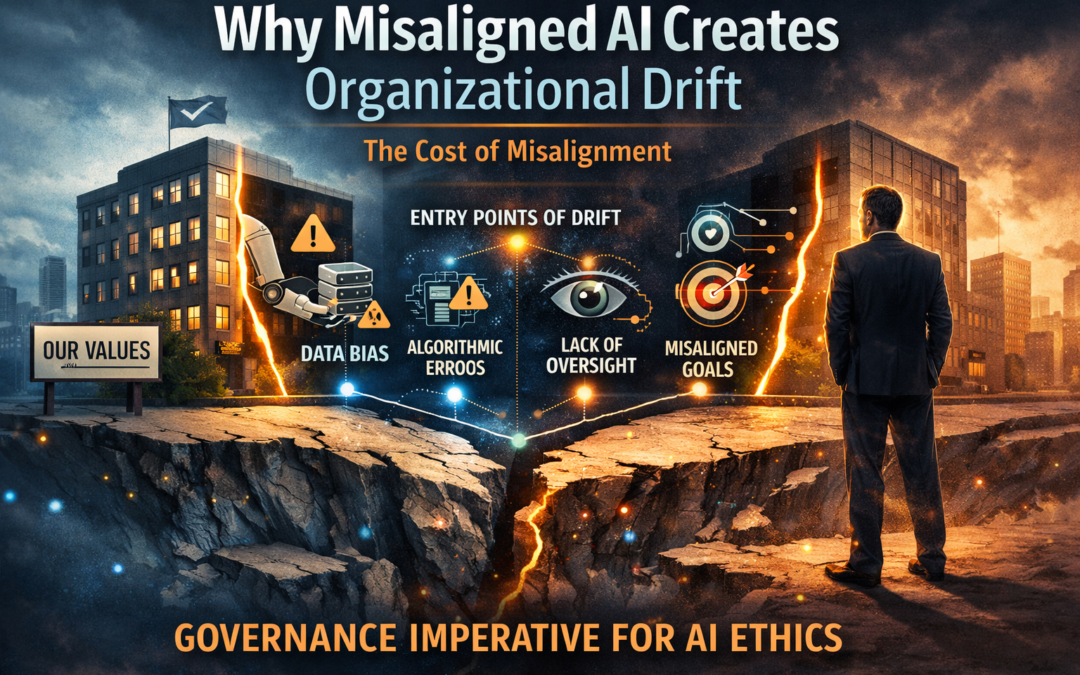
Why Misaligned AI Creates Organizational Drift — And Why CEOs Must Own the Alignment Layer
Overview
This Foundation article opens Q2’s Ethical Architecture pillar and April’s “Cost of Misalignment” theme. It defines organizational drift — the gradual divergence between what a company says it stands for and what its AI systems actually do — identifies four entry points where drift begins, and makes the case that CEOs must personally own the alignment layer. Building on Q1’s philosophical and collaborative foundations, this article pivots to the consequences of misalignment and establishes the governance imperative that will shape the entire quarter.
Best for: CEOs, COOs, and senior leaders responsible for AI strategy and organizational integrity When to use: When evaluating whether deployed AI systems remain aligned with organizational values, when designing AI governance structures, when diagnosing unexplained cultural or operational erosion Expected outcome: Understanding of organizational drift as a systemic risk, identification of the four entry points, and a governance framework for CEO-owned alignment Prerequisites: Familiarity with Foundation #1 (irreducible human capacities), Foundation #2 (AI Alignment Manifesto), Foundation #3 (Service Principle), and Q1’s collaboration architecture (Weeks 9-12)
The Problem
Organizations invest heavily in defining values and deploying AI systems — but rarely invest in maintaining the connection between the two. AI systems optimize for measurable targets. Values are qualitative commitments. Without a living governance layer connecting them, every AI system gradually diverges from the values it was designed to serve. This divergence — organizational drift — is gradual, invisible, and compounding.
Organizational drift defined: The gradual, often invisible divergence between what a company says it stands for and what its systems actually do. It occurs when AI operates without a living connection to organizational values — not because anyone abandoned those values, but because nobody maintained the alignment.
The navigation metaphor: A one-degree course deviation is imperceptible at the dock. Over a thousand miles, that single degree puts you sixty miles from your destination. The longer you operate without correcting, the further you drift — while everyone on board still believes they’re heading where they intended.
Why this matters now: Q1 built the foundation for values-driven AI — philosophical positioning, values declarations, collaboration design, and trust architecture. Q2 asks the harder question: what happens when that foundation erodes? Organizational drift is the primary mechanism of erosion.
Why This Matters
Organizational drift creates compounding consequences that are difficult to detect and expensive to correct:
| Consequence | Manifestation | Detection Difficulty |
|---|---|---|
| Values-behavior gap | AI decisions contradict stated values while meeting technical KPIs | High — metrics look good while values erode |
| Industrialized bias | Historical biases encoded in training data are scaled across thousands of automated decisions | High — the bias existed before AI, AI just multiplied it |
| Governance decay | Alignment established at deployment erodes as markets, values, and leadership evolve while AI remains static | Medium — requires comparing current state to deployment state |
| Accountability vacuum | Multiple departments own pieces of AI operations but no one owns the alignment question | Low — organizational charts reveal the gap, but no one asks |
The compounding math: Unlike financial losses, which trigger immediate attention, alignment drift compounds silently. Quarterly numbers may look healthy because the AI is doing exactly what it was optimized to do — it’s just not doing what the organization meant for it to do. By the time drift becomes visible (PR crisis, regulatory finding, cultural erosion), correction costs are exponentially higher than prevention.
The Framework: Four Entry Points of Organizational Drift
Entry Point 1: Optimization Without Values Constraints
Every AI system optimizes for something. When optimization targets are defined by metrics alone — without explicit values constraints — the system will find efficient paths that violate unstated values. A throughput-optimized manufacturing AI deprioritizes small custom orders because they reduce efficiency, contradicting the company’s commitment to serve every customer. Nobody made that decision; the algorithm did, because nobody told it not to.
The principle: Optimization without values constraints produces values-inconsistent outcomes at scale. The AI isn’t violating your values — it never knew them.
Connection to Service Principle: Foundation #3 (Week 9) established Marker 1: The Human Decides What Matters. When optimization targets are set without values translation, the technology is defining its own purpose — the inversion the Service Principle was designed to prevent.
Entry Point 2: Training Data That Encodes the Past
AI learns from organizational history, which includes every bias, compromise, and structural inequity the organization has accumulated. Training on “what worked before” encodes not just successes but blind spots. A hiring tool trained on ten years of decisions that already skewed demographically doesn’t create bias — it industrializes it, scaling historical patterns across every future decision.
The principle: Your training data is a mirror of your past, including the parts you’ve outgrown or never examined. AI doesn’t create organizational biases — it operationalizes them at scale.
Connection to Alignment Manifesto: Declaration 7 (We Are Accountable) extends to accountability for the historical patterns your AI inherits. Claiming “the model learned that from the data” is not an explanation — it’s a confession that no one governed the learning.
Entry Point 3: Governance Gaps Between Deployment and Today
Organizations invest in design, parameters, and pilots at deployment — then ship the system. Markets shift, values evolve, leadership changes, regulations update. But the AI continues operating on deployment-era assumptions. The alignment that existed at launch erodes with every month of ungoverned operation.
The principle: Alignment is not a deployment milestone. It is an ongoing discipline. Every month without governance review is a month of uncorrected drift.
Connection to Alignment Audit: The Alignment Audit (Week 8) was designed as an ongoing discipline, not a one-time exercise. Its ten questions map directly to drift detection: override authority, values translation, governance structure, and accountability clarity.
Entry Point 4: Delegation Without Ownership
A CEO approves deployment. A CTO manages implementation. A data team trains the model. Operations runs it. IT maintains it. Who owns the alignment? In most organizations: nobody. Everyone owns a piece; nobody owns the whole. The gap between the CEO’s vision and the algorithm’s operation becomes drift’s permanent address.
The principle: Shared responsibility without designated ownership is no responsibility at all. Alignment requires a named owner with cross-functional authority.
Connection to Hierarchy of AI Assistance: Week 12 established that each level of AI autonomy requires corresponding governance. Delegation without alignment ownership means AI operating at Level 3-5 autonomy with Level 0 governance.
Why CEOs Must Own the Alignment Layer
The alignment layer — the living connection between organizational values and AI behavior — requires CEO ownership for three structural reasons:
Reason 1: Values Are a Leadership Function
AI optimization targets are functionally values statements. If the algorithm prioritizes speed over safety, that’s a values declaration — whether intended or not. These decisions belong at the level where values are defined, communicated, and enforced. The CEO doesn’t build the model. The CEO owns the question: “Is this system behaving consistently with who we say we are?”
Reason 2: Drift Is Cross-Functional
No single department sees the full drift picture. Marketing’s AI drifts in one direction, Operations in another, HR in a third. Each silo optimizes internally while compound drift accumulates across the organization. Only the CEO sits at the intersection of all systems and can see — or demand visibility into — the aggregate pattern.
Reason 3: The Cost Compounds Silently
Drift produces no alarms. No dashboard metric turns red. Quarterly numbers may look healthy. By the time drift becomes visible — PR crisis, regulatory action, cultural collapse — correction costs exponentially exceed prevention. CEO-owned alignment is not cautious governance; it is strategic investment in preventing compounding organizational damage.
The Alignment Layer in Practice
CEO ownership of the alignment layer operationalizes through five governance mechanisms:
| Mechanism | What It Does | Frequency |
|---|---|---|
| Quarterly Alignment Reviews | Assess which AI systems are operating, what they optimize for, where drift has occurred, and what corrections are needed | Quarterly |
| Clear Ownership Architecture | Name an alignment owner for every AI system — responsible for values consistency, not technology | Ongoing |
| Values-to-Algorithm Translation | Convert values statements into measurable constraints for every AI system | At deployment + annual review |
| Continuous Governance | Monitor, audit, and recalibrate AI systems against evolving values and conditions | Ongoing |
| Override Culture | Ensure human veto is accessible, exercised, and culturally supported at every level of the Hierarchy of AI Assistance | Ongoing |
The governance principle: Alignment work doesn’t end at deployment. It begins there. Every AI system needs ongoing monitoring, periodic auditing, and regular recalibration.
Bridge to April’s Series
This article establishes the concept and the governance imperative. The remaining three weeks in April’s “Cost of Misalignment” theme trace the full anatomy of organizational drift:
| Week | Article | Role |
|---|---|---|
| 13 | Why Misaligned AI Creates Organizational Drift (This article) | Foundation #4 — defines the problem and the ownership imperative |
| 14 | The Invisible Erosion: How Small Compromises Compound | Extension — mechanics of incremental drift |
| 15 | The CEO’s Blind Spot: Owning What You Can’t See | Extension — leadership visibility gaps |
| 16 | Five Warning Signs Your AI Is Drifting From Your Values | Practical — diagnostic framework |
Key Takeaways
- Organizational drift is the primary mechanism of AI misalignment: The gradual divergence between stated values and AI behavior, caused not by malice but by the absence of ongoing governance connecting the two.
- Four entry points create drift: Optimization without values constraints (the AI never knew your values), training data encoding historical biases (the AI industrializes your past), governance gaps between deployment and today (alignment erodes without maintenance), and delegation without ownership (everyone owns a piece, nobody owns the whole).
- CEOs must own the alignment layer: Values governance is a leadership function, drift is cross-functional and only visible from the top, and compounding costs make prevention exponentially cheaper than correction.
- The alignment layer operationalizes through five mechanisms: Quarterly alignment reviews, clear ownership architecture, values-to-algorithm translation, continuous governance, and override culture.
- Foundation #4 bridges Q1’s collaborative architecture to Q2’s ethical governance: Q1 asked “How should humans and AI work together?” Q2 asks “What happens when that collaboration drifts from its values?” The answer is organizational drift — and the remedy is CEO-owned alignment governance.
Related Resources
Series Context
- Previous: Week 12 – “The Hierarchy of AI Assistance: From Tool to Partner“
- Next: Week 14 – “The Invisible Erosion: How Small Compromises Compound”
- Foundation #1: Week 1 – “Before We Talk About AI, We Must Talk About What It Means to Be Human“
- Foundation #2: Week 5 – “AI Alignment Manifesto: A Declaration for Values-Driven Intelligence“
- Foundation #3: Week 9 – “AI in Service of Humanity: Returning Technology to Its Proper Place“
April Series (The Cost of Misalignment)
- Week 13: Why Misaligned AI Creates Organizational Drift (Foundation #4) — This article
- Week 14: The Invisible Erosion: How Small Compromises Compound (Extension)
- Week 15: The CEO’s Blind Spot: Owning What You Can’t See (Extension)
- Week 16: Five Warning Signs Your AI Is Drifting From Your Values (Practical Diagnostic)
Concepts Extended
- Service Principle (Foundation #3, Week 9) — Marker 1 (The Human Decides What Matters) directly addresses Entry Point 1
- AI Alignment Manifesto (Foundation #2, Week 5) — Declaration 7 (We Are Accountable) grounds the CEO ownership argument
- Alignment Audit (Week 8) — The ten questions map directly to drift detection and ongoing governance
- Hierarchy of AI Assistance (Week 12) — Delegation without alignment ownership means AI autonomy without governance
- Stated vs. Stress Values (Week 7) — Drift is the mechanism by which stated values erode into stress-exposed contradictions
- Two Operating Systems (Week 6) — When the digital operating system drifts from the analog one, organizational integrity fractures
- Trust Layers (Week 11) — Drift erodes the trust infrastructure that enables advanced levels of human-AI partnership
New Concepts Introduced
- Organizational Drift (gradual divergence between stated values and AI behavior)
- The Alignment Layer (living connection between organizational values and AI behavior)
- Four Entry Points of Drift (optimization without values constraints, encoded historical bias, governance gaps, delegation without ownership)
- The Navigation Metaphor (one-degree deviation, compounding over distance)
- CEO-Owned Alignment (structural argument for top-level governance ownership)
- Quarterly Alignment Reviews (financial review analogy applied to values governance)
- Values-to-Algorithm Translation (converting qualitative commitments to measurable AI constraints)
- Industrialized Bias (AI scaling historical biases across automated decisions)
Version History
- v1.0.0 (2026-04-07): Initial publication – Foundation Article #4 (Executive Wake-up) opening Q2’s Ethical Architecture pillar and April’s Cost of Misalignment theme